Tag: Foundry

  • Getting Started with Spawn

    I’m excited that the Redgate Foundry is working on some cool projects. The Future of DevOps is one and part of that work is with Spawn. I’ve played with this a little, and I wanted to write about a few adventures I’ve had.

    First, you need an account as Spawn is hosted and there is a login. The idea here is that the service (hosted now, but could be on premise) handles all of the complexity of databases in containers, spinning them up and managing them, with you just connecting to an endpoint to use the database. We can spin up SQL Server, PostgreSQL, MongoDB, MySQL, and Redis in this fashion. It’s truly a Database-as-a-Service (DBaaS).

    Spawn on Windows

    For once, this is easier, or I think it is. I downloaded the spawnctl.exe CLI and then put it in a folder in my path. For me, I have a “utilities” folder where I drop stuff and that’s where this lives. I can check this working with a version parameter.
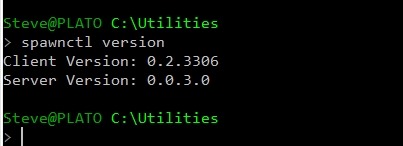
    2019-06-21 14_30_24-cmd

    So far, so good. Now we need to log in. I like integrated authentication schemes, and this one works well. I start with a “spawnctl auth” call from the command line.
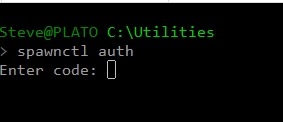
    2019-06-21 14_32_40-cmd - spawnctl  auth

    This pauses and opens a web browser window. It’s here I need to log in. We support Github and Microsoft, but have mostly been using Github for our demo work.
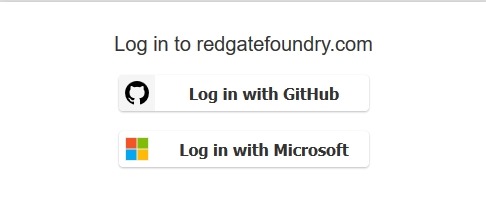
    2019-06-21 14_32_46-redgatefoundry.com

    Once I click that, since I have a Github session elsewhere, I’m logged in and I get a code back.
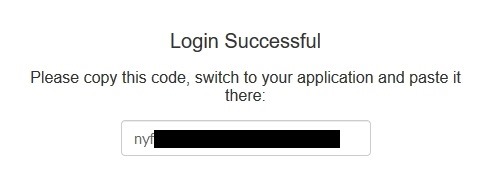
    2019-06-21 14_33_08-redgatefoundry.com

    I paste that back in the cmdline and I am authenticated. From here, I can then see what images I have. As you can see, there are both MSSQL and PostgreSQL images for me.
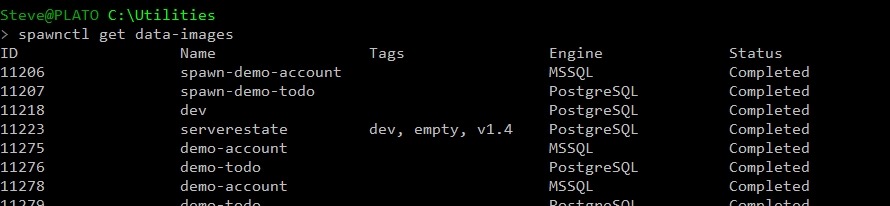
    2019-06-21 14_33_55-cmd

    I also have a few containers from my demo work.
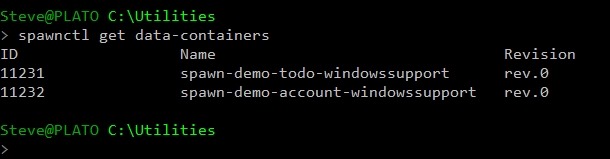
    2019-06-21 14_35_10-cmd

    Let’s make a new container and connect to it. I’ll use Azure Data Studio, since I can connect to both SQL Server and PostgreSQL.

    Logging In

    To get a database, I’ll use a CREATE verb and the DATA-CONTAINER noun, along with an image. When this runs, I get a note this container is being created, then I get a response with login information.

    2019-06-21 14_42_51-cmd

    Let’s put that in ADS. I can copy/paste my credentials into a connection dialog and then hit Connect.
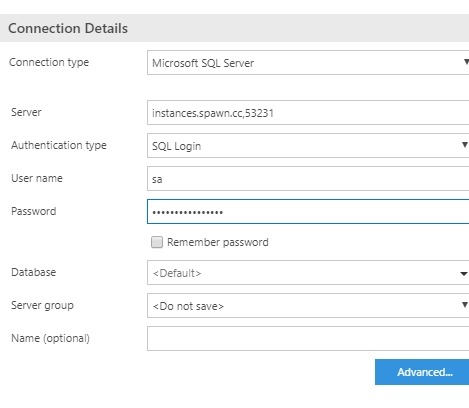
    2019-06-21 14_43_52-SQLQuery_1 - disconnected - CoolADSNotebooks - Azure Data Studio

    As you can see, I’m connected.

    2019-06-21 14_44_21-● SQLQuery_1 - instances.spawn.cc,53231.master (sa) - CoolADSNotebooks - Azure D

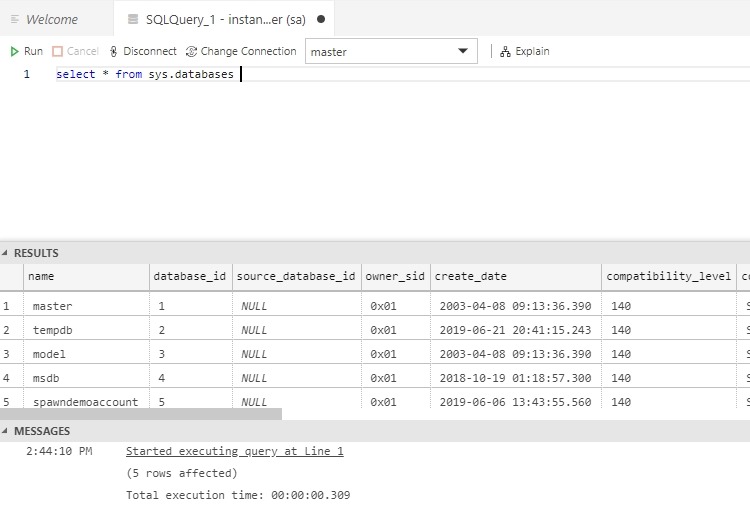
    I see the demo database we’ve been using and the tables in there. How this works is worthy of more posts, but for now, this is pretty cool.
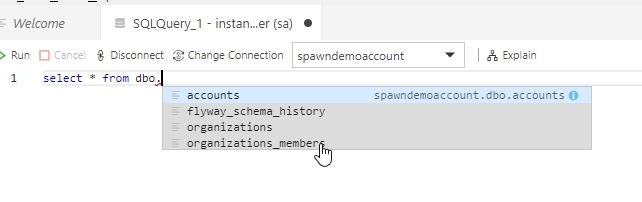
    2019-06-21 14_45_04-● SQLQuery_1 - instances.spawn.cc,53231.master (sa) - CoolADSNotebooks - Azure D

    I can do the same thing with PostgreSQL. Create a container.
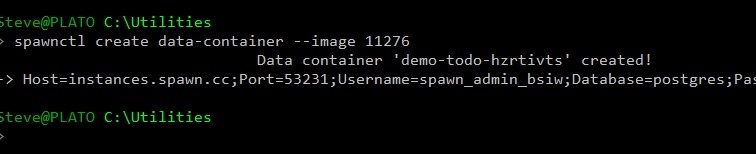
    2019-06-21 14_48_00-cmd

    Then connect (need to specify the port in Advanced)
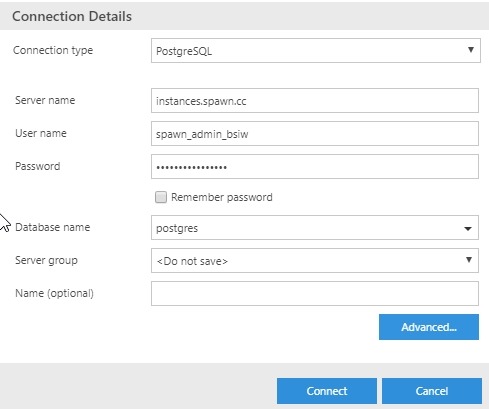
    2019-06-21 14_51_57-Window

    And query:

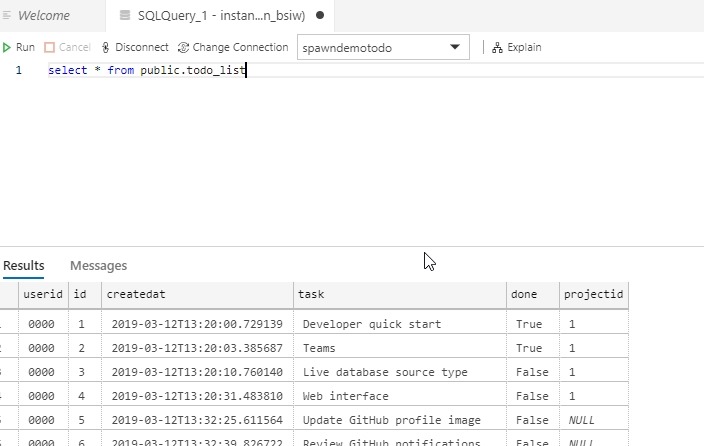
    2019-06-21 14_52_59-● SQLQuery_1 - instances.spawn.cc.postgres (spawn_admin_bsiw) - CoolADSNotebooks

    Pretty cool. Simple, easy, and I think about as fast and easy as any other cloud database. Here, though, I am spinning up a container from an image template. That’s valuable for dev work, and I’ll talk about that in the future.

  • SQL Census–From the Redgate Foundry

    The Foundry at Redgate Software is our version of Microsoft Research. Kind of. We tackle some projects that are interesting and might make good products at some point, but we’re looking at the in the investigative phase. You can read about the Foundry here.

    Some interesting work is taking place in the Foundry and there’s one project that I think is interesting and solves a problem that many of us have had, but I’m not sure how commercially viable this is in the real world.

    Maybe you can help us learn more.

    SQL Census

    SQL Census started as investigation into the area of security, something that is both very simple in SQL Server, but can also become a cumbersome, complex, nightmare.

    The work has progressed well, and there’s a product available. Sort of. It’s in the stage where we are trying to decide how to move forward with both future development and starting to sell this. For now, you can get a look at the tool and give us some feedback. We’re really looking for more information about

    • Do you need this for compliance purposes?
    • Will this help you better secure your environment
    • Does this meet permission management needs?
    • Something else?

    We’re like to get more users, especially those that have larger environments where there isn’t a single user or role that everyone has.

    If you’re interested, read a little about the product and give it a try.

  • More Data Masking Options from The Foundry

    I’ve written about The Foundry before, a research group within Redgate Software. It’s a bit like Microsoft Research, but with a tighter focus on specific database related issues. One of the areas of investigation is data masking, which is becoming more important to organizations all the time as development and QA systems get breached by hackers.

    In an effort to continue their work, they’ve added a new option to the data  masking: configurable masks. This is is along the lines of the choices that Dynamic Data Masking gives you in SQL Server 2016+, but it’s built for refreshing your dev/test systems.

    If you think you want to understand the issues and how masking might help you, give the POC a try. It’s a basic representation of the problem (deployed in Azure) that you can play with and investigate the issue.

    We’d love feedback, and perhaps some of this will make it into a product, or maybe this will just be research into the issue. Either way, it’s the chance to participate and learn a few things about the problems that we face with databases.

  • The Foundry–Data Masking Research

    For most of the time I’ve been working for Redgate, we’ve had some sort of R&D group that tries out new ideas. Over the years we’ve done this in a few ways, evolving things over time. I had the chance recently to meet with The Foundry, which is formally investigating ideas for feasibility, interest, and general knowledge. Not all their ideas will move forward to actual pieces (or parts) of software, but it was interesting to meet with them.

    One of the areas they’re investigating is data masking, which is a much larger topic than you might think. I got the chance to review some of their research areas and thought a few of you might be interested in helping research and giving your thoughts.

    Data Masking Demos

    In looking at data masking, the group spent some time getting feedback from individuals, trying to understand the challenges and possible solutions, and then build some interactive demos. These aren’t really software, but they are a bit more than wireframes. you can see all the demos in the Data Masking Demo section of their site.

    Each of the items deals with a different aspect of data masking. The demos aren’t completely intuitive, which is both interesting and frustrating. It’s good that there is some open-ended-ness that gets me to think. Hard that I don’t always quite get the intention. I had the luxury of getting some time where someone would sit down and explain a scenario, but I’d be curious what some of you think.

    If you have a few minutes and want to play with potential areas of data masking research, try a demo and give some feedback. I particularly think the Manage Test Cases and Realistic Generation demos are things I’d like to see engineered, particularly together. I would really like the idea of some production-like data and some real test cases being moved into good, not-production, data sets that I can use for development and testing. I’ve given some feedback, but I’ll play more and leave notes here, and at foundry@red-gate.com .

    If you have a few minutes, maybe you want to do the same.