Tag: T-SQL

  • Fun with Savepoints–#SQLNewBlogger

    Another post for me that is simple and hopefully serves as an example for people trying to get blogging as #SQLNewBloggers.

    I haven’t spent a lot of time with savepoints, but I did find a question recently and thought I’d take a moment to dig into how they work. They are interesting, and they can be useful for you in certain situations.

    Warning: Anything involving transactions can be tricky, so be sure you test, test, test and check out how things work with a wide variety of situations, including some you might not expect.

    Here’s a basic setup. I’ll create a table to log some actions.

    CREATE TABLE TransLogger
    (ID INT IDENTITY(1,1) NOT NULL CONSTRAINT TransLoggerPK PRIMARY KEY
    , LogMessage VARCHAR(200)
    )
    GO

    Now that I have a table, let’s do something in a transaction. I’ll start a transaction, make two inserts, but set a savepoint between them

    BEGIN TRANSACTION
    

    INSERT dbo.TransLogger (LogMessage) VALUES ('First insert inside transaction')

    SAVE TRANSACTION Firstsave

    ROLLBACK TRANSACTION Firstsave

    COMMIT

    SELECT top 10
      *
      FROM dbo.TransLogger AS tl

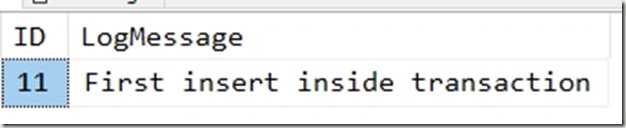
    If I look at the results, I see this:
    2018-11-12 16_46_08-SQLQuery8.sql - Plato_SQL2017.sandbox2 (PLATO_Steve (57))_ - Microsoft SQL Serve

    That makes sense. I inserted this row (I’ve been testing, so that’s why it’s 11), and marked a savepoint with the SAVE TRANSACTION Firstsave line. Then I rollback a transaction to this savepoint, which does nothing. Finally I commit. I see my one row.

    Let’s add something. I’ll add a second item, and decide to roll it back.

    DECLARE @rollback INT = 1
    

    BEGIN TRANSACTION

      INSERT dbo.TransLogger (LogMessage) VALUES ('First insert inside transaction')
       SAVE TRANSACTION Firstsave

      INSERT dbo.TransLogger (LogMessage) VALUES ('Second insert inside transaction')
       IF @rollback = 1
         ROLLBACK TRANSACTION Firstsave

    COMMIT

    SELECT top 10
      tl.ID, tl.LogMessage
      FROM dbo.TransLogger AS tl

    Note I’ve added a variable so I can decide to rollback or not. I’d often have some condition or error handling that might cause a rollback, so this simulates that. Note that work before the savepoint is committed, but work after is removed with the ROLLBACK TRANSACTION Firstsave.

    My results are a single row. Note, I cleared the table between runs.

    2018-11-12 16_49_42-SQLQuery8.sql - Plato_SQL2017.sandbox2 (PLATO_Steve (57))_ - Microsoft SQL Serve

    Savepoints give me a place to commit work if I need it before doing more. This potentially allows me to capture some changes and not others if I don’t want to fail my entire transaction.

    Personally, if I’m doing this, I would likely just have two transactions if I can have one commit without the other.

    SQLNewBlogger

    A few minutes of experimenting gave me a quick post. I need to do more, and certainly test more, but this is a basic idea of what savepoints are. You can write something similar.


  • Break Problems Down

    Recently I was pouring over a few questions in the forums and noticed something that I would think is obvious, but apparently it isn’t so for other people. A poster was attempting to run a query across multiple databases and needed help structuring code to work in the context of each database. The poster was going back and forth a few times with others that were attempting to help them, struggling to get suggestions implemented into their code. That’s typical, as someone that needs an answer often doesn’t understand the solution and is learning. In this case, I found that the original poster was losing some of their troubleshooting skills in the process.

    Years ago I read a piece on Simple Talk from Kathi Kellenberger. She is now the current editor of the site, but at that time she was just a SQL Server MVP and expert that was looking to help others learn more. The article was called Solving Complex T-SQL Problems, Step by Step, and it stuck with me. There wasn’t any knowledge that I didn’t know, but it was an organized explanation of the Kathi’s steps that I found refreshing. This was a nice reminder to me to not move too fast, but ensure that I really understand what the problem is and work in stages.

    I’ve certainly been guilty at times of moving too fast and glossing over some details. That might be fine in some cases, but if I produce code that’s doing that, likely I (or someone else) is going to be rewriting code later. That’s not what we want to do, especially if this is a logical error. I might understand some less than optimal code from a performance perspective, but there shouldn’t be logical errors.

    In this case, the poster had incorporated some changes into code and kept running the entire script, getting bad results. They even started to pinpoint a few areas where data wasn’t correctly being returned, but couldn’t solve the issue. This was a somewhat complex script, and it could be easy to miss some mistakes. This was also a dynamic SQL script, which often means that we have to extrapolate from our code to understand what the engine will actually execute. There’s often a simple solution to help you break the problem down: use PRINT.

    I’ve done this for most of my career, in many languages. Even today, I sometimes use this in PoSh to ensure that I’m not missing something being done. Watch windows and other debugging tools are great, but they sometimes are more difficult to understand when there are long strings of data. Print often simplifies the process.

    No matter what tools, languages, problems, etc. you are working on, breaking things down is often the best way to tackle a complex task. You might be surprised how much clarity this can bring to a tough problem. Even if you need to ask for help, having a list of things you’ve tried, and some data on the results is very much appreciated by those you ask. That way they know what you’ve tried and what to recommend.

    Steve Jones

    The Voice of the DBA Podcast

    Listen to the MP3 Audio ( 3.9MB) podcast or subscribe to the feed at iTunes and Libsyn.

  • Republish: Embrace Stored Procedures

    I’m getting home today,but not sure how wiped out I’ll be. So, one last republish: Embrace Stored Procedures

  • Finding Objects in a Schema #SQLNewblogger

    Another post for me that is simple and hopefully serves as an example for people trying to get blogging as #SQLNewBloggers.

    One of the things I needed to do recently was move some objects from one schema to another. I wrote about moving an object between schemas recently, but another part of that process was finding  the objects to move.

    This is a quick post on how to find the objects in a schema. To start, here are a number of objects in a test database.

    2018-09-17 19_25_07-SQLQuery1.sql - dkrSpectre_sql2017.sandbox (DKRSPECTRE_way0u (68))_ - Microsoft

    A schema has a name, which is the way that we would search for related objects. That means I want a parameter for my query, so I’ll start with a variable to store the name. For me, I’ll use a well named variable like this:

    DECLARE @schema VARCHAR(100) = 'SallyDev';

    Now I have a schema name, where do I find schema data? There is a DMV called sys.schemas, which contains a bit of meta data. If I query that, I see this:

    2018-09-17 19_26_25-SQLQuery1.sql - dkrSpectre_sql2017.sandbox (DKRSPECTRE_way0u (68))_ - Microsoft

    I can see my SallyDev schema, so I know I’ll query this DMV.

    The other information I need is the object data, which is in sys.objects. I query that for the various data I want, but I want to limit data by the schema. In sys.objects, there is a schema_id, which is the data I’ll join with from sys.schemas.

    When I do that, I build a query like this:

    DECLARE @schema VARCHAR(100) = 'SallyDev';
    SELECT
            o.type_desc,
            s.name AS 'Schema Name',
            o.name AS 'Object Name',
            o.object_id
    FROM sys.objects o
         INNER JOIN sys.schemas s ON s.schema_id = o.schema_id
    WHERE s.name = @schema;

    I can execute that and I’ll see the objects I need.

    2018-09-17 19_28_57-SQLQuery1.sql - dkrSpectre_sql2017.sandbox (DKRSPECTRE_way0u (68))_ - Microsoft

    SQLNewBlogger

    This was a post related to the one on moving objects and I wrote this write after that one. It was only about 5 minutes longer to put this together, and it gives me a script I can easily search for on my blog if I need to do this task.

    Once again, a quick and easy way to show some skills, practice explaining something, and get some knowledge stored for my own reference.