Tag: T-SQL

  • Renaming a Column–#SQLNewBlogger

    Another post for me that is simple and hopefully serves as an example for people trying to get blogging as #SQLNewBloggers.

    One of the things I rarely do is rename objects. There are good reasons to do so, but often the changes required in other objects and applications isn’t worth the hassle. This is one reason why it would be good to spend a few minutes in design and come up with good names from the beginning.

    In any case, do you know how to do this? You could use SSMS and easily change the design of the table. Of course, SSMS might try to rebuild the table, which might not be what you want. Hopefully that’s not the case, though you should always get the script instead of just saving the change.

    The code you’d like to see is a simple meta data change that uses sp_rename. In my case, I want to change Qty to Quantity. I’d use this code:

    EXEC sp_rename @objname = ‘Sales.OrderLines.Qty’ ,
    @newname = ‘Quantity’ ,
    @objtype = ‘column’;

    I wish we had a direct ALTER TABLE statement that worked here, or better yet, an ALTER TABLE that allowed the entire table code to be shown (that’s not coming), but I’m not holding onto any hope that Microsoft will change this.

    If you’re a person that thinks you might need a temp table that you insert data into and then two renames of the tables, that’s not the best way. Simple meta data changes are always preferred.

    SQLNewBlogger

    I ran into this while helping someone test a change and thought this was a good, easy reminder of how to change names. You could show you understand this in a blog in five minutes.

  • ROLLing UP Totals–#SQLNewBlogger

    Another post for me that is simple and hopefully serves as an example for people trying to get blogging as #SQLNewBloggers.

    I was editing an article recently that talked about ROLLUP, and I wanted to play with this a bit more. I hadn’t used this much in my career, but it’s a handy operator that’s worth including in your toolkit.

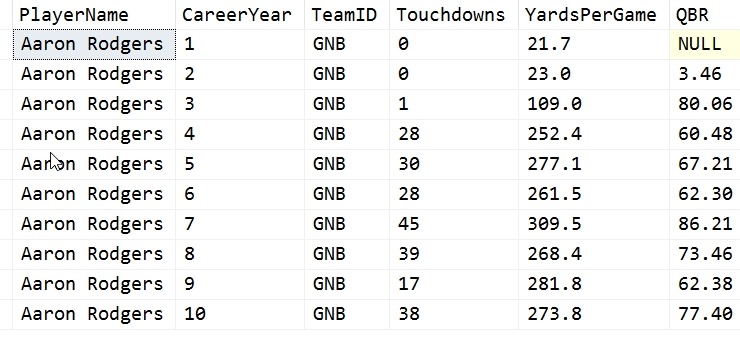
    ROLLUP is used to provide additional totals for your aggregates while using GROUP BY. Here’s a little example. I’ve got some data for American Football quaterbacks. In this case, I’ve extracted some stats for a few noteworthy players today. Here’s a sample:

    2017-10-16 13_05_05-SQLQuery1.sql - (local)_SQL2016.NFLAnalysis (PLATO_Steve (74))_ - Microsoft SQL

    I want to aggregate some data together. For example, let’s say that we want to look at the total touchdowns scored per year by these players in their first 5 years. That’s a simple query:

    SELECT
       Season = qs.CareerYear
       , TDs = SUM(qs.Touchdowns)
      FROM dbo.QBStats AS qs
      WHERE qs.CareerYear <= 5
    GROUP BY qs.CareerYear

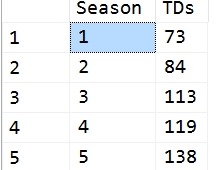
    This gives me data like this:

    2017-10-16 13_06_28-SQLQuery1.sql - (local)_SQL2016.NFLAnalysis (PLATO_Steve (74))_ - Microsoft SQL

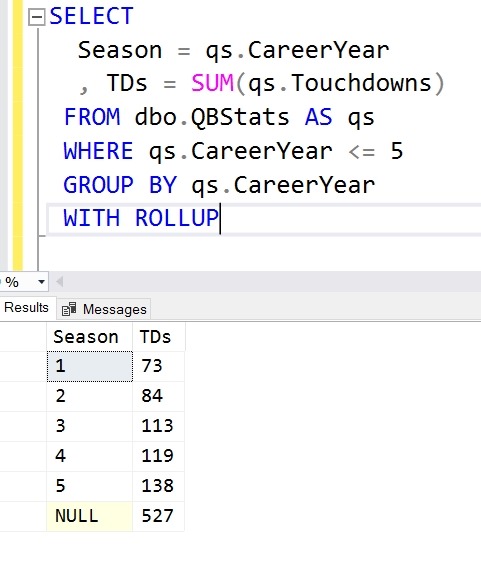
    However, when I look at this, I don’t have a total across all years. In my set, there are players that have played up to 18 seasons, and I want to know the aggregate number of TDs. I can get that by adding WITH ROLLUP. This is added

    2017-10-16 13_07_25-SQLQuery1.sql - (local)_SQL2016.NFLAnalysis (PLATO_Steve (74))_ - Microsoft SQL

    after the group by. However, I can also change this to GROUP BY ROLLUP and include the columns in parenthesis.

    SELECT
       Season = qs.CareerYear
       , TDs = SUM(qs.Touchdowns)
      FROM dbo.QBStats AS qs
      WHERE qs.CareerYear <= 5
      GROUP BY ROLLUP (qs.CareerYear)

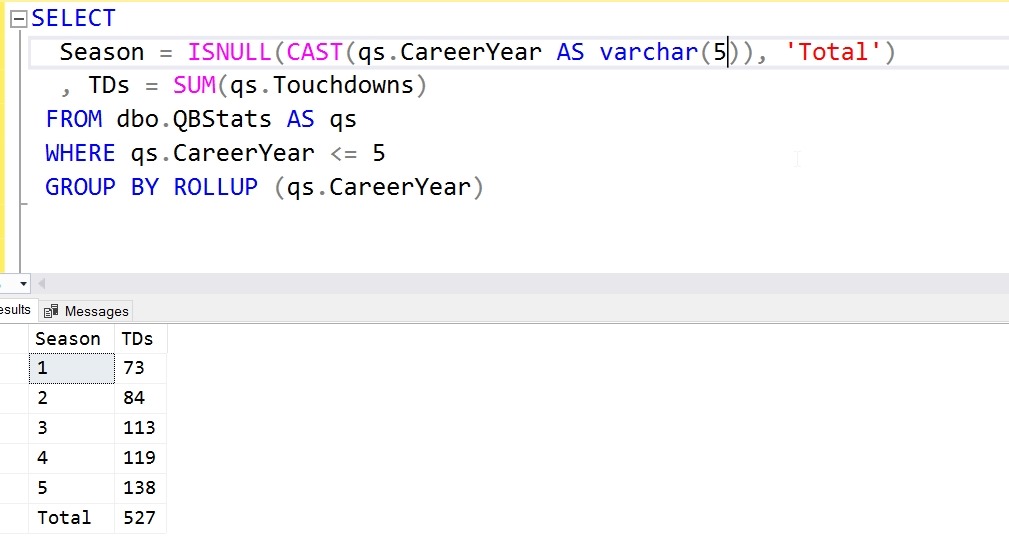
    This is OK, but the NULL isn’t great. What can I do here? I can add an ISNULL or COALESCE to my query and get this:

    2017-10-16 13_10_04-SQLQuery1.sql - (local)_SQL2016.NFLAnalysis (PLATO_Steve (74))_ - Microsoft SQL

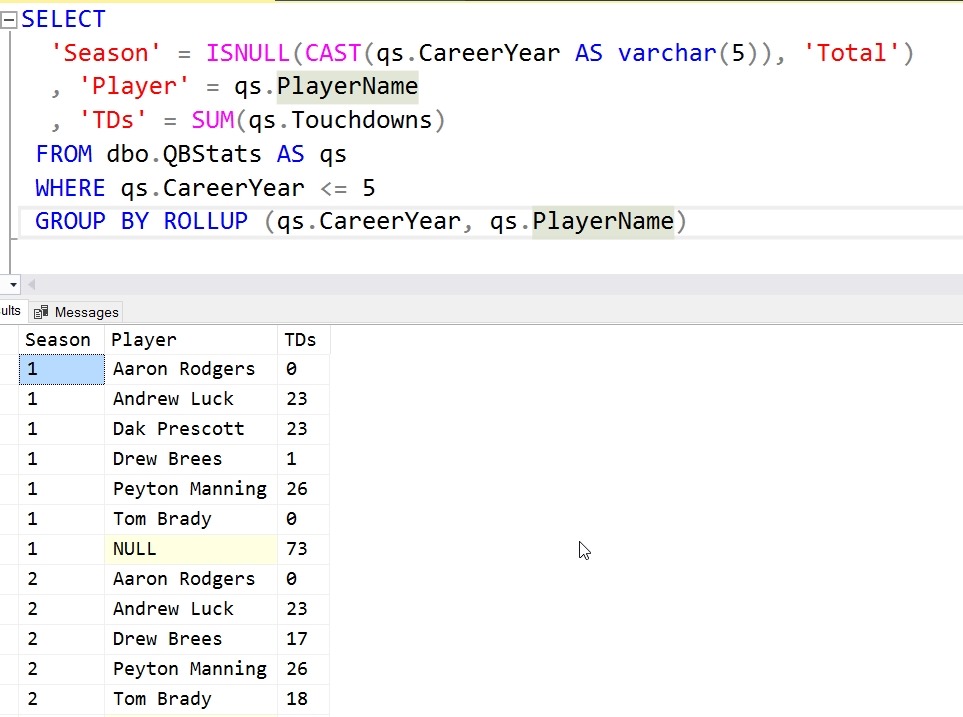
    Useful, but what about if I’m aggregating by individual players? I can add the player to the column list, but I also need to add the player to the ROLLUP (or GROUP BY) list as well. If I do that, I get this:

    2017-10-16 13_11_40-SQLQuery1.sql - (local)_SQL2016.NFLAnalysis (PLATO_Steve (74))_ - Microsoft SQL

    That’s quite a bit more data, and I now see NULL values in the Player name. What’s this?

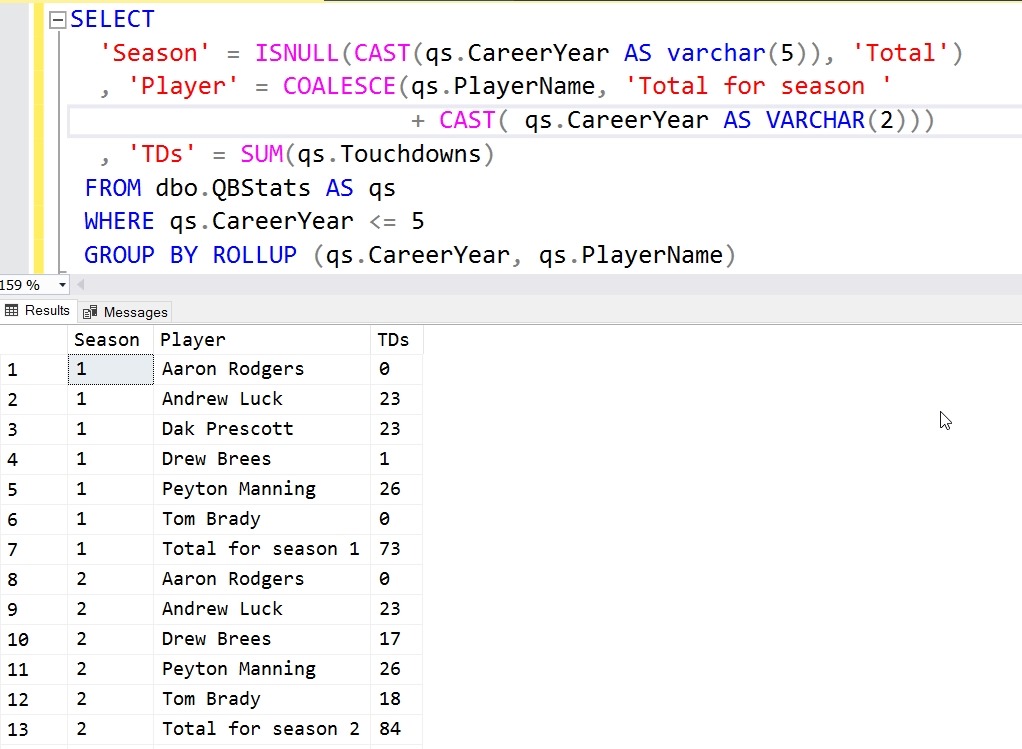
    These are the totals for that subgroup. In this case, the first NULL above, next to the 1, is the total for all players for season 1. I can use another trick to clean this up:

    2017-10-16 13_14_33-SQLQuery1.sql - (local)_SQL2016.NFLAnalysis (PLATO_Steve (74))_ - Microsoft SQL

    This now shows some data in an easier to understand fashion, with some totals. We can see for season 1 that 3 players really started their careers in a strong fashion and 3 didn’t.

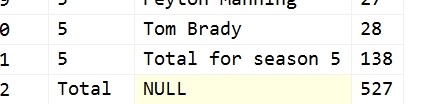
    At the end, however, we get a different result.

    2017-10-16 13_17_09-SQLQuery1.sql - (local)_SQL2016.NFLAnalysis (PLATO_Steve (74))_ - Microsoft SQL

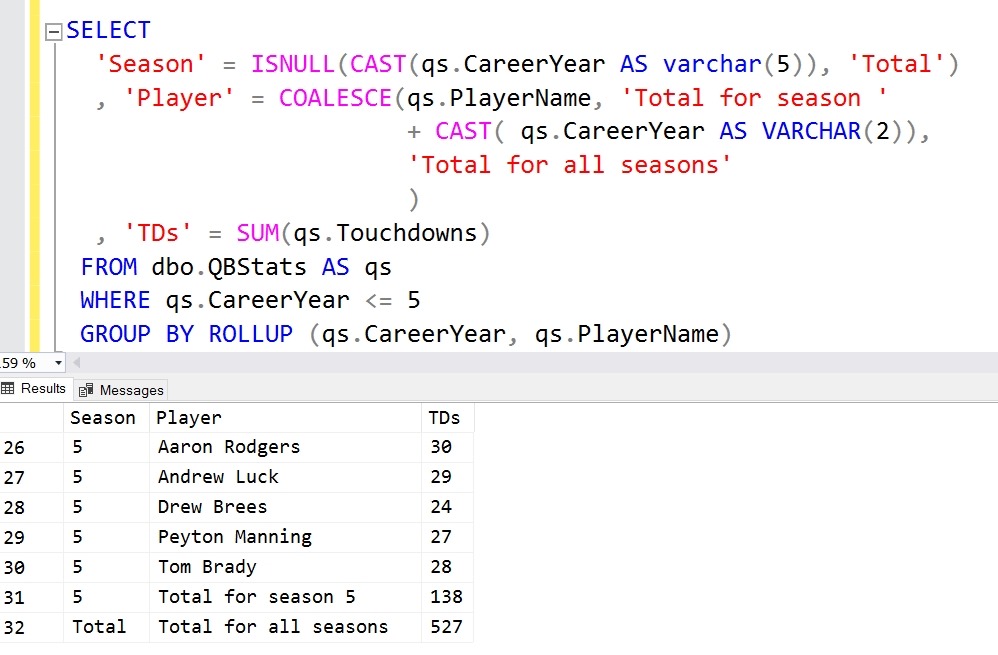
    This is because we have handled the player name as a NULL for the second column, but not the season as a NULL. For this last row, out “Total” text comes from an ISNULL of the first column. Here we’d want to do this:

    2017-10-16 13_18_30-SQLQuery1.sql - (local)_SQL2016.NFLAnalysis (PLATO_Steve (74))_ - Microsoft SQL

    This is where COALESCE  comes in handy, allowing us to account for multiple NULL values.

    ROLLUP is a nice way to get totals for each of your GROUP BY columns. This can make some of your reporting easier, and perhaps even faster by having the totals calculated in the result set.

    SQLNewBlogger

    This was a fairly easy piece to write. It took longer to get data together and find a set that had two grouping elements and was interesting than write the queries. I also had to play with ROLLUP a bit to clean up the NULLs, which always made this seem like a useless operator.

    I think I’d look to use this more if I had the chance for many reports, as summing totals in some client tools is a pain.

  • Basic FORMATting– #SQLNewBlogger

    Another post for me that is simple and hopefully serves as an example for people trying to get blogging as #SQLNewBloggers.

    I saw the addition of FORMAT() to the T-SQL language, but didn’t play with it much. Recently it appeared in some code, and decided to experiment a bit. I had assumed this was mainly for dates, but it’s a general format/culture function that handles numbers as well.

    On the doc’s page, there are the basic description of the parameters, which are NVARCHAR(), so passing in VARCHAR() causes an implicit conversion. It shouldn’t be much, but there are already performance penalties (see Aaron Bertrand’s piece), so don’t add to the overhead.

    One good thing to note is that if you pass in invalid formats or cultures, a NULL is returned. Since the format and culture strings aren’t completely intuitive, this might be a source of issues in your code.

    This is a neat function, relying on CLR formatting rules. That means I can do fun things like:

    DECLARE @i int = 5000;
    
    SELECT FORMAT(@i, N'USD$#');

    Which returns:

    USD$5000

    Or even:

    DECLARE @i INT = 5000
    ;
    SELECT  FORMAT(@i, N'# dahlahs')
    ;
    GO

    Which gives me:

    5000 dahlahs

    There are lots of formats, and certainly lots of nuances to numeric formatting strings. It’s worth reading up if you plan to use this, but again, beware of performance. I’d avoid using this if the data size is large, maybe more than a few hundred rows.

    After all, the database server is a shared resource, and using this CPU to handle simple formatting may not be the best use of your system.

  • Unit Testing T-SQL Code

    Abstract

    Unit testing has become an integrated, expected part of most software development teams. Many database developers have yet to implement unit testing as a regular habit. This session will look at two-unit testing frameworks and show how to implement tests for common types of non-trivial T-SQL queries. You’ll examine the tSQLt framework as well as the Microsoft Unit Testing framework for SQL Server.

    You will learn:

    • How to structure and build unit tests for database code with tSQLt
    • How to structure and build unit tests for database code with database projects
    • Understand the challenges of test data and how to solve them

    Level: 200

    Demos

    These are the testing demos for this talk:

    • Loading and reloading test data
    • Checking standards
    • Checking joins, specifically outer join refactoring
    • Checking function calculations
    • Checking boundary conditions
    • Using the 0-1-Some pattern
    • Checking NULLs

    PPTX and code on github:

    Data Platform Summit – https://github.com/way0utwest/UnitTestingTSQL/tree/master

    VS Live 2017 – Anaheim – https://github.com/way0utwest/UnitTestingTSQL/tree/vs2017Anaheim