Tag: T-SQL

  • Quick SQL Prompt Updates in a Pattern

    I work for Redgate and write about products. I’ve got a series of SQL Prompt posts here on little things I like. SQL Prompt might be my favorite tool.  SQL Prompt will be yours as well if you give it a try.

    We had a customer post a question today on how they can built an update statement with a pattern. Specifically, they said that the code often looks like:

    UPDATE dbo.Contacts
       SET 
       c.Salutation = @Salutation
    , c.FirstName  = @FirstName
    , c.MiddleName = @MiddleName
    , c.LastName   = @LastName
    , c.Suffix       = @Suffix
    WHERE ContactID = @contactid

    The table columns are the same name as a variable. That’s a good pattern, and I’d think SQL Prompt could handle that.

    It doesn’t.

    The column picker doesn’t work with Updates (logged w/ product team), and I can’t duplicate selected text over (also logged for discussion). However, I do have a workaround.

    As I thought about it, I realized there are some features of Prompt that help here, and some of SSMS that will work.

    I made a quick video of the process, but I’ll describe it below:

    The Process

    The first thing is to get a column list. ssf<tab> does for me. I’ll get the select statement for a table and then expand the list of columns with a tab when on the *.

    Now, I’ll copy the columns. I tend to copy all since it’s usually easier to remove than pick and choose specific ones. I’ll wrap these in an update, which could be a snippet. If it’s not, that’s fine.

    From here, I use the power of Shift+ALT. If you’ve never done this, it’s amazing. I use this to select the columns and copy them. Then I’ll CTRL+ALT  to add the = and paste in the columns. I can then use CTRL+ALT once again to remove the alias and replace with a @.

    And, of course, I can reformat to make it look nice with SQL Prompt. Give SQL Prompt a try today and see how it can improve coding and feel free to share your tips here.

  • WAITFOR isn’t a function–#SQLNewBlogger

    Another post for me that is simple and hopefully serves as an example for people trying to get blogging as #SQLNewBloggers.

    I needed to delay the execution of some code the other day. This was a test that was trying to simulate a few things happening, and one batch needed a random delay. I started typing and got something I didn’t expect.

    2017-09-27 08_41_53-CandidateList

    Where’s the TIME or DELAY? SQL Prompt didn’t like this, and since I expect SQL Prompt to save me from writing bad code, I knew I’d done something wrong. I backed up and removed the parenthesis and ‘R’ and then typed again, this time adding a space.

    2017-09-27 08_42_07-CandidateList

    That works. Now I can change this test to real code.

    WAITFOR is designed to delay execution, but it’s not a function. No parenthesis. Instead, it’s a control of flow statement, like CASE, so it just takes other expressions after.

    SQLNewBlogger

    This was one of those commands I haven’t used in a long time, but is a handy one. Hopefully this 5 minute writeup will help me remember this in the future.

  • SQL Grouping on Sums (with testing)

    I ran across a post recently that I thought was an interesting T-SQL problem. The user wanted to group values into a running total, but the groups would reset based on a sum.

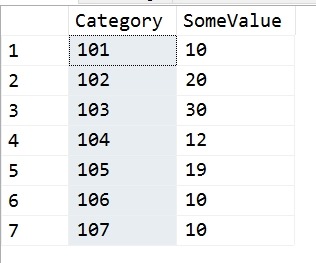
    In this case, the user had this set of data:
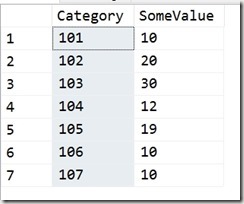
    2017-09-14 18_09_39-SQLQuery1.sql - (local)_SQL2016.sandbox (PLATO_Steve (72))_ - Microsoft SQL Serv

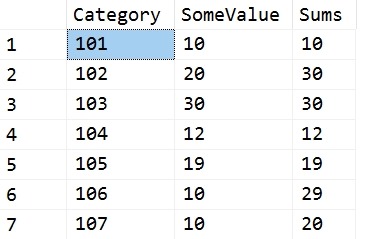
    Their goal was to run through these values, in Category order, and whenever the running total sum of SomeValue exceeded 30, reset the sum. Their requirement was that this could only be a single value or two values, which boxes in the problem nicely. In other words, they wanted these results:
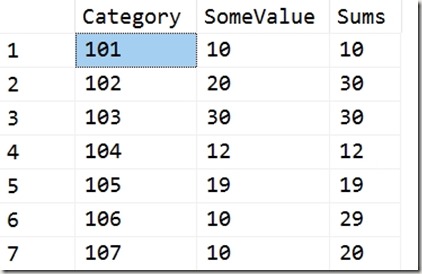
    2017-09-14 18_12_02-SQLQuery1.sql - (local)_SQL2016.sandbox (PLATO_Steve (72))_ - Microsoft SQL Serv

    The first two rows equal 30, so we reset for the third row. The third row is 30, so we reset for the fourth. The fourth and fifth would exceed 30, so each gets a reset. Five and six give 29, so we stop there.

    I don’t know what the use case is here, but it’s an interesting problem.

    My Solution

    I had a quick solution using Lag. I created a quick query that looked back 1 and 2 rows. I could have stopped with one, but originally I thought that the poster might go to three rows if the 30 value wasn’t met. I use a CTE to get the current row and previous values, then  a simple CASE to sum values or return the current row.

    WITH lagCTE
    AS (SELECT
              Category,
              SomeValue,
              LagValue1 = LAG(SomeValue, 1, 0) OVER (ORDER BY Category),
              LagValue2 = LAG(SomeValue, 2, 0) OVER (ORDER BY Category)
         FROM Source
        )
    SELECT
          lagCTE.Category,
          lagCTE.SomeValue,
          Sums = CASE
                     WHEN lagCTE.SomeValue + lagCTE.LagValue1 > 30 THEN
                         lagCTE.SomeValue
                     ELSE
                         lagCTE.SomeValue + lagCTE.LagValue1
                 END
    FROM lagCTE;

    I also created a test, because, why do the math. Once I’ve done this, I want to ensure any code changes, any logic changes will still pass the same test. Here’s my test code:

    EXEC tsqlt.NewTestClass @ClassName = N'tTSQLTests'
    GO
    CREATE PROCEDURE tTSQLTests.[test running total reset]
    AS
    -----------------------------------
    -------   Assemble
    -----------------------------------
    EXEC tsqlt.FakeTable
         @TableName = N'RTSource'
    
    INSERT RTSource
    VALUES ('101', 10),
            ('102', 20),
            ('103', 30),
            ('104', 12),
            ('105', 19),
            ('106', 10),
            ('107', 10);
    
    CREATE TABLE tTSQLTests.Expected
    (   Category     VARCHAR(5),
         SomeValue    INT,
         RunningTotal INT
    );
    INSERT INTO tTSQLTests.Expected
    VALUES
           ('101', 10, 10),
           ('102', 20, 30),
           ('103', 30, 30),
           ('104', 12, 12),
           ('105', 19, 19),
           ('106', 10, 29),
           ('107', 10, 10);
    SELECT
           Category,
           SomeValue,
           RunningTotal
    INTO  tTSQLTests.Actual
    FROM  tTSQLTests.Expected
    WHERE 1 = 0;
    
    -----------------------------------
    -------   Act
    -----------------------------------
    INSERT tTSQLTests.Actual EXEC RunningTotalQueries
    
    -----------------------------------
    -------   Assert
    -----------------------------------
    EXEC tsqlt.AssertEqualsTable
         @Expected = N'tTSQLTests.Expected',
         @Actual = N'tTSQLTests.Actual',
         @Message = N'incorrect query'
    GO

    Adding Counters

    The poster then asked for a group counter, which becomes much harder. I was about to try for another CTE that would give me some counter I could work with when Jeff Moden used the quirky update to build a better script. You can read his code here.

  • The Code Coverage Report

    I had someone that told me recently that they needed to find a way to get code coverage in T-SQL. Not for them, not to improve quality, but because their manager wanted a report.

    OK, here it is.

    First, build a nice SSRS report that displays your company logo, a header, the current date, and a pie chart. Yes, I know pie charts are bad, but they’re good for managers that want something like code coverage.

    Now, for the data source of the report, here’s your query:

    SELECT 90 + ((RAND() * 8)-2)

    Now, you won’t always get over 90%, which is what some people want, but you’ll get over 90 eventually.