Tag: Tesla

  • Driving Costs With a Tesla Compared to Gas

    This is part of a series that covers my experience with a Tesla Model Y.

    I wrote recently about the costs for me to charge at a Supercharger. The USD$0.43 was higher than I expected, but lower than the USD$0.58 I’ve seen some CA people post about.

    With the intricate linkages of the World Wide Web, I’ve seen a few articles lately about charging. First, there was a debunking of a meme at Jalopnik, which I thought was crazy. Especially since I own a horse trailer. Then there was a user posting at Reddit that ended up poorly shared on Autoevolution. For the record, I find that site have poor journalism standards.

    I also caught a post on Facebook about new public electric chargers coming to Colorado and was amused by all the comments about the grid failing and not being able to handle things and how expensive and poor for the environment electric cars are.

    A lot of hype and silliness, or FUD, from lots of non electric positive people. However, I wanted to check on the real costs for me. So I got some of my data.

    Comparing Costs

    I still have a 2012 BMW X5. I was thinking to replace it with something similar when we got the Tesla. So purchase costs are out for me, but I did decide to compare the cost of operating that car with the Tesla. I also decided to add a Prius in. Now, our old Prius would get around 47-48 in the summer, 43-44 in the winter. This car was rated at 50mpg. A newer one, like the Prime, is rated at 54, so I’ll use these values for my MPG:

    • BMW – 22
    • Prius 50

    I also compared the cost of home charging v Supercharging. My experience recently is these costs:

    • Home – $0.14
    • Supercharging $0.43

    I have solar, but since I just use power, if I spend it charging the car, I pull more from the grid, so I’ll leave that cost the same.

    Trips

    I run Teslamate, which logs all my drives. I can see the distances and power usage for each trip. As you see below, there is a lot of data.
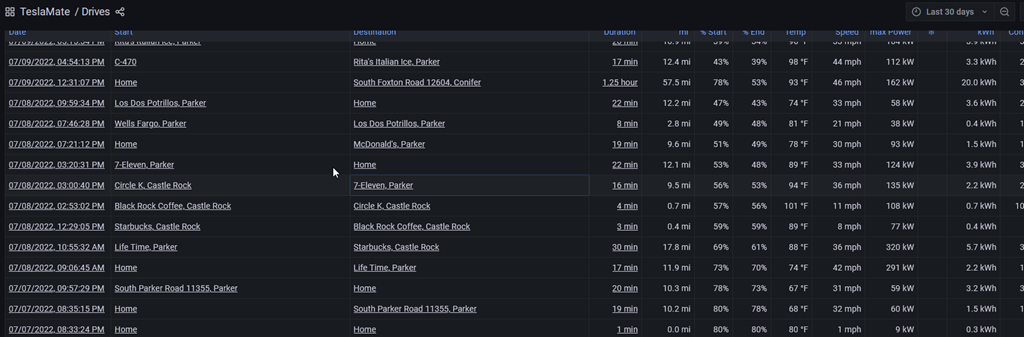
    2022-07-27 10_25_50-Drives - Grafana — Mozilla Firefox

    I grabbed a sampling of trips, long and short, around town and into the mountains. The gas cars do worse in the mountains, as does the Tesla, but rather than try to make things complex, I left the same MPG for the gas cars.

    Methodology

    • For a particular trip, I get the mileage and kWh used. I can multiple kWh by cost and get a simple cost for electricity in two ways: home and Supercharging. This isn’t my actual cost, but hypothetical if all my charging were in one of these two places. As an example, for a 20.2mi trip, I get:
    • home cost –  $0.56
    • Supercharger cost – $1.72

    For the gas cars, I divide the miles by mpg. This gives me gallons used. For that 20mi trip is just under a gallon for the BMW and under half a gallon for the Prius. I then multply by the gas cost. I set that at $4.30 for now. It’s been higher lately, but I paid that last week on a trip to the airport (I took the BMW).

    I put a set of 11 random trips in a spreadsheet and compared things. This is what I see:
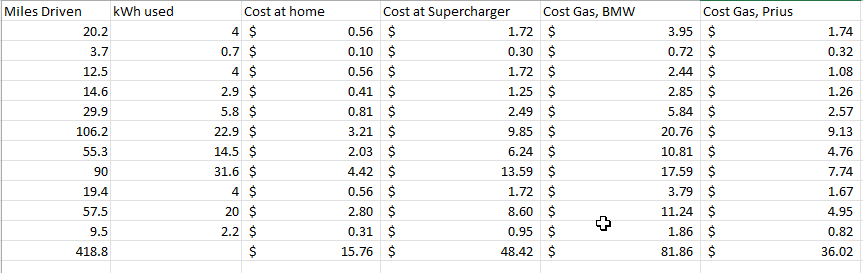
    2022-07-27 10_30_21-Book1 - Excel

    For my 2o mile trip, I see these costs:

    • Home: $0.56
    • Supercharging: $1.72
    • BMW: $3.95
    • Prius: $1.74

    For a longer trip in the mountains, 55mi, I see:

      • Home: $2.03
      • Supercharging: $6.24
      • BMW: $10.81
      • Prius: $4.76

    The aggregates for 418.8 miles (this sample) are:

    • Home: $15.76
    • Supercharging: $48.42
    • BMW: $81.86
    • Prius: $36.02

    Clearly the Tesla is a lot cheaper if I charge at home. My power costs are mostly fixed, though the Supercharger can be cheaper than $0.43. It could be more expensive, but I haven’t seen that. Gas certainly goes up and down and even at $4, home charging is cheapest.

    The Prius looks good in a bunch of places compared to Supercharging. I had 4 of those 55mi trips in the mountains, all on Supercharger charging, but I also know the Prius would not be getting 50mpg there. Probably more in the 25-ish range. Mountains are steep.

    My Experiences

    I’ve owned lots of cars. My experiences in the last year, in looking at data and comparing to the Prius, BMW, RAM 3500, and other cars, is that the Tesla is a lot less expensive to operate. My back of the napkin thoughts before this were the Tesla is about 1/2 of the Prius cost and 20-25% of the BMW to operate.

    You can make all sorts of comparisons on ROI and costs, and you should. For your situation. For me, given my life and choices, this was a great purchase. I’d have spent $45-50k anyway on a car, so the purchase wasn’t something I calculated in. I also carry 5 adults at times and that wasn’t very comfortable in the Prius. The BMW worked fine, as does the Tesla.

    Charging isn’t simple, and while I got a wall charger + installation for US$760, I would not be surprised if a lot of people paid closer to $1500. However, it’s not a crazy cost, and it’s essentially adding another circuit for your clothes dryer. A good portion of us can do this, and then we have a “full tank of fuel” every morning. That alone is a very neat experience.

    I think Tesla is great. If we needed another car, we’d look at Polestar, Hyundai, Rivian, and a few others. I’m sold on them as an every day car that is relatively cheap to operate. We’ll always have the diesel pickup for towing and trips if we need it, but having owned different types of cars, the electric paradigm makes a lot of sense.

    And if we really wanted a car for a trip and worried about charging, like through Montana, we’d just rent a car. We’ve done that in the past to save wear and tear, and it’s hard enough to find fuel in Montana and Wyoming at times. A rental would be an easy choice, so range anxiety isn’t a problem. If I have it, I get rid of it for that trip. Not for the rest of my life.

  • Charge Costs at Tesla Superchargers

    This is part of a series that covers my experience with a Tesla Model Y.

    I finally had a charge for a Tesla Supercharger. These re the public, high speed chargers that Tesla has put all over the world, which can add 200-500miles of range per hour to your car.

    I mostly charge at home, as you can see from my log:

    2022-07-21 10_08_58-Charges - Grafana — Mozilla Firefox

    However, last weekend my wife and I were in Keystone, CO and driving over to the Winter Park Jazz Festival each day. The drive takes about 20% charge each way through the mountains, so we charged each time we were in Silverthorne on the way to/from Keystone.

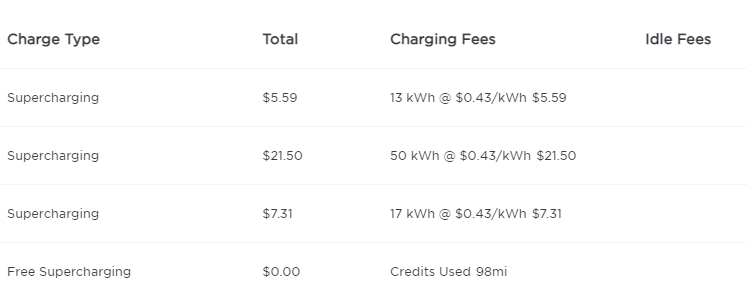
    I got 1000 free miles of Supercharging when I bought the car with a referral code from Glenn Berry. While I haven’t charged away from home much, we have a few times. This time we got part of one session for free, and then charges started. I don’t know why my logger doesn’t have the charges, but I see them in my Tesla Account.

    2022-07-21 10_12_39-Payment History _ Tesla

    US $0.43/kW, with my car having 75kW of capacity. The 50kW charge was from around 15%-80% ish. We plugged in the car and walked over to have dinner nearby. This was close to a fill up for just over $20. Not cheap, but not bad.

    The prices for “fuel” here seem to vary around the country, and possibly by time. I’ve seen reports in CA of lower and higher values ($0.29 – $0.58). I was expecting something more like $0.28-$0.30, but in the mountains, early evening, things were different. The average reported here is higher, so I can’t complain.

    I definitely plan on charging mostly at home, and using the public chargers when I don’t have a choice. I haven’t successfully charged at a non-Tesla charger yet (tried twice, once failed/broken, one too slow), but I’m sure I will one of these days.

  • Using Telsa Dog Mode

    This is part of a series that covers my experience with a Tesla Model Y.

    It’s summer in Colorado. Actually, it’s a hot summer, with quite a few days approaching 100F. While I tend to work at home, the other day I was working remotely between a few doctor’s appointments. At various times I was in and out of coffee shops, or even working in my car. The latter is convenient when I have a meetings and need a quieter space than a coffee shop.

    While I was working at one point, the climate controls turned off. Not a big deal, but I decided I wanted to avoid this, so I turned on Dog mode. This is a change to the car software Tesla added a year or so before I bought mine. This allows the car to control the climate, which makes it safe to leave a pet in the car.

    I’ve used it a few times with our dogs when we’ve been running errands and we want to be sure they’re safe, and a cracked window might not be comfortable enough, especially on 90F+ days.

    I used it for myself, and it worked well. I didn’t get the message on the screen, but it did keep the car at a comfortable temperature. I’ve also had a few friends note they enable this when running errands so the car doesn’t get too hot (or cold) in between stops.

    I might start doing this when I got to the gym in the summer, just to keep the temperature a little more even.

    One more thing I love about my Tesla.

    A short video of this is on my channel.

  • Tesla Power Use in Summer and Winter

    This is part of a series that covers my experience with a Tesla Model Y.

    When I look at my top destinations in the Tesla, I find that home is the top one (327) and my gym is second (102). That seems about right as I go to the gym 3-4 days a week and usually run some other errand then.

    2022-06-07 08_51_39-Drive Stats - Grafana — Mozilla Firefox

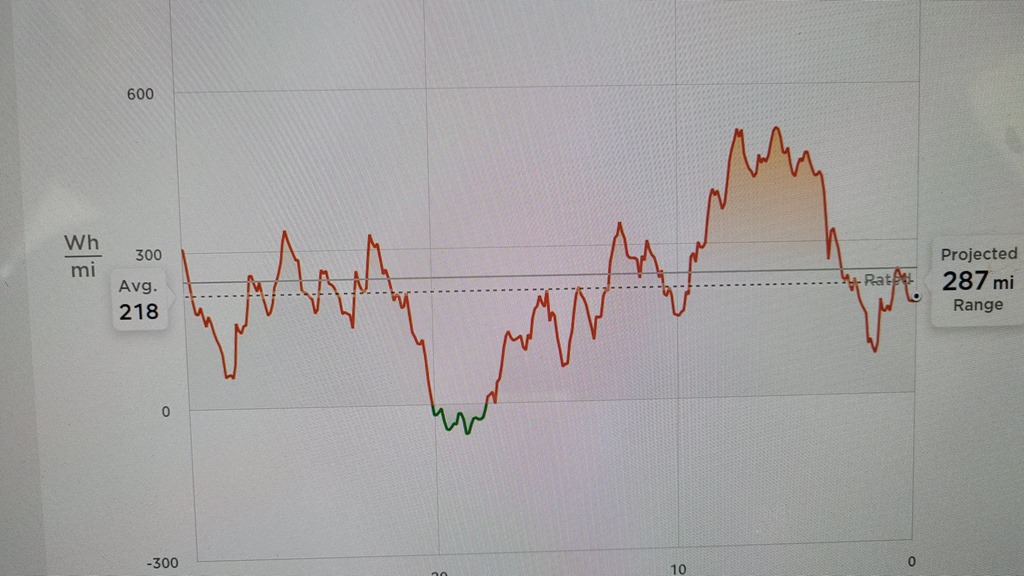
    When we got the Tesla and started to drive a bit, I found myself enamored with the Energy usage screen. It tracks the last 30 miles (configurable) and gives you a range estimate. Here is a typical screen for me:

    20210922_161212

    This shows the energy usage as I drive, with the most recent mile on the right and the oldest (30th) on the left. I see the amount of watt hours used at that time and then an average. There’s also a solid horizontal line for the rated range.

    For this 30 miles, I averaged 218Wh/mile, which is pretty good. You can see there are some high spikes in the 500Wh/mi range and some low ones. The green areas are where I actually recovered some energy back. This was at the lowest point leaving my house and heading West to Parker, CO, which is about 800 feet lower in elevation. I actually am generating power with the regenerative braking thanks to gravity.

    The Gym Run

    I go to the gym regularly, often 3-4 times a week. It’s an easy drive, and I’ve played the energy video game for years, trying to use the minimum amount of gas (Prius) or power (Tesla) on my trip there. I found this to be fun, and I’ve beaten my high (or low) score a few times.

    With the Tesla, it’s been an interesting metric to see how much power I used in the summer and winter. I grabbed a few screen shots in the fall when the weather was warm and then again in the winter. Here’s what I learned.

    Summer(ish)

    Here’s a summer graph. This trip was a 72F day, so not too summer-ish, but warm. A pleasant day. The drive stats are:

    • 11.8mi
    • ~2% battery used downhill
    • 21 minutes
    • 133 Wh/mi downhill
    • 1.6kWh

    The return home is as little different as I went to the grocery, but I had:

    • 9.8mi
    • ~4% battery used
    • 342 Wh/mi
    • 3.3kWh

    This is reflected in my graph for the downhill. The arrow is about where I start from home and the end is the gym. Lots of downhill, though not all. I was trying to be careful here and managed to get my 30mi average down to 184Wh/mi.

    20210922_142615

    This was pretty good to me, though admittedly I don’t have any point of reference as this is my first electric car. In terms of cost, this still is about US$0.69 for the drive. As a point of comparison, the X5 would cost about a gallon of gas. Around US$3.20 back then. The Prius would have been US$1.47.

    Winter

    A similar trip, slightly longer, so I must have varied the route a bit, but I see this:

    • 12.0mi
    • ~3% battery
    • 228Wh/mi
    • 2.7kWh
    • 33F

    The return:

    • 10.2mi
    • ~5% battery
    • 360Wh/mi
    • 3.7kWh
    • 28F

    The temperature dropped here, and as you might have guessed, I was using the seat and car heaters.

    What is interesting here is the downhill show 133Wh/mi in summer and 2.7 in winter, a significant change. The uphill has less of a difference ( 3.3 v 3.7kWh). Gravity is a bigger issue, I’m guessing. Maybe some battery conditioning on the downhill as well, but that’s still a factor.

    The cost in winter is more like US$0.90. While the BMW is still in the 20-21 range in winter, the Prius dropped from 47-48mpg to 42mpg, so it also showed a bigger battery effect in cold weather.

    Conclusions

    I don’t quite know what to make of this, other than expect range to shorten in the winter and plan for more charging. In general, since I mostly charge at home and my daily trips never get close to the range limit, this doesn’t change anything for me. We will use more power in winter, but since we don’t have time of day (or year) cost changes, and we have solar power to somewhat stabilize the cost of power, I don’t worry about this affecting my life.

    We have learned to cut off Sentry mode and also to charge a little more in cold weather if the car is sitting outside and unplugged. It’s not a big deal, but it is something to think about if you have an electric car in a cold climate. A little more forward thinking is needed in this paradigm.