Author: way0utwest
-
The End of XP
This week we have the end of Windows XP. At least, we have the end of support, which means the lifespan of the OS was over 17 years. That’s a long time. It’s longer than I’ve run any system without an upgrade. I have some Windows 7 systems I use at times, but that’s a mere 10 years old. I know there are still a few SQL 2000 systems out there, which is older than XP, and likely a few of them are running on Windows 2000 in a VM somewhere.I have to admit that I liked Windows XP and thought it was a nice upgrade from previous versions. I ran it for a long time, skipping Vista, before moving to Windows 7 when it was released. Most of the early days of SQLServerCentral were run from an XP workstation, with SQL Server personal and lots of text editors helping me manage the site. I’m somewhat sad that it’s gone, though I think Win7, and now Win10 were very nice improvements.XP isn’t likely gone, as some companies will continue to run it and I expect some ATMs, some kiosk displays, and other embedded applications will show that XP start screen on occasion. That’s not unlike the way that some of us might connect to an SQL instance and be surprised to see a single digit number in the major version space. In fact, a lot of you might still see a “9”, for SQL Server 2008. I was seeing that until last year when we moved SQLServerCentral to SQL Sever 2017. I expect the more and more organizations will be slowly moving on, perhaps reluctant to upgrade those old versions that work and don’t cost much to maintain.Or do they? Is there a big cost on older systems that run and don’t see regular development work? My thought has been that for many internal systems, I need a database platform, and likely an OS, to run for 10 years or more. I know some of the larger enterprises have this view as well. Picking a platform is a major decision and it can be very hard to change directions. Porting takes a lot of resources, as do upgrades, so ensuring a system can handle a load for 10 years makes sense.I know many of us would like to regularly switch versions, and one of the great things about my job is that I get to do so. I’ve held onto SQL 2014 and 2016, but I’m slowly moving all my work to SQL Server 2017 and 2019, with the idea that apart from some repro situations, I won’t try to run older versions anymore.It seems many people are town about upgrades. Some people prefer the system they know and are comfortable with, since they know what workarounds are needed. They may bemoan the need to learn new skills and change old habits. Others prefer the latest and greatest, quickly adopting new platforms and agonizing over the spend on old systems. No matter which way you feel, it’s likely that you’ll be forced to do a bit of both as the pace of change for SQL Server means many of us will adopt new versions for new work and end up supporting 4 or 5 versions at any one time.Steve Jones -
SQLServerCentral Design Decisions–Forum Threads
It’s been a long couple of weeks. Almost two weeks ago we cut over from our older, v2 version of the site to the new (and current) v3. Lots of bugs, lots of disruption, and lots of unexpected items.
As a bit of trying to help me understand as well as a catharsis, I wanted to jot a few thoughts on things that I’ve had to make decisions on or work within our framework. This post looks at one small item, the display of forum posts.
The New Look
Here’s the top of a thread in the current site.
A post and two responses, and I think it’s easy to see who’s posted, their avatar, the text and content, I can follow a user or send a message, I can reply or quote a post. My signature is small and a different font from the text.
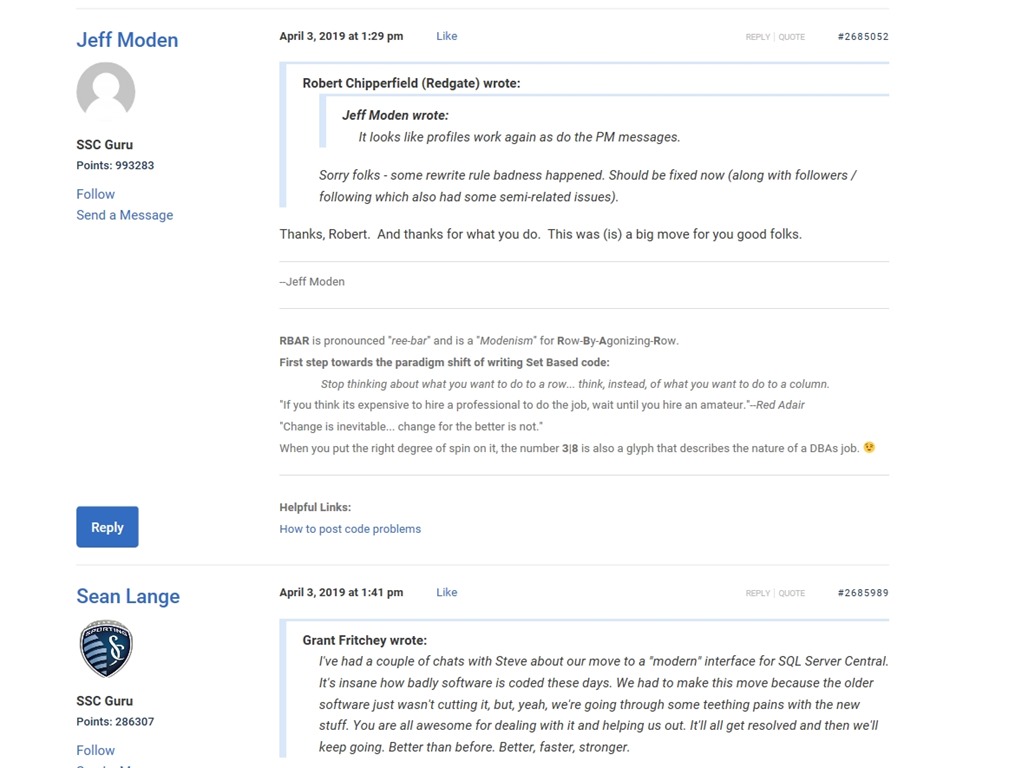
Here’s another couple posts, which I think are harder to read:
These are older signatures, which don’t format as well, and some of the quoting is a little broken and causing issues.
I don’t think the new format is necessarily more visually appealing to me, but it is less elements and a cleaner look in a more modern style. For everyone that liked the old format, we have people that didn’t.
And vice versa.
In this new format, we took the default bbPress items and tried to aim for less extraneous information. We styled this to have less color and contrast that is distracting while presenting the information that users need to see. We limited the options, of which we had too many and confused people in the older forums.
This also gives us a good codebase on which we can make future changes. While many of those aren’t visible here, the pace and breadth of changes we’ve made in the last two weeks to tweak things is way above anything we went through the last time we touched the forums. I’m amazed at how well we’ve adapted to new areas and requirements as we go along.
That being said, I know there are lots more changes to make and look for more to be coming in the next few months. We’ll change the styles slightly and perhaps redo some of the layout to make things easier.
One thing this project has taught me is that what I think is a simple decision for software isn’t so simple for my users. We have thousands, really hundreds of thousands of users and some days it feels like none of them are pleased. I couldn’t imagine how hard it is when your software or site has 10x or 100x that size.
-
Cloud Native
The cloud is an amorphous thing that isn’t well defined, but we do know that there are various types of services (IaaS, PaaS, Saas) that many of the cloud vendors offer. While IaaS is the easiest platform on which to move our software applications, it is fundamentally limited and lacks the scalability of the other services.PaaS systems offer the largest opportunity for systems that scale up and down, allowing the ability to meet workloads while ensuring cost savings by reducing resources when times are slower. To use PaaS, we often need to rewrite code to be cloud native as most on-premises applications do not run smoothly in the cloud. This often entails different code structure, connection handling, and other technical details in the software development.There is continued pressure to move both application code and databases to the cloud, often because of financial advantages. There can be a cost savings by reducing resource loads, as well as changing from capital to operational costs. Today I’m curious how many of you are moving to the cloud, whether wholesale or in a limited fashion.If you are moving any systems to the cloud, are you rewriting software to be cloud native? Or are you trying to lift and shift systems into an IaaS infrastructure? Do your teams think there is an advantage in rewriting code to take advantage of the cloud or is it too much work and effort? If you are moving to the cloud, are you doing any work to change and improve your database code. After all, a more efficient database will matter in the pay-for-use model.Steve JonesListen to the podcast at Libsyn -
Computer Disruptions
I travel a fair amount for work to speak at various events around the world. Traveling can be quite a disruption to my life, and I do work to limit the amount of time that I’m gone. As my kids have gotten older, I’m have less commitments at home and an extra night during a trip isn’t as much of a burden. It’s even enjoyable when my wife can accompany me to enjoy a few days visiting another part of the world.I still get on airplanes enough that the scheduling matters. I often plan trips to limit the number of hours I spend in transit, which means I depend on the airlines to keep to their timetable. I’ve been lucky that I haven’t experienced many delays, usually localized to a specific airplane, but I do worry when I see reports like this about computer glitches for the airlines.There are numerous computer systems that airlines share, some of which are still running on large mainframe systems. As the travel industry has grown, the software managing it has changed. From a single system (and company) coordinating all flights to a distributed set of applications that must interact and share data.Do we think this is going to happen more frequently in the future? Is the state of software development improving enough to prevent large scale issues and disruptions? As much as I’m pleased by the advancements in software development and the higher quality of code, I still think that companies often take too many shortcuts, without enough testing and evaluation in their quest to build systems quicker.I hope nothing goes too wrong as I’m traveling this year. I’m sure I’ll have a few delays, but if I do, hopefully I don’t miss any of the speaking engagements.Steve JonesListen to the podcast at Libsyn.