Tag: data

  • Data Points From Life

    I spent a week in Hawaii with my wife, which was wonderful. Relaxing, recharging, and a vacation with almost no plans. We did things somewhat day by day, which we often do, but many days had no plans at all. Sitting on the beach reading, or floating in the ocean were a good way to relax.

    At one point my wife wanted to know about some data in her life. She asked about how many trips we’d taken together this year (8 as of then). She also noted that with this visit to Hawaii, she’s now visited 49 states. That’s more than me.

    It got me thinking about some data in my life. I track a few things, but I decided to run a few queries and note some lifetime things:

    States Visited:46 (though 3 more I haven’t spent a night in the state)

    Countries Visited: 23

    Cars owned: 31

    Blogs posted professionally: 3,524

    Editorials Written: 2,440

    Years running SSC: 21

    Years speaking: 19

    Talks given (since 2008): 404

    Miles flown on United: 830k

    Longest running streak: 1564

    Probably a lot more to track and more I can log. I’m slowly assembling data about my life into a database, mostly for fun. Hopefully I’ll get more organized and use it in a few presentations.
  • A Quick Data Backup

    The other day I was driving in the Tesla and clicked and Spotify application and chose a playlist. In this case, it was the “This is Stevie Wonder” playlist, which my wife and I had listened to the night before. I got a “load error” on a song.

    I tried another and got the same thing. I tried a third in this playlist, thinking this was some network error, but nothing worked. I switched to a different playlist and got a song to play, but when I went back to the Stevie Wonder one, it showed all the songs, but wouldn’t play.

    I finally connected my phone and opened the playlist in Spotify only to see it was empty. Somehow the Spotify generated list was deleted and the app in the Tesla didn’t update to see the issue.

    That got me thinking. I don’t have a lot of playlists, but I do sometimes follow and set up system playlists that I like. In the modern world where I’m sharing this data with others, I’m dependent that someone else doesn’t break things.

    I looked around to see if I could export and import playlists, or copy them, but I didn’t see anything, so I decided to make my own backup. There are really only 5 or 6 of these I follow, so I created my own new playlist.

    2022-01-13 17_03_56-John Mayer - All We Ever Do Is Say Goodbye

    I renamed it to the band name, in this case, The Beatles. Next, I opened the Spotify list, selected the songs, and then dragged them over.

    2022-01-13 17_05_03-John Mayer - All We Ever Do Is Say Goodbye

    I did this for the 5 or 6 “This is xxx” lists and then removed those Spotify ones from my list. If those get updated, I won’t know, but that’s not critical here. If I find something missing, or want to add something, I can. In fact, my “John Mayer” list now has “83”, which was missing from the Spotify list.

    Another case where a quick manual task works well and likely is better than a lot of code work. Here, that would probably be a lot of research to find something that might not even exist.

  • The State of Data Growth

    About a decade ago I did some presentations on Filestream and Filetable in SQL Server.  These were technologies that Microsoft added with the idea that lots of data would need to be linked to data in a database, but wasn’t necessarily a good fit for a relational table. At the time, I looked at the growth of data, which was incredible back then. Statistics I had from that time were from the invention of the printing press for the next 500 years, we created 1 EB of data. In the 2011/2012 time frame, we created 2EB each day.

    That’s changed. I saw a blog on the story behind the explosive growth of data, which looked at a recent IDC report that showed we created and replicated (a strange term) about 64ZB of data in 2020. With a ZB being 1000 EB, we can see that a decade has brought us multiple orders of magnitude of data growth.

    That doesn’t mean we need to store all this data. The report notes that a lot of this is consumption data, which is transferred, but not saved. This means that we do need strong networks, but that most of the time the data is being viewed and not actually stored. That’s certainly the case with things I see on Netflix, where I may end up transferring part of a show multiple times to get through it, usually because I fall asleep.

    The estimate for the next 5 years, through 2025, does indicate that we expect to need 200% more storage capacity and that a lot of data storage is going to be at the edge, in devices and server machines, as well as in the core, made up of data centers, cloud and private. While plenty of this data will be outside of databases, and plenty will be in non-relational stores, this does tell me that working in the database business as a career is one that’s going to be in demand for a while.

    I’ve enjoyed my career working with data, and I expect to keep doing so for the foreseeable future. I am confident there will always be work for those that know how to work with data in a variety of situations. I also expect a very high demand, and high compensation for those that do it well.

    Steve Jones

  • Gathering More Digital Data with Tile Slim

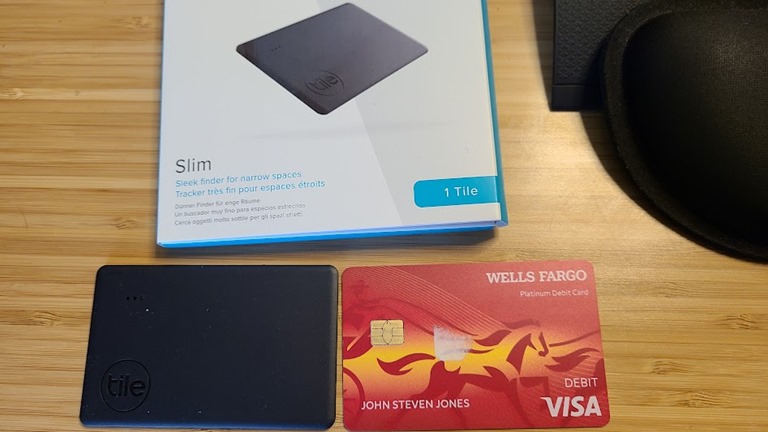
    After my wallet misadventures, I ordered a Tile Slim to track my wallet. It came a few days later and I walked through the setup. As you can see here, it’s literally the size of a credit card. It’s about as thick as 3. How do I know? See the post above.

    20210730_162436

    The instructions say to download the app and follow the instructions.

    I did that, and the setup consisted of creating an account, pressing the button on the Slim and then letting my phone find it. Most of the rest of the setup was getting location services added and then enabling Find my Phone (or not). I did this, as I’ve lost my phone a couple times lately for a short while.

    I think I’m getting old.

    In any case, I completed things, put this in my wallet and then walked away.

    Actually, like any good developer, I tested it. First, I left my wallet on the desk and walked upstairs. Since the bedroom is above the office, this wasn’t helpful. I could see the wallet very close to me in it’s history. If I activated the sound, I could hear it, which is good. If I drop my wallet behind a bed or piece of furniture, this should work. Especially if I walk around a bit.

    Next, I took it outside to the camping trailer. I left it there and went inside, almost right away. Not quite, as I loaded up a few things I needed to pull out of the trailer. When I checked the tile, Bluetooth told me it wasn’t in range, but the location history showed it a short distance from where I was standing in the kitchen. That’s cool.

    Of course, I need to have my phone and my wallet near each other for location history, but still, that’s helpful.

    I’ll see how this works, and if I can get some of this digital data and maybe see how often I don’t have my phone and my wallet. That might be an interesting piece of IoT data to plot.