Tag: software development

  • Better ReadyRoll Script Naming

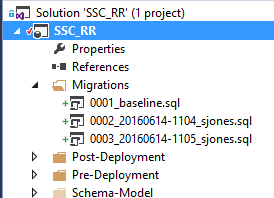
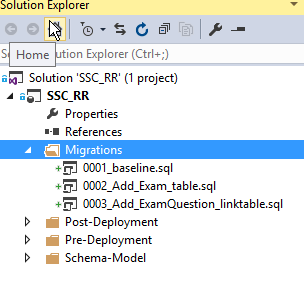
    One of the things that I like about ReadyRoll is that the product will automatically build new scripts that are named in a sequential order. This usually results in a few scripts that look like this:

    2016-06-14 11_05_15-Movies & TV

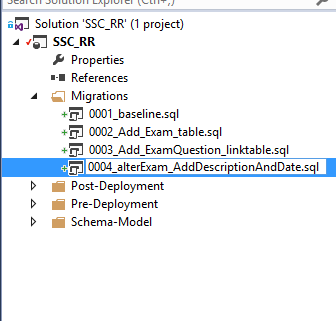
    As you can see, these scripts aren’t very intuitive. In fact, if you get lots of scripts, this starts to look fairly complex and confusing. What about something more like this:

    2016-06-14 11_08_13-Movies & TV

    That’s easier to read and understand. I’d also have a better idea of what happens in each script. How can I do this? It’s easy.

    Add an Object

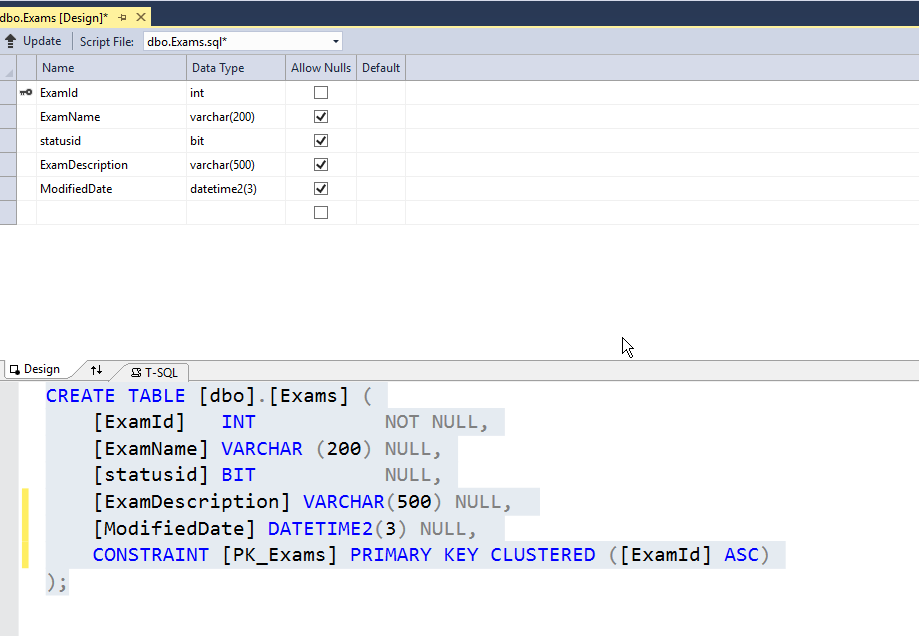
    First, let’s add an object in ReadyRoll. I’ll alter my Exams table to add a few columns. To keep this simple, imagine I want to add a modified date and a short description. I could do this in SSMS, but I’ll open the designer in VS. Here’s the table.

    2016-06-14 11_10_30-Photos

    I’ll make my changes.

    2016-06-14 11_11_01-Photos

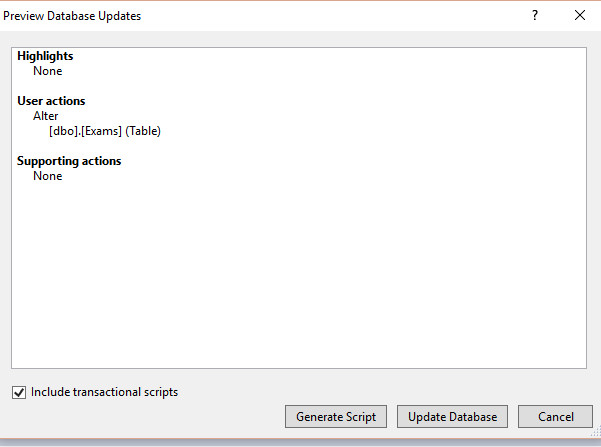
    Now, I click the “Update” button in the upper left. When I do this, I get a Generate script item. I could do other things, but I like to do this and see my script before applying it to the dev database.

    2016-06-14 11_12_04-Movies & TV

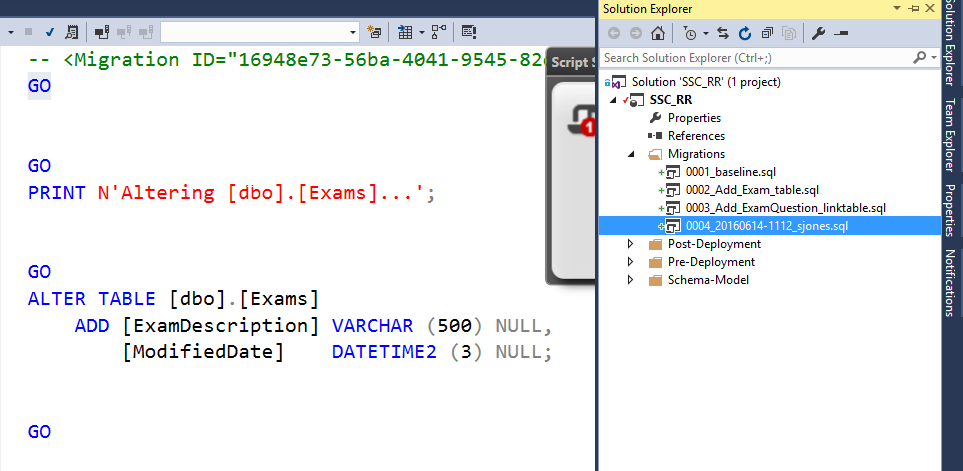
    I click Generate, and I get the script. Notice, it’s named with some random number (after the 0004) on the right.

    2016-06-14 11_12_34-Photos

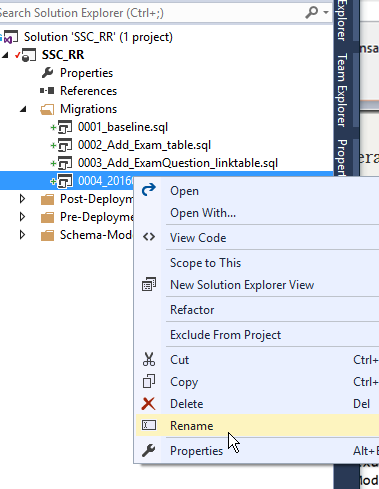
    If I right click the script, I can do all the normal file operations.

    2016-06-14 11_13_32-Photos

    Let’s give this a more descriptive name. It’s taken me a long time from my 8.3 name days, but I’ve learned to take advantage of file names to make them descriptive. A few bytes in a name is cheap.

    2016-06-14 11_13_58-Photos

    That’s it.

    ReadyRoll does use the first characters in front of the underscore (_) to order scripts, so I don’t want to change those. I could, but in this case, I need script 4 to come after script 2 at the very least.

    After the underscore, I can do whatever I like. In this case, I can see the changes being made to my database, just reading down the scripts and seeing how things will occur. I always have the detail in the code, but at a high level, I can see the changes.

    I’m sure if you adopt this technique, you’ll find that it’s much easier to manage scripts and track what’s happening to your database.

  • Starting ReadyRoll with an Existing DB

    I’ve been working with ReadyRoll quite a bit the last few months, and wanted to start putting out some information. I’m looking to do a longer series, but here’s a quick post on getting started.

    When you install ReadyRoll, you get a new project type under SQL Server.

    2016-06-14 12_27_14-Photos

    This is a database project that will track all changes to your database as a series of migration scripts. Let’s get started. I’ll choose this and give it a name.

    Once I do this, I get the ReadyRoll window with some information. What I really want to do here is point this to my existing database. Right now it’s looking at a LocalDB instance.

    2016-06-14 12_28_07-Photos

    I’ll click the configure link and get the Connection String dialog. This is the database that mirrors one of the SSC databases, with lots of objects in it.

    2016-06-14 12_29_38-Photos

    Once I’ve done this, the project will use this database. The Shadow database will also be on this instance.

    I need to make one other change and set the correct version in the Project Settings.

    2016-06-14 12_48_29-Photos

    Now, back to the ReadyRoll window. I’ve configured the DB connection, so I can ignore that. What I want to do is import my database, getting a baseline script.

    2016-06-14 12_49_32-Movies & TV

    I click that and ReadyRoll creates a Shadow database (since one doesn’t exist) and begins to import objects.

    2016-06-14 12_49_39-Photos

    Once that’s done, I get a list.

    2016-06-14 12_49_48-Photos

    And a migration script.

    2016-06-14 12_49_58-Movies & TV

    This is my baseline, starting script. This contains all the objects that exist in the database at this point. These are also added to the Schema-Model, but I can ignore those. I’m going to work on the database itself.

    The ReadyRoll widget notes this was an import, and there’s no need to deploy anything since these aren’t changes, but just the state of the db.

    2016-06-14 12_52_09-Movies & TV

    I can see this if I do a Visual Studio build. Note the message in the middle: No migrations pending deployment. The changes in script 1 (001_20160614-1249_sjones.sql) are already in the db.

    2016-06-14 12_52_50-Photos

    Now I can make changes to my database and get new scripts. Add a table in the designer?

    2016-06-14 12_54_55-Photos

    When I click Update (and Generate Script), I get a new migration script.

    2016-06-14 12_55_09-Movies & TV

    Note that I just generated this script. I’ll write more about this process later, but for now, I’ll click Deploy Project to execute this against my database. When I do that, VS does a build, and one migration is executed.

    2016-06-14 12_56_06-Photos

    Add a procedure?

    2016-06-14 12_57_13-Photos

    Generate a new migration script.

    2016-06-14 12_57_35-Movies & TV

    And so it goes. I can work with my database in VS and get new scripts. I can also do an import if someone else makes changes to the database from their own machine with VS, SSMS, SQLCMD, isql, etc. The import will generate another migration script that gets added.

    This is a really basic look at ReadyRoll, but it will get you started. I’ll tackle more topics and different ways of working with database development in another series of posts.

  • We Manage Algorithms

    “Every business is an algorithmic business.”

    That was a phrase that Microsoft’s Joseph Sirosh used in a keynote at SQL Nexus, talking about the future of software and data. Rather than managing data, many of us will move to manage algorithms, which will determine how data is interpreted, used, processed, and potentially returned to users as information. There are starting to be too many sources of data, too much data itself, being generated at too quick a rate, to the point where algorithms become more important than the actual data in examining, grading, interpreting, filtering, and more.

    This is exciting on one hand, with new opportunities for those that can develop, choose, write, tune, or enhance algorithms. I can easily see greater influence from both developers and DBAs as we work to better manage the floods of data. Especially with 50 billion sensors, IoT devices, and more that are predicted to be online in the 5 years. That’s potentially a tremendous amount of data being generated.

    On the other hand, this is a bit scary as separating good data from bad in the ocean of bits, and choosing helpful rather than hurtful algorithms might create lots of stress, and perhaps even fewer opportunities if few algortihms are reused. This also means we will need algorithms that can help us determine if data is actually good enough to use. After all, in the deluge, there will be bad data, that potentially needs to be excluded from queries. Will software developers become more important than DBAs as we end up with more unstructured data stores, data lakes, or other constructs that might require less administration?

    I’m not sure how things will change, but it will be an interesting world the next few years as we work with larger and larger, more diverse sets of data in our organizations.

    Steve Jones

    The Voice of the DBA Podcast

    Listen to the MP3 Audio ( 2.3MB) podcast or subscribe to the feed at iTunes and LibSyn.

  • Abstraction

    One of the core tenets of good software design is to abstract away details in any particular part of an application. We want to use well defined and constructed interfaces so that the implementation of any particular method or section can change without affecting the way the system works. This allows for improvement and upgrade over time. The same thing occurs in hardware, where we can replace a hard drive, a graphics card, or other components and the system should still function in the same manner. There might be a bit of work, such as updating a device driver, but the core system should still work.

    This is also present in the real world. I can replace the wheels and tires on my car, since as long as I have the same pattern for the bolts to attach to the axle, things still work. Electrical systems work this way, allowing any device that has the correct plugs and uses the expected voltage to interface with an outlet. The examples of abstraction are numerous, and the more we use abstraction, the more flexible our systems can be. Where we haven’t abstracted away details, it becomes complex and expensive to change part of a system.

    In a database setting, we want to use abstraction where possible. The use of views or stored procedures (or functions) allow the underlying table implementations to change without an application being too tightly coupled to the structure. This isn’t always well adhered to, despite the well known practice of building a data access layer into an application. Too often developers want to tightly couple their application to the underlying table structure.

    But, how abstracted should you be? Certainly I’d hope that your application had the ability to easily change connection settings, and these days I’d hope you actually had two: a read/write connection and a read-only connection. What about the database name? Should that be abstracted away? Again, I’d hope so, even in a multi-database application. If for no other reason than to simplify development by allowing the database name to change on a development server. Certainly security objects, especially encryption mechanisms, need some abstraction to prevent the requirement that they exist in non-secure environments.

    Are there other abstractions you’d want to see widely implemented? I wonder what other examples might be important to developers or DBAs out there. I know that allowing abstractions also brings complexity, and the ability to change those values between environments is critical. This could be performed with injection of different parameters as software changes are deployed, but the mechanisms for doing this are still immature and not standardized.

    There are plenty of other places we can abstract away implementations, but without mentioning too many, I want to know what you’d like to see. What abstractions would you want, or do you implement in your systems?

    Steve Jones

    The Voice of the DBA Podcast

    Listen to the MP3 Audio ( 2.7MB) podcast or subscribe to the feed at iTunes and LibSyn.