
 It’s that time of the month again, with T-SQL Tuesday coming along. I managed to not forget about this and checked with the host. He had an issue, but fortunately I got a friend to step up.
This month Pat Wright has an interesting question, asking how your code has aged. He and I have had a few conversations lately about getting older and when I asked him to host, this was a perfect choice.
I’m definitely getting older, but what about my code?
25 Years Later
Actually a little more, but I wrote a series called “Tame Those Strings” for Swynk a long time ago. That became Database Journal, but during the switch, they stopped paying us authors. A few of us started SQL Server Central and we went live 25 years ago.
In that piece, I referenced the oldest article, which is Tame Those Strings Part 4 – Numeric Conversions. There’s also a part 3, but in those pieces, is that code still useful?
A bit.
These are basic articles looking at string functions that are still heavily in use today. The idea of cleaning phone numbers using REPLACE is still something we might do today. If we are using SQL Server 2025, there are additional functions, but I still see a lot of code that still use multiple CHARINDEX+SUBSTRING or REPLACE functions.
I asked the Prompt AI if it could do better.
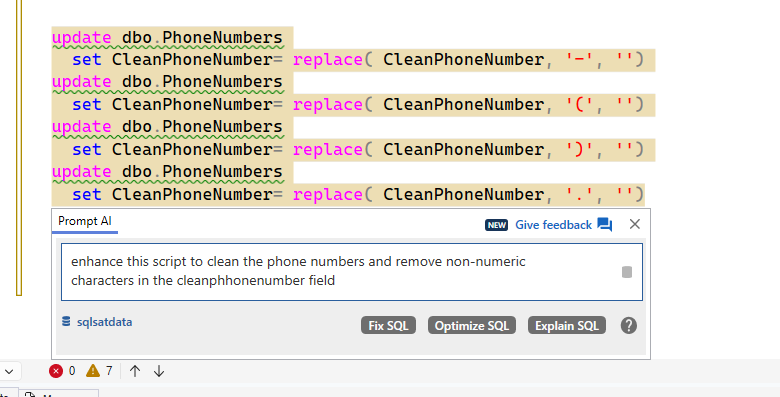
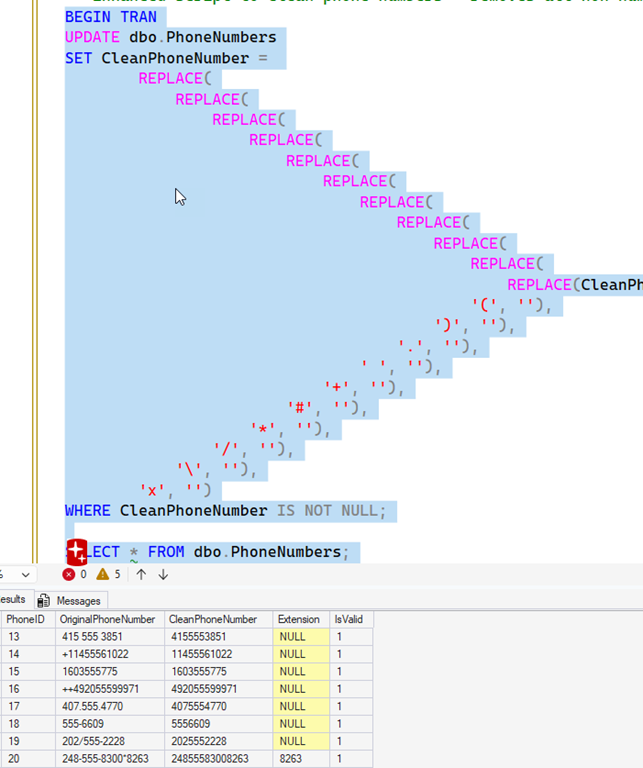
It gave me two pieces of code. The first is nested REPLACE() statements. This works, but I find this hard to read. I’d rather have separate statements, for ease of maintenance.
The second is a single statement, using a CASE and STUFF and XML to clean things. I like this, thought it’s a semi-complex way of doing things. However, it works.
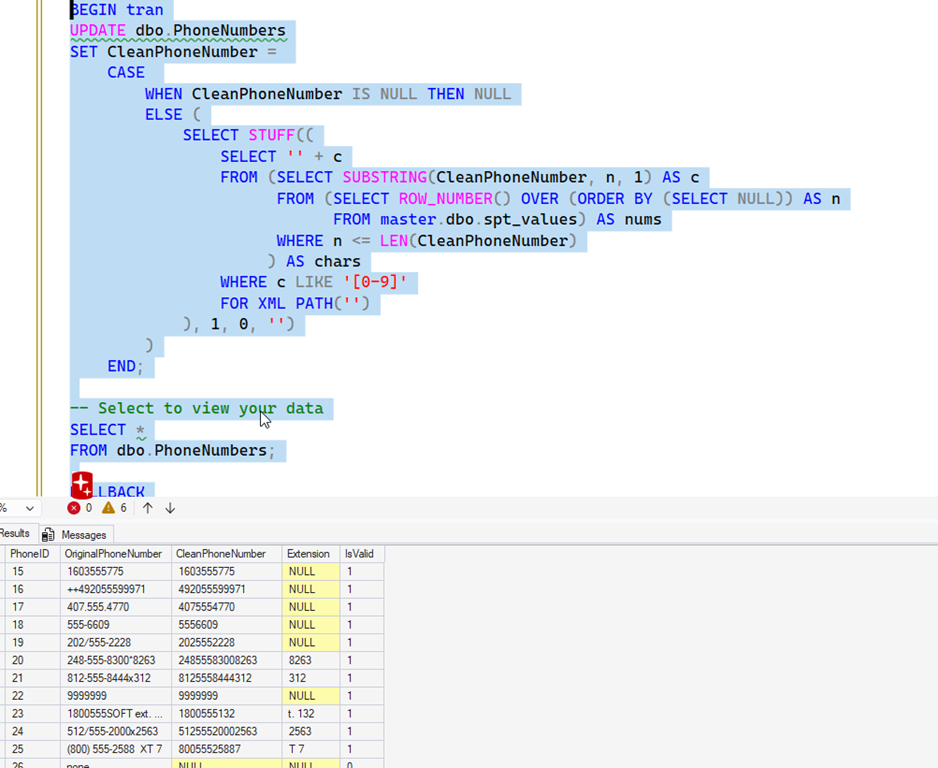
Has the code aged well? I think it’s OK. There are better ways, as shown with the STUFF/XML version, which wouldn’t have worked in SQL Server 2000. Still, the use of REPLACE is a common technique still used today.
For part 4, with the use of LTRIM and STR(), today we have FORMAT, which is cleaner. However, it’s likely less performant. In a simple test of 500,000 values, the FORMAT takes over 600ms to return the results while my LTRIM/STR combination consistently runs in the 460ms or quicker range.
I think my code aged well.




 Voice of the DBA
Pingback: T-SQL Tuesday #195 Summary – Sql Insane Asylum (A Blog by Pat Wright)