Stop Snagit from Saving .SNAGX Files Automatically

I recently installed SnagIt and it was annoyingly saving both PNG and SNAGX files. This post shows how to get rid of the SNAGX file. If you just need the solution, scroll to the bottom.

I installed Snagit recently with a new machine. The old screenshot software I had been using was banned by IT as it had an unpatched vulnerability.

The main reason I want a screen capture tool is for sharing an image. This might be for a note for me, feedback to a product team, a part of a screen for a blog or article, or even showcasing something for a customer.

What I have done for a couple of decades:

  • hit a hotkey
  • select a region of the screen
  • move on

I expect to have the region of the screen saved in a folder on my workstation, where I can then grab it later and send it somewhere.

The SnagIt Problem

When I added SnagIt, I set up a automatic capture with these settings.

  • select: region
  • Effects: non
  • Share: File, automatic filename, specific folder
  • No preview, no delay, capture the cursor
  • Preset – One set up
    • hotkey: CTRL+Shift+B
    • Image type set to PNG

This worked well, with my images being captured.

Except, with every PNG, I also had a SNAGX file. That was really annoying because if I edit, I’m editing the PNG  and resaving it. I don’t need 2 image files.

Customer Support

I had a chat with customer support, who was not helpful. They suggested this article: Save to another format. I eventually got the person to understand I didn’t need that, and they said this wasn’t supported.

I complained a bit on Twitter, mostly just annoyed. The person who responded gave me the same article, but then they responded later with the solution.

The Solution

The place to configure this isn’t the SnagIt app, which is where I’d expect it. It’s in the Snagit Editor. I’m guessing that the capture process calls the editor somehow, which is why this design exists.

Go to the Edit menu, then select Editor Preferences. Go to the Library tab. In there, uncheck the “automatically save new image captures to library”. It’s checked below, but remove that and it should stop with the SNAGX versions.
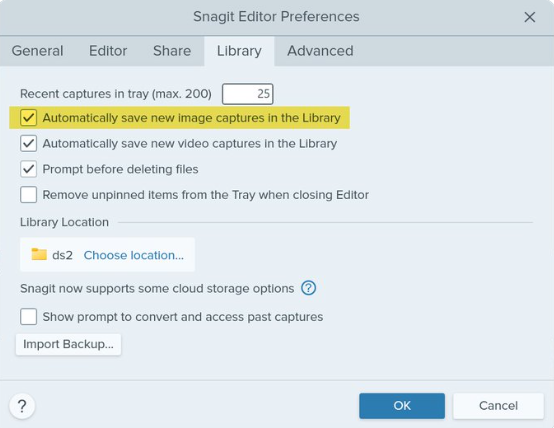
2024-08_0118

Summary

No screenshots because, well, when I try to capture one the SnagIt app and Editor disappear. The one above is from Twitter.

This is a weird architectural design. The capture widget would be the place I’d expect this, but the “save new image captures” implies to me all image captures, not just the SNAGX format. It’s poorly worded, IMHO, for users to understand.

However, my problem is solved and I don’t need the job I created that runs every day and deletes *.SNAGX from my folder.:

Posted in Blog | Tagged | Comments Off on Stop Snagit from Saving .SNAGX Files Automatically

Labor Day 2024

It’s Labor Day in the US, the traditional end of summer for me as a kid growing up in Virginia. This was the last day of summer before school started for me. It was also the day when many of the seasonal businesses closed in Virginia Beach.

It’s not quite the end of summer for me, but it is a day of Labor. Travel and a strange weather pattern this summer have me behind on ranch chores, plus, the ranch manager AKA my daughter, is on vacation. Today I’ll handle the horse chores and then start fixing, building, and more today. There is always plenty to do, and as my daughter has taken over much of the day-to-day ranch management, she continuously sends me a list of things that need repairing. She’s happy to help, but I have to go over how to accomplish some tasks that she’s never done.

Hopefully it’s a quiet day for those of you working in technology, with no outages or security incidents and you can start the week slowly.

For those in the US, hopefully you have a great day off and enjoy a break from your labors.

Steve Jones

Posted in Editorial | Tagged | Comments Off on Labor Day 2024

Trying New Technology

I had someone ask me about DuckDB recently. Would I think that’s a good choice for a database? I don’t really know. From their blog and some online research, maybe, but it’s also a minority player in a niche space.

I had a chat recently with someone that had implemented ArangoDB, a graph database. Why that and not Neo4J I asked them? Someone at the company had tried the database and recommended it. Not a bad reason, as I think experience with tech is important, but it’s not the most important thing.

As I’ve aged, and maybe matured, I think less about the ability of a technology to work and more about the ability of a technology to be maintained over time. Not by me, but by everyone in my organization. Not everyone, but can anyone working on our staff learn and use it, including the future employees we haven’t yet hired.

There seem to be no shortage of new niche technologies. I have a few newsletters I subscribe to, and I see new projects and new solutions appearing every day. New tools, utilities, frameworks, even databases. Some of these might be amazing, and incredibly useful, but will they exist in a few years? In fact, that’s a question I ask myself about plenty of Microsoft technologies that appear. Will they really be around in 5 years? Long-term, or at least medium-term, supportability is important.

I also worry about the training and learning required for new technology. I’ve seen companies that adopt too many products in their tech stack and it becomes hard to hire experienced people. Even if we hire smart people that can learn, we have a lot to teach them. The more we need to teach, the slower they are to be productive. It can be even slower for us to trust them to work independently, especially in a crisis.

I think that most organizations should limit the number of technologies they use. This could be frameworks, languages, and more, including databases. Don’t add something new just because a developer, DBA, or even executive likes it. Certainly, be careful about changing technologies when the change isn’t adding value to your organization. Every change has costs, every new advantage contains a disadvantage, and every additional thing creates training requirements. Some people might pick things up quickly, easily, and during their off hours. That person might be you, but how many others will be able to do that?

Not many. That’s been my experience. The world is full of average people, by definition. While the average level (skill, capability experience, etc.) at your organization might be higher than our industry, over time, that will change. As our organizations grow, and as we change staff, we often become more average.

Our choices, and methodologies, our architecture, and more must survive the average employee, not the high performing ones.

Every organization ought to limit tech choices. There ought to be a process and way to add new technologies, and employees ought to be able to submit a request, make a case, and have others decide if taking on a new technology makes sense. If so, great, but do so carefully.

I like seeing new technologies built and adopted, but I also try not to just adopt the latest shiny things. Experiment, in a time-boxed fashion, and make decisions when appropriate, consciously because the benefits outweigh the costs. And not just slightly outweigh the costs, but substantially. In all likelihood whoever proposes the new tech isn’t thinking about the downside, and there will always be more downsides than you can see right now.

Steve Jones

Listen to the podcast at Libsyn, Spotify, or iTunes.

Note, podcasts are only available for a limited time online.

Posted in Editorial | Tagged | Comments Off on Trying New Technology

A New Word: Flashover

flashover – n. the moment a conversation becomes alive and real, when a spark of rust shorts out the delicate circuits you keep insulated under layers or irony, momentarily grounding the static emotional charge you’ve built up through decades of friction.

I sometimes wonder how sad or disappointed (or angry) the authors or this dictionary are at the world.

I don’t get too insulated with irony, but I do have flashover moments when I suddenly become interested in a conversation. It can be with a customer, when they have a cool problem, or they see some excitement in how they might adopt DevOps.

It can be with friends or family, when I hear them tell me something wonderful about their life.

It’s a cool feeling when you might be half paying attention to a conversation, or you feel like you’re having small talk, and all of a sudden you get excited or interested, more invested, in the chat.

I love that.

From the Dictionary of Obscure Sorrows

Posted in Blog | Tagged , | Comments Off on A New Word: Flashover