A New Word: Exulansis

exulansis – n. the tendency to give up trying to talk about an experience because people are unable to relate to it – whether through envy or pity or mere foreignness – which allows it to drift away from the rest of your story, until it feels out of place, almost mythical, wandering restlessly in the fog, no longer even looking for a place to land.

I try to avoid exulansis in my verbal stories, but I know it doesn’t always work. I actually ran into this recently while traveling to a volleyball tournament as a coach. I wasn’t talking with a player, but rather a parent, talking a bit about my fatigue and challenges. On the 22nd of June, as I chatted about life, I realized I’d only been home for 7 days that month.

This parent was a lawyer, primarily working in Denver and rarely traveling for work. They took vacations, but those tend to be spread out, where as this trip was my 4th of June. I realized as I tried to talk about the experience of crossing time zones and the world back and forth that this person couldn’t relate and my point was being busy and needing to catch up on chores, as well as dragging a bit at the tournament. The travel experiences across time zones weren’t really something that they could relate to.

Interestingly enough, another parent heard and asked me for some tips, as they were about to embark on 3 cities in 3 weeks for work. They didn’t have exulansis from my story.

From the Dictionary of Obscure Sorrows
Posted in Blog | Tagged , | Comments Off on A New Word: Exulansis

HIPPO vs. Data

One trend for many organizations is to be data-driven. This means using data to make decisions at all levels, or at least support those decisions. This was popularized by many companies, and there is research to back up the claims that those organizations who do this have more success, more revenue, more profitability, etc. Much like DevOps, however, it seems many organizations don’t want to actually invest in making data-driven decisions.

Instead, many opt to make decisions by HIPPO. If you’ve never seen this acronym, it stands for highest paid person’s opinion. Many managers will defer to whoever is above them in the org chart, often someone that is paid more money than them. Even when there is data to make a different decision, the HIPPO is still used.

It’s not just management. I sometimes see technical people do this. In that case, it might be the loudest or most senior person rather than the highest paid, but the sentiment is the same. Rather than using a lot of information, someone makes a decision based on what they want/see/need/desire. I’ve seen this often with tooling, where one person likes Jenkins (or hates it), and the organization changes from  (or to) Octopus Deploy or Bamboo for no real reason. Lately, it seems some people are advocating moving from Azure DevOps to GitHub Actions because, well, I don’t know why. There’s not a good rational reason.

The goal of collecting and using data is to do so intelligently and with purpose. And not just for big decisions, but for everyday actions. By senior managers and frontline people, to help guide a more efficient and effective company. This involves a lot of technical work, but also cultural change. We have to position data as a strategic and tactical asset that everyone shares and uses as the basis to make the entire organization better.

Of course, these are similar to the concepts of DevOps. Let’s build software better. In practice, many attempts succeed initially but fail later as more and more groups fight individual incentives that promote one group’s goals over another’s. When silos aren’t broken down, we fall back into the same patterns.

In this case, listening to (or lobbying) the HIPPO.

Steve Jones

Listen to the podcast at Libsyn, Stitcher, Spotify, or iTunes.

Posted in Editorial | Tagged | 2 Comments

Creating a Speaking Failures Support Group

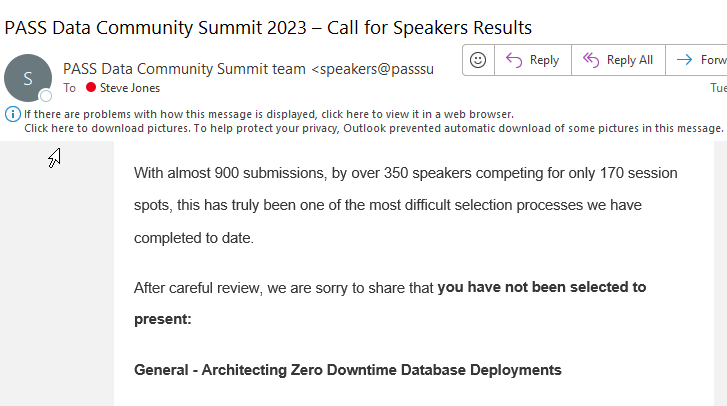
Earlier this week the emails went out to speakers who submitted to the PASS Data Community Summit 2023 conference. These were acceptances and rejections, letting people know the results of the volunteer review.

I got this one:

2023-07-13 10_39_20-PASS Data Community Summit 2023 – Call for Speakers Results - Message (HTML)

I had only submitted one session after being buried last year, and I assumed (we know what assume means) that this one would get picked. It wasn’t, and that’s OK.

A Speaking Failures Support Group

I know I’m not alone. I’ve had many speaking submissions rejected. From big conferences and little ones. It is disappointing, but I’ve learned not to take it personally.

I know this is a hard message to get, especially for less experienced speakers. So I decided to a) publicly disclose my rejection, and b) create a place to get support.

Since I am the editor of SQL Server Central, that’s a natural place for me to do this. I set up a forum for a Speaking Support Group, which you can use to post questions, ask for feedback on your submissions or ideas, get spell/grammar/phrasing help from others, commiserate with fellow speakers, and give them support/encouragement to try again.

Feel free to join me there, and comment on my first post, hopefully telling me to not take this too personally.

Posted in Blog | Tagged , , , | 1 Comment

The Value of Doing Something

I live on a working horse ranch. My wife boards, trains, and trims horses and has employees. Occasionally I have to help out with chores, or more often, fixing things. I was talking with a coworker recently and showing some pictures. He was asking why I do things like tap a bolt instead of hiring someone to do it.

I caught this excerpt from a book on cooking, which got me thinking. I don’t love the flow here, as it wanders between cooking, economics, politics, social justice, and more. However, the core ideas of specialization and taking on a task was what I got out of the piece.

I work for a software company, and certainly, I make much more doing that than I save by cooking a meal or fixing a bolt. I could hire someone at much less than my hourly rate to do the work. Except, I don’t get paid more for working more. Maybe if I do more sales and get a quota, but for now an extra hour of work hasn’t helped me.

Then there’s the satisfaction of getting something done. I talk and write and move bits around all day; nothing that has a tangible result. It can be satisfying but in a very different way than cooking or physically finishing a task. I actually like getting my hands dirty and seeing the results of my work. Seeing a new fence go up, a tree come down, or a repaired bolt brings about pride. I feel good when my family appreciates a tasty recipe and everyone cleans their plates. It’s a nice challenge.

At the same time, routine maintenance, like changing oil, sometimes feels like doing an expense report. Needs to be done, it helps me, but there’s nothing very exciting about it.

In the era of specialization, or even the era of automation and AI tools, it might seem that we don’t need to learn or work on anything outside of our area of expertise. I think it’s important to practice, learn, and use a variety of different skills. Even if I don’t need to write PoSh often, it is helpful to sometimes tackle work that needs doing. Each bit of new knowledge brings new understanding and appreciation for the work others do.

It also helps me gain confidence in my ability to learn and use new technologies should the requirement arise. This has also served me in past jobs where I can step in and help others or even tackle a job when they aren’t available. This is something that I find far too many people struggling with. Either because of a lack of confidence or not having enough general skills that help them troubleshoot, build, or even support the vastly changing environments in which we work.

Doing something old, new, challenging, or easy is good for all of us. Try something new, while you also appreciate and use the skills you have. Believe in your ability to learn and prove it to yourself on a regular basis.

Steve Jones

Listen to the podcast at Libsyn, Stitcher, Spotify, or iTunes.

Posted in Editorial | Tagged | Comments Off on The Value of Doing Something