Daily Coping 12 Sep 2022

Today’s coping tip is to forgive yourself when things go wrong.

A theme of being better to myself, starting with last Thur and Fri.

What’s gone wrong for me? I was working on some ranch chores, setting up a new gate opener. Some hard, physical digging, but also some planning and preparation. I also had to buy a few things, and in the process of the work, I mis-aligned one set of brackets and had to replace them. I had trouble with the digging and had to change tactics and re-do some work. I also chopped an underground wire, which I had to replace.

All of this made the process take longer, and also meant we manually opened and closed the gate for awhile. Getting out of a car in bad weather to do so is really annoying. I was annoyed with myself for inconveniencing myself and others, and making simple mistakes.

However, I’ve learned that this isn’t my full time job. I will make mistakes. I need to be ready to deal with them without getting upset or beating myself up. I tried to forgive myself and overall that helped, but not completely.

Something I need to work on more.

I started to add a daily coping tip to the SQL Server Central newsletter and to the Community Circle, which is helping me deal with the issues in the world. I’m adding my responses for each day here. All my coping tips are under this tag.

Posted in Blog | Tagged , , | Comments Off on Daily Coping 12 Sep 2022

The Redgate 100

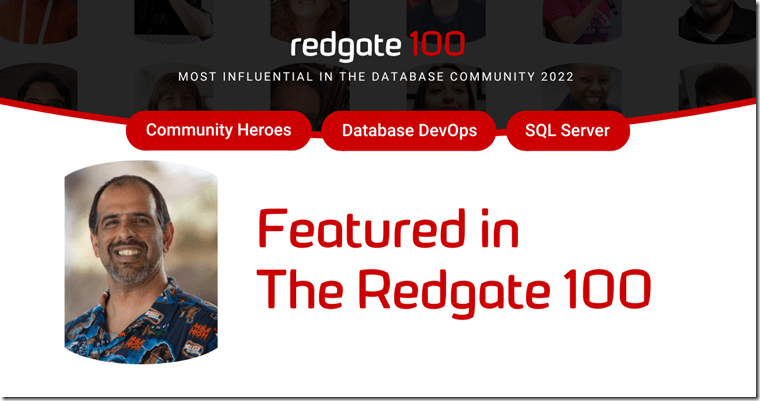
The Redgate 100 is a list of 100 people that are influential in the database world in a number of categories.I made the list in a few places, which is pretty cool.

Redgate 100 Social individual influencers (35)

Disclosure: I do work for Redgate as an advocate, and I helped with some discussion of the list and nominations. I didn’t pick the list, vote, or make decisions.

This is a marketing effort, as are many of the “best of” awards and notices you see out there. In many case, those are often paid placement, as I’ve been offered the chance to be on those lists if I paid a fee. I always decline, or at least to date I have.

In this case, Redgate are in the business of database software and tools. We sell them, but we also support a lot of community efforts as well as are constantly researching to better understand what people need and want. Sometimes we build products in those areas, sometimes we just publish research results.

In any case, I thought this was a pretty neat idea and a great list. You can read about the selection process, which doesn’t tell a lot, other than they took some nominations, calculated some score based on what people do in the community.

While Kathi, Grant, and I work for Redgate and are on the list, part of the reason why we work for Redgate is that we do a lot in and for the community. I could say the same for Kendra who used to work for us, and if we’d have done this list before we were hired, I think we’d have been on it anyway.

This doesn’t imply that everyone who is an influential database professional is on the list. With 100 slots, there were decisions and choices, and there are some experts and incredibly valuable community people who didn’t make the list.

Thanks to all of the people who blog, speak, volunteer, and otherwise help drive the database professional industry forward.

It’s an honor, and I hope Redgate continues to do this in the future.

Posted in Blog | Tagged , | Comments Off on The Redgate 100

Summon in the Tesla FSD

This is part of a series that covers my experience with a Tesla Model Y.

One of the features that came with my FSD subscription was Summon. This allows you to move the car from the mobile app without being in the car. I decided to test this a few times and see what happens. I ran these tests:

  • Coming out of the garage – failure
  • Backing out of a parking space at the gym – failure
  • Crossing the parking lot at the doctor – mostly OK
  • Summon to target in the gym parking lot – mixed
  • Summon to me in the gym parking lot – works

I’ve described the experiences below.

Garage

When I first subscribed, I drove home and parked the car short of coming into the garage. I walked into the garage and selected the forward arrow. The car drove very slowly into the garage, with lots of minor adjustments left and right. Not sure I loved that.

In the video of my testing, I tried to get the car to come out of the garage. It would wake up and start for an inch, and then stop. I think the right corner of the garage made the car nervous, and it didn’t quite believe it could back straight up. I didn’t test the come to me or come to target.

In a Parking Lot

I had tried this at a doctor’s office once, and stood in the middle of a parking lot, away from other cars. When I pressed come to target, the car backed up, turning out of a parking spot and then drove forward to me, though past me to a spot marked on the map. I’m not quite sure how a “target” is picked, but since I could have stopped the car near me, I wasn’t too worried.

Later I went to the large, mostly empty parking lot at my gym and did some other testing. Two tests couldn’t get the car to back out of the parking space, and I’m not sure why. No other cars around, so it was strange.

When I backed in, I could get the car to drive to me, though only with selecting “Come to Me”. The “Come to target” again picked a weird spot. Actually across a couple parking spots.

Summary

During a month of having FSD, I never really had a time when I wanted to summon the car. Of course, in Colorado in the summer, it rains rarely, and I’m not one to be worried about a little rain on the few days we have some. I also don’t quite know when I find it useful. Maybe if someone parks too close to let me get in or park.

The feature worked OK, though not great. Certainly not enough, or not consistently enough, for me to want to pay for this.

I made a video of my tests that you can check out.

Posted in Blog | Tagged , | Comments Off on Summon in the Tesla FSD

Fixing Impostor Syndrome

I think that most of us feel like an impostor at some time in our lives.  We will get asked to do something we’ve never done, with others expressing confidence in us. We may tackle the task, or we may not. We may succeed or we may not In any of those cases, we may still feel like an impostor, someone that isn’t really qualified to do this thing. Many of us continue to feel this way in our careers, suffering from impostor’s syndrome.

While I know that I’m good at my job, good at working with SQL Server and teaching others to do so, I still suffer from impostor syndrome at times. There are periods where my mind wonders if I’ve just gotten lucky and slipped through some evaluation process. Maybe my knowledge hasn’t been well tested. Will someone like my boss, or their boss, question my skills at some point and get rid of me? Will I be able to find another job if that happens? Can I really compete with others out there? This isn’t a constant or regular feeling, but I do experience it at times.

I work with technology, helping customers better manage their database software. However, I also work in marketing, which is a completely different kind of job. Someone in my company posted an article about impostor syndrome for marketing, which I found fascinating. This could be written for technologists or, perhaps, any other profession. Read through it and think about a few things that I saw in the article.

If you feel you don’t have the knowledge you need, you’re not alone. I think that’s very true in technology, where it feels that the pace of change from vendors, from peers, and what you might read in the media (including here at SQL Server Central) can make anyone feel as if they don’t know as much as others. I do try to acknowledge to myself that others feel as I though. It’s slightly comforting, but not a lot. Especially when I converse with some amazing experts. Discussing execution plans with Grant or T-SQL with Jeff or HA with Allan can cause me to question my knowledge and success.

The second thing to think about is how poor the state of the industry can be. Whether this is the skills of others or the architecture of software, systems, or databases. How often have you seen software that’s been purchased or deployed and you question the decisions that got it to this state. Are you amazed at how many problems you see? Do you start to question the skills of others? I know at SQL Server Central we try to help others, but I can also be amazed at the lack of knowledge out there about what I’d consider to be simple topics. At the same time, I recognize others may be in a different place in their journey. Having empathy and compassion keep me answering questions. The need to keep answering them reminds me that I do know quite a few things.

Lastly, education helps. I constantly experiment and build demos of different things. Often these are learning experiments. I don’t know that I become an expert in many of them, but learning more about how something works, or increasing the depth of knowledge in some area I’ve worked help me to build confidence to tackle the challenges I face (or my customers face).

The article notes that marketing is an imprecise science. I think software can be that way as well, despite the growing number of “engineers” in our industry. Like marketing, there are no shortage of people who think they know it all, or use boisterous, blustery, loud discussion to convince others that they do. Even hen their choices or design might be suspect or perhaps their approach is outdated. One of the tenets of DevOps is that we continuously learn and experiment. I try to apply that to my own knowledge, and find it can help me feel like less of an impostor some days.

Not all, but there’s always tomorrow, and I usually find that these feelings pass with time, especially when I apply myself and continue to grown and learn.

Steve Jones

Listen to the podcast at Libsyn, Stitcher, Spotify, or iTunes.

Posted in Editorial | Tagged | Comments Off on Fixing Impostor Syndrome