We’re coming back to New York, which is exciting for me. I love NYC.
The Redgate Summit 2026 – New York City comes back on May 5, 2026. You can register today and I’ll see you back in Manhattan the first week of May. Once again Bob Ward is giving the closing keynote, with me and fellow Redgater’s giving the opening one.
We’ll have three tracks, but I’ll be hosting a session with one of our customers, so you can hear how and why Redgate Monitor helps them out and what it’s like to work with Redgate. We did this in Chicago, and there were some great questions from the audience.
We’ve chosen customers who have had good experiences, but feel free to ask them anything about how Redgate Monitor works and how we are as a vendor. I’m certainly proud of how we partner with customers, so come get a first-hand view from a large financial services organization.
New York City is such an amazing place, and we’ll have a drinks reception after, but there is lots to do. I’ll be bringing my wife and we’ll likely go see a Broadway or comedy show the night before. You should do the same.
We also have a Redgate track and an AI one, so this is a great chance to see how Redgate views the world and how we’re approaching building software that helps you become more efficient inside your organization.
When people used to setup Redgate Monitor in the 2015 timeframe (formerly SQL Monitor) they sometimes complained about the noisiness of the alerts. Just too many alerts were sent out.
I felt this way about other products I’d used in the past, and our dev teams worked hard with support to enhance the produce and tune our defaults to make them less noisy. Many customers appreciate this, though a new install can take a little tuning to customize to what is helpful and actionable vs what is noise for each customer.
A Better Way
As the AI-LLM rise started in 2024, we started to work on different ways to use this tech in Monitor. One of our first ideas was an ML based alert that didn’t work on a set level to trigger, but rather would look at historical data and adjust the threshold for alerts. In this way you would
We released this in v 14.0.37, so you need to be on that version or higher to use this. This is in a documentation page that describes how this work. Basically we take 14 days worth of history (the min required) and run that through a machine learning algorithm to decide what a predicted level should be. There is a pad added, and you can still set a min threshold and a duration.
If the value exceeds the predicted value + pad, an alert is sent out.
This is intended to reduce the amount of alerting from a system that might have a variable workload, but one that repeats and is predictable.
Enabling Alerts
This is available for the following alerts so far:
Processor (CPU) utilization
Server waits
DTU utilization
Query throughput
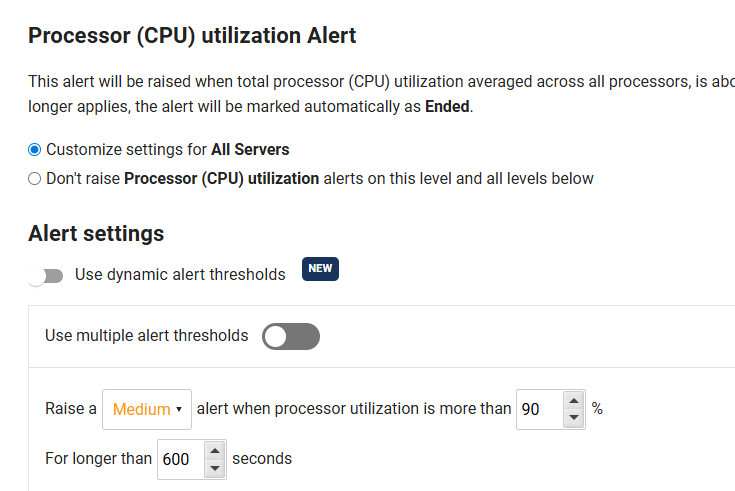
If you go into the configuration for any of these alerts, you wil see a “dynamic alert” toggle that can be enabled. You can see this below where is says “Use dynamic alert thresholds”.
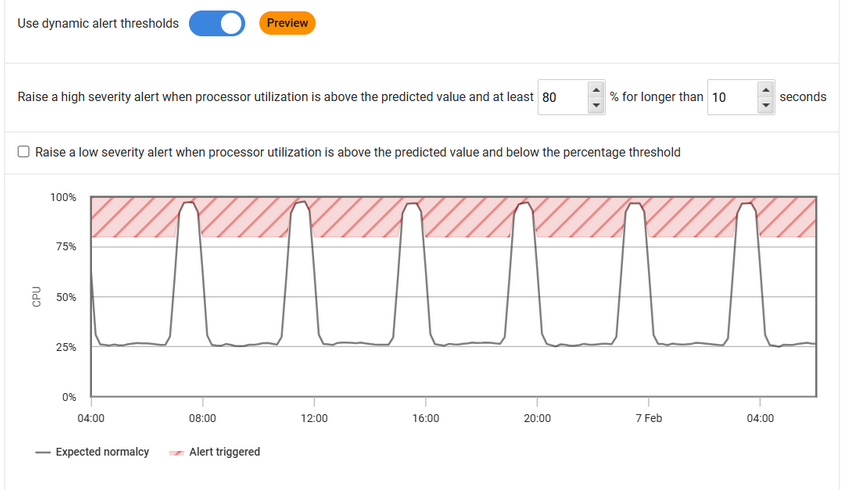
When you do that, you can still set the levels, and as shown below (from the doc page), you get an idea of how the threshold works. The predicted values are shown as the line. If the line gets into the red areas, an alert is raised.
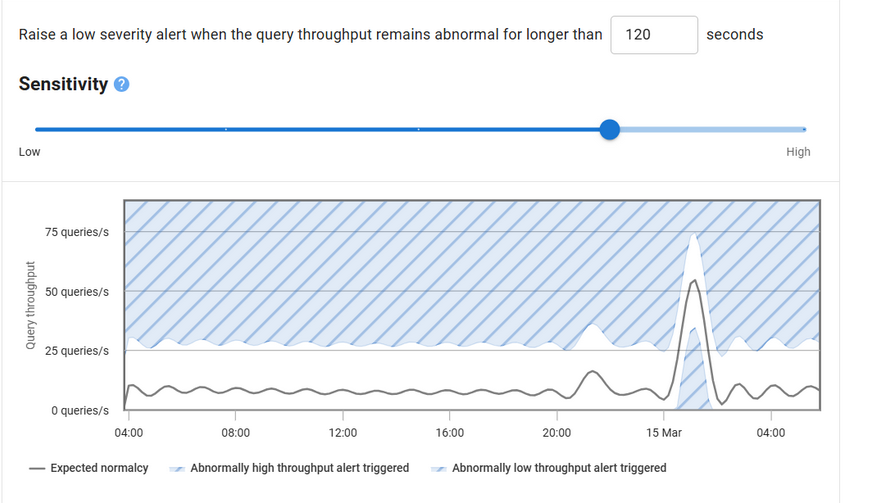
The time limit works as shown for sensitivity. The value would have to get into the blue area, so you can see a pad around the predicted value alerts are not raised.
That’s it. Set the alert and if there is 14 days worth of data, each machine gets its own custom alert levels.
Seeing the Expected Values
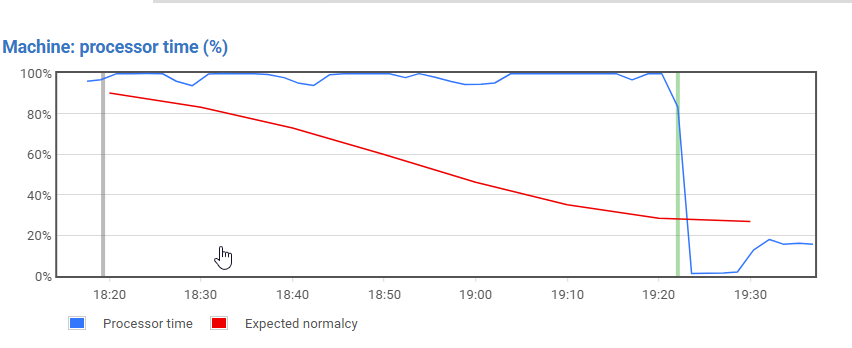
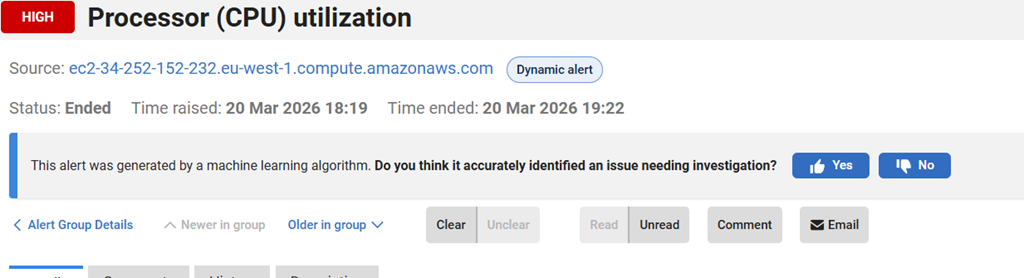
When an alert fires, the alert includes the predicted values as well as the values recorded. You can see below in this alert that CPU was expected to decay, but hadn’t, so an alert is fired where the green line is shown.
At the top of the alert, you can see that this was generated by an ML process.
Summary
This dynamic levels should reduce the amount of alerts you get from variable workloads, since the predictions are made based on each machine’s history. You can set some threshold and sensitivity over time, but the actual values used for alerts are predicted.
There is also a feedback place in the alert so that you can let us know if this is helpful or not. We use feedback from you to help better tune our the ML works.
If you have feedback in general, please let us know as we value your opinions and comments on how we shape the future of Redgate Monitor.
Redgate Monitor is a world class monitoring solution for your database estate. Download a trial today and see how it can help you manage your estate more efficiently.
When I was young and needed to learn about something, I had to go to a library or a bookstore to get information. I often started by looking through an encyclopedia. I had to wander between entries to learn more about the topic I was researching. A few lucky friends had their own copy of an encyclopedia, which was nice since we could research at home. At some point these collections of information were moved to CD/DVDs, which made them more portable and more accessible to a larger group of people than in the past.
In the 90s we had the innovation of search engines, which allows us to more quickly move through information. There was more information available on the Internet than was ever published in encyclopedias. Over the years, these search engines improved their ability to rank and recommend information that is relevant to your query. However, you still need some idea of what you are trying to learn about. You have to direct the searches, although the Google auto-complete felt very predictive at times.
However, I heard a quote recently that is the title of this piece: everything is the right question away.
That might seem like something a search engine or even an encyclopedia would help with, but consider the fact that with an AI LLM you don’t have to specify much at all to get started. You can even ask it the question of how do I do/learn/find something and get a result that seems better than any computer system in the past. It might be better than what you get from most humans as well.
Of course, you might not get the answer you want or need, though you can continue to ask the LLM and refine what you need. What’s even better is that once you get a good answer, you can shortcut the route to that knowledge by asking the LLM to provide you with a better prompt to get you to the place you end up in faster.
Asking the right question to get an answer is an age-old human problem. Philosophers and religious figures have debated and hinted at this for centuries. You still need to build strong communication skills to ask a clear question and some expertise to judge the results. AI LLMs, however, make this a much easier and quicker process than at any time previously in human history.
A few weeks ago I was in Bletchley Park, at the facility where the Allies decoded and broke many of the German Nazi messages in World War II. It’s quite a facility and museum, and I hope to go back. I was distracted that day and didn’t get a lot of time to enjoy the exhibits and really learn more about what happened there.
I was there for our Redgate 2026 Company Kickoff, and as a part of that, two different executives in our company shared their stories of people who had worked there. What was interesting is that until we planned this event, these two people had no idea that there were people they knew well, who had been part of the effort to end World War II at Bletchley Park. This facility can be considered to be one of the birthplaces of computing.
They were some of the hidden heroes of World War II.
Our executives drew a parallel of these people to our customers, notably the DBAs we work with. These are often hidden heroes in their organizations, toiling away, getting things done, keeping systems running, without the recognition or gratitude they might get if their efforts were more widely broadcast.
That might be a bit of a stretch. However, many of us who work on database systems are doing essential work that our organizations depend on. If we do a poor job, many people complain. If we make mistakes, (usually) lives aren’t lost, but profits can be. Often, no one knows our names, we don’t get a lot of thanks for databases working well, and we have high expectations from our customers.
Many of us know that data is critical for most organizations today. Many in management today are acknowledging this as well, at least to investors. I don’t know if they’ll ever start to truly appreciate data professionals with kudos and compensation. That might not be a step they’re willing to take since many other departments might claim to be just as important as they also work with data in some way.
Perhaps we will remain the hidden heroes in today’s organizations.




 Voice of the DBA