Challenging Trends

I was studying for the DP-900 exam recently and in one of the Microsoft resources, I ran across this quote: “Historical data is equally important, to give a business a more stabilized view of trends in performance.” This was in context of looking at database performance, but it would apply to any part of your business.

The world has changed dramatically in the last two years. In early 2020, at this point, I was finalizing work and getting ready for a sabbatical from work. I managed to get the last sabbatical before the world shut down and most people didn’t see the value of one during a pandemic. I returned from sabbatical, with a trip planned to the UK in early March that I canceled. Since that time, I can’t imagine the quote above applies to the airlines’ business. I’ve flown a bit across the last year, but rarely for work. I suspect most of their models and ideas about how to manage their business had to dramatically change.

Is that quote still applicable to your business? I wonder how many businesses have started to see new trends and needed to abandon some amount of historical data from their charts and graphs. If that’s the case, then is it worth archiving some of that data away, rather than needing to keep it in an online database? Do reports need beginning default dates that start sometime after the pandemic affected the world? Interesting questions.

For most of us, we don’t necessarily worry about a lot of business impacts. We’ll adjust to what the business analysts ask us to do. However, I wonder if the way you approach your job has changed? For DBAs, have you reset your baseline for how the performance of your systems ought to look during normal times?

For software developers, many of you are working remotely, so how do you approach work and coordination with others, has that changed? Do you need more or less lead time to work with others and get code tested and deployed? I know many developers have found work during the pandemic, especially remote, to be more enjoyable.

Lots of things in the world changed, but much of our work continues on the same path. Approaching things with the idea of adapting to change, but using the past as a guide is what has worked well for me. I have strong opinions on how I work and live, but I adapt when there’s a need or evidence to support changes.

Steve Jones

Listen to the podcast at Libsyn, Stitcher, Spotify, or iTunes.

Posted in Editorial | Tagged | Comments Off on Challenging Trends

Daily Coping 5 Jan 2022

I started to add a daily coping tip to the SQLServerCentral newsletter and to the Community Circle, which is helping me deal with the issues in the world. I’m adding my responses for each day here. All my coping tips are under this tag.

Today’s tip is to plan an act of kindness towards another.

Obviously I don’t want to disclose this before I do it, but this was a good one. I had to think a bit here and decide what I should do for someone else.

It did a small thing, but an item I think matters. My daughter was coming home from college. I usually keep her plant alive while she’s gone and it’s been a habit of mine to clean her sheets and remake her bed before she returns.

This time I added something else. She’s gluten sensitive, which isn’t a big deal for me to cook, but I’ve gotten out of the habit of having stuff around she can eat. It’s been nearly 5 months since I’ve worried about gluten.

I swung by the store after the gym the day she returned. I didn’t really need anything, but I grabbed some gluten free bagels and dropped them in the fridge. When she got come from the airport, she noticed and was thrilled. Gave her something for breakfast the next morning.

A small thing, but a bit of joy that was easy to create by thinking of someone.

Posted in Blog | Tagged , , | Comments Off on Daily Coping 5 Jan 2022

Daily Coping 4 Jan 2022

I started to add a daily coping tip to the SQLServerCentral newsletter and to the Community Circle, which is helping me deal with the issues in the world. I’m adding my responses for each day here. All my coping tips are under this tag.

Today’s tip is to set a career goal to focus on this year.

I have to admit this one is hard. I’m in my 50s, near the end of my career. I honestly hope this is the last job that I have where I need to work. I hope I find things to keep my busy in retirement, which might be paid jobs, but I’m hoping this is my last full time, need a paycheck job.

I do usually set some goals to help me keep working on myself, but seeing this as a “career goal” makes me think I ought to be more ambitious.

I don’t worry or aim for too many technical skills, but I would like to get better at helping my employer do well. As a result, I’m going to set a goal this year to brush up on Oracle and learn about PostgreSQL. In doing this, I want some way to measure this, so here it is:

  • Set up a git repo with folders to SQL Server, Oracle, and PostgreSQL.
  • Create 3 pipelines that will CI changes for each platform.
  • Have a release pipeline to each platform, likely hitting a container somewhere for each platform.
  • Ensure that I can demo this and that I know enough Pl/SQL and pgsql that when I write T-SQL, I can duplicate it in the other languages.

Not really a high bar, but something to work on this year.

Posted in Blog | Tagged , , | Comments Off on Daily Coping 4 Jan 2022

Getting Started with KQL

I saw an episode of Data Exposed with my good friend, Hamish Watson. He talked about KQL (Kusto Query Language) being the next query language you need to learn. I was skeptical of the title, but I decided to give this a try.

In the episode, Hamish points out a cheat sheet from Microsoft, which I thought was a good resource. However, while watching the video, I browsed over to the demo site Microsoft has at https://aka.ms/lademo. You need an Azure account to log in, but this is a demo site where you can query some Log Analytics data. The new query window below is what appears when you go here:

2021-12-22 14_37_43-Logs - Microsoft Azure

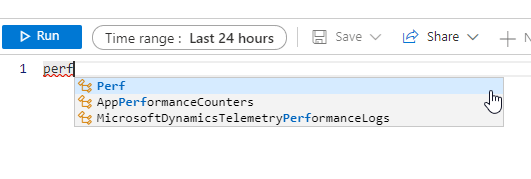
Hamish shows some sample items, and I noted that to query a table, you just include the name. The query window in Azure has intellisense, and I used Hamish’ example to look at perf data.

2021-12-22 14_38_36-Logs - Microsoft Azure

The structure of queries is that you choose a table, then you can add a pipe (|) and add a where clause or other structures. I glanced at the cheat sheet, but really I played around a bit.

For example, I saw in the demo there was a “take” option, so I tried this:

Perf
| take 6

This gave me six results, so it’s like a TOP clause in T-SQL.

2021-12-22 14_42_19-Logs - Microsoft Azure

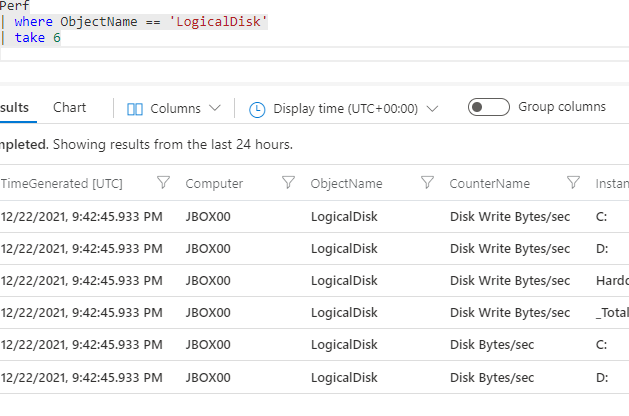
Next, I tried a WHERE. This is also structured as a line after a pipe. I picked a value I saw and then ran the query.

2021-12-22 14_45_03-Logs - Microsoft Azure

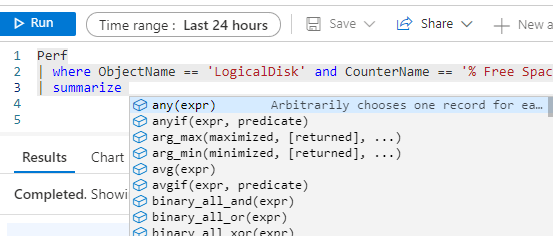
I noticed there was a summarize option, so I tried entering this. What I liked was that I had some intellisense options to help me with the various aggregates.

2021-12-22 14_46_15-Logs - Microsoft Azure

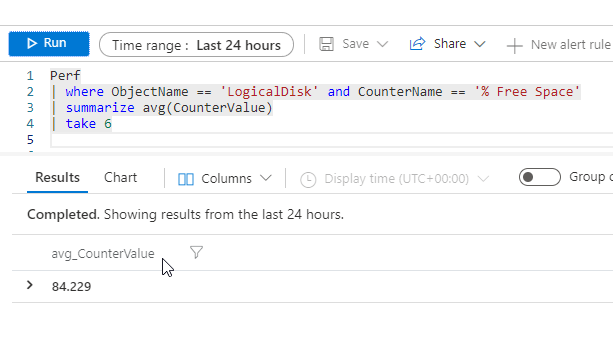
I ran this query, and got an average of the free space across all disks.

2021-12-22 14_47_04-Logs - Microsoft Azure

That isn’t a number that really means anything. I tried GROUP BY in a few ways, but eventually had to look at the cheat sheet to see just “by” is needed. I ended up with this query to get space by disk.

2021-12-22 14_48_54-Logs - Microsoft Azure

In some ways, I found KQL to be easier to work with than SQL. It’s cleaner, and logically follows what I’d do when writing a query. I build this in a way similar to how the query is executed, which is unlike how SQL works.

I don’t know if KQL is going to be that important to me, but I will play around with it a bit more.

Posted in Blog | Tagged , | 8 Comments