Tag: security

  • Maybe Security is Harder than Rocket Science

    I was giving a talk last year about software development and I made an off-hand remark that most of developers out there shouldn’t be writing authentication schemes for applications. My reasoning was that most people aren’t good at writing these systems and there are plenty of good authentication schemes already written that you can incorporate into a system.

    However there are some bad ones as well. While I hope you don’t pick any of them, I also know that many of you might just build a poorly architected system because your focus isn’t on authentication. Your focus is on some other aspect of your application. I’m sure you know some of the good advice for building systems, as well as the best ways to handle passwords, but do you follow it? Under deadlines? When you have pressure to focus on more important aspects of your system? Or do you implement anti-patterns because it’s easy?

    The European Space Agency (ESA) is full of rocket scientists. Literally, as they send rockets and astronauts into orbit around the earth. However they were hacked recently and the disclosures aren’t pretty. They not only had personal information released, but passwords were stored in plain text. What’s worse, 39% of the passwords were three letters.

    Three.

    I’m sure many of the people working on ESA systems were smart individuals, and they may be great web developers that build beautiful, useful sites. However their security programming is extremely poor, and really, there’s no excuse. Not even the pressure of scientists that want simple, easy logins.

    It’s 2016. No short passwords, no limitations on complexity such as preventing special characters (one site recently didn’t allow a “,” for me), and no storage in a reversible format. There are lots of best practices, but they require some effort to learn, understand, and implement, as well as modification over time to keep up with changing guidelines.

    Or, as I suggested, just stop implementing this yourself. Use some authentication scheme that’s been shown to work well with few vulnerabilities.

    Steve Jones

    The Voice of the DBA Podcast

    Listen to the MP3 Audio ( 2.6MB) podcast or subscribe to the feed at iTunes and LibSyn.

  • Training at the Top

    Many of us see flaws and problems in the way that we code securely as we build software, as well as the way in which our infrastructure security is configured. There have been no shortage of times in my career when I, or a coworker, wondered why our company didn’t work to implement better security in its systems.

    Perhaps it wasn’t us. Perhaps it’s not a lack of desire, but maybe it was due to a lack of knowledge. I ran across a piece in Enterprise Security that notes we should have security training starting at the top, with our C-level executives. Far too many of them don’t necessarily understand the threats or nature of the threats because many of these threats didn’t exist 20, or even 10, years ago. Often we have management that has never faced these kinds of vulnerabilities.

    I think there’s certainly room for most of us to learn more about security, especially database security and SQL Injection as these are fundamental issues around some of our most important assets: our data. However when we want to implement stronger security, or limit access, we need the support of management, who themselves need to understand the issues, not just respond to whoever makes the best case, or complaints the loudest.

    The world has changed, in that our valuable assets can be transferred to our competitors, or common criminals, and we aren’t away of the disclosure. Or perhaps worse, our enemies could change some data and we might never know without the ability to perform comprehensive audits of our systems, something many of us might not be able to do. We certainly need technical capabilities, but also the time and support from management.

    I think there is a good case to ask our management make an effort to understand cybersecurity, and I’d urge you to pass this link along to your management.

    Steve Jones

    The Voice of the DBA Podcast

    Listen to the MP3 Audio ( 2.3MB) podcast or subscribe to the feed at iTunes and LibSyn. feed


  • Security Convenience

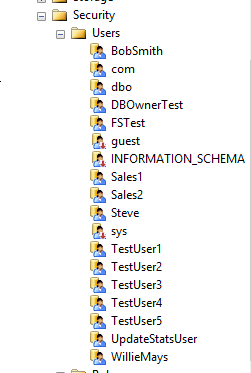
    I wrote a question of the day recently that seemed to catch many people. The question had to do with mapping users when a login isn’t specified in the call. The behavior is to auto match existing logins with the same name. About 60% of the people answering the next day got it right, but a third missed it, expecting an error to be thrown.

    One of the commenters was surprised that more people didn’t know this. I’d hope people knew this, though to be fair, I bet lots of people manage security through SSMS or a GUI and never write security code. I know I did for years early on. However I really think that the third of the people that got this wrong in its behavior, are actually right about how SQL Server security should work.

    We do not want ambiguity when we configure security. We should be sure that rights granted (or removed) are exactly those that we expect. A strong security system should not tolerate any unexpected behaviors.

    Security should require specificity.

    Steve Jones

    The Voice of the DBA Podcast

    Listen to the MP3 Audio ( 1.6MB) podcast or subscribe to the feed at iTunes and LibSyn.

  • Hacking to Hide

    It’s probably no surprise to you that the black boxes for ships are vulnerable to hacking. These are the Voyage Data Recorders (VDR) that should capture telemetry, audio recordings, and more. These devices are really computers now, connected to the onboard networks used for satellite communications and physically accessible in many vessels.

    It was surprising to hear that some of these VDRs are running Windows XP. While I get that there is some ease of development in using Window systems, that OS wasn’t what I’d call robust and stable for stressful and rugged environments. Some systems use real time OSes, which seems like a better compromise, but Linux might be the best choice for a system both tolerant to a variety of conditions as well as one that might be easy to build applications for.

    However no matter what the choice, I’d hope that the developers building software for these systems would treat them with the importance they deserve. While lives aren’t at stake from these applications, liability is. These systems are used in legal proceedings, so the data they collect, in an autonomous fashion, should be protected to ensure its integrity.

    Apparently that doesn’t happen, as there are incidents of these devices being hacked an data erased, corrupted, interrupted, or even accessed by those on the ships. That’s not surprising as it seems people always find ways to take advantage of the computer systems they physically control. Ultimately I’d hope that we might constantly transmit some of this data off the ship to ensure there are backup copies, but that brings to mind the problems of securing data in transit, preventing access or disclosure and more.

    However these systems might provide a good testbed for researchers looking to better build and architect auditing systems. This is a challenging environment, with high stakes, and if we can develop ways to ensure auditing data is intact when we have lost physical control of the device for long periods of time, perhaps we can find ways to build this same auditing into other platforms.

    Steve Jones

    The Voice of the DBA Podcast

    Listen to the MP3 Audio ( 2.4MB) podcast or subscribe to the feed at iTunes and LibSyn. feed