
Another post for me that is simple and hopefully serves as an example for people trying to get blogging as #SQLNewBloggers.
I saw a question recently about querying an XML document. Certainly avoid this in the database if you can, but there are times you need to. Rather than link to the post, I wanted to show the basics of how you query a node.
Let’s suppose I have an XML document like this:
<Order>
<OrderID>4FB9</OrderID>
<ORderDate>2019-07-20-00.31.23.000000</ORderDate>
<Status>Open</Status>
<Customer>
<CustomerName Type=”Individual”>
<FirstName>Jon</FirstName>
<LastName>Doe</LastName>
</CustomerName>
</Customer>
<Customer Type = “Company”>
<CustomerName>
<CompanyName>Acme</CompanyName>
<Account>12345</Account>
</CustomerName>
</Customer>
</Order>
Now, I saw someone query this with code like this to get the OrderID.
DECLARE @xml XML;
SET @xml = N’
<Order>
<OrderID>4FB9</OrderID>
<ORderDate>2019-07-20-00.31.23.000000</ORderDate>
<Status>Open</Status>
<Customer>
<CustomerName Type=”Individual”>
<FirstName>Jon</FirstName>
<LastName>Doe</LastName>
</CustomerName>
</Customer>
<Customer Type = “Company”>
<CustomerName>
<CompanyName>Acme</CompanyName>
<Account>12345</Account>
</CustomerName>
</Customer>
</Order>
‘;
SELECT
t.b.value(‘(ORDERID)[1]’, ‘NVARCHAR(100)’) AS MSGID
FROM
@xml.nodes(‘/Order’) t(b);
This doesn’t work.
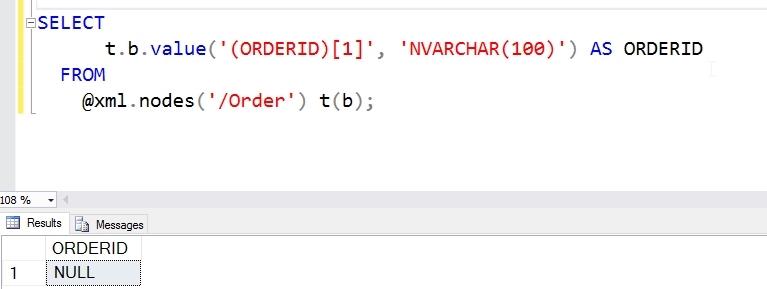
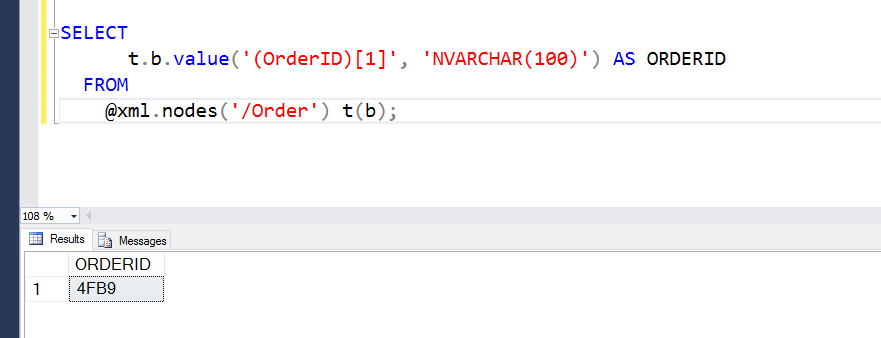
The reason this doesn’t work is that XML is case sensitive. Meaning ORDERID != OrderID. The former is in the query, the latter in the XML document. If I change the query, this works (note I have OrderID below).
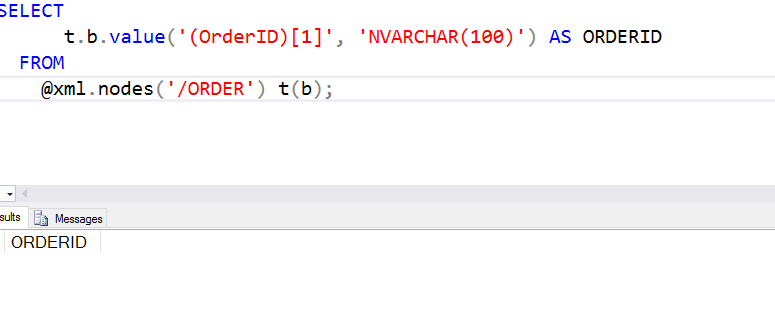
This would also apply to the .Nodes call. If I had .ORDER, this also wouldn’t work.
The @xml.nodes() call determines the root at which I’ve essentially set the document. I could have this as /Order/Customer if I wanted. In that case, I couldn’t access the OrderID. The OrderID isn’t below the Customer node.
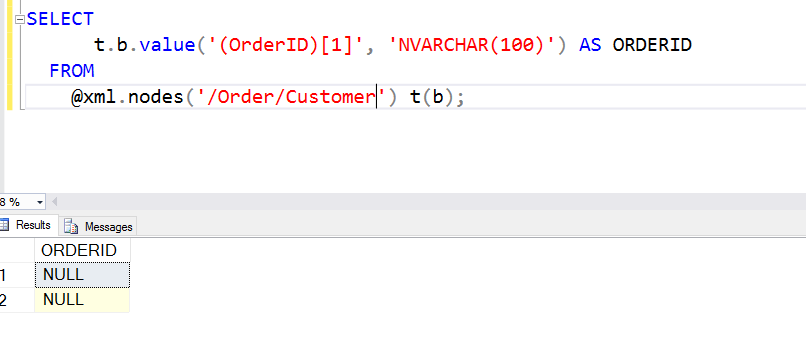
However, from below Customer, I can get to the names.
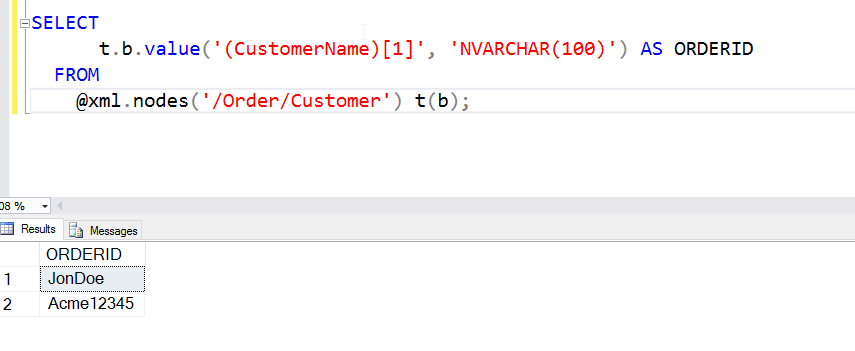
There is a lot more to know about XML, but you can experiment with the various nesting levels by including different paths. I’ll show a few more things in another post.
SQLNewBlogger
Querying XML is hard, and can be frustrating as the document size grows and complexity grows. However, this is a good way to showcase your skills (or build them), but tackling different query questions or challenges and writing about them.
Hint: this will also help solidify your XML skills.




 Voice of the DBA