
Over the years I’ve had no shortage of licensing questions for SQL Server. At times it’s felt a little crazy. Look at the licensing guide. Choose EE or SE and the number of cores. Then check if you’re using VMs. Oh, and consider the cloud, and which cloud you’re running a workload on.
It’s simple right?
It can seem confusing, and at times I’ve wished Microsoft would make it simpler. And perhaps even give us some add-ons, like adding some additional hardware capabilities (cough more RAM *cough) in SE.
Then I run into something like the introduction to Oracle licensing. This is one of the smaller guides on a site devoted to Oracle licensing. There are numerous articles on there, with lots of information, perhaps too much, to help anyone get a handle on this process. There are even companies (one, two) built around helping you manage Oracle licenses.
There’s a core factor table, where you need to figure out how to adjust your “license cost” based on the CPU. That’s after you pick the edition, and likely before you go into the other features you might need. I’m guessing this is why a lot of people might just pay for the Unlimited license and stop worrying. I think this is also why Oracle is still such a huge company and worth billions (or trillions?) of dollars.
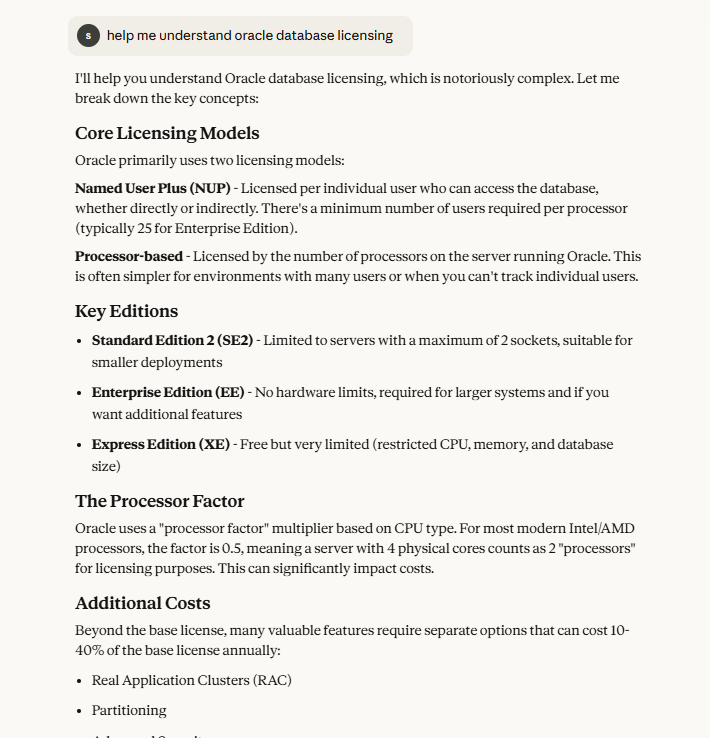
I actually asked Claude to help me with Oracle licensing. I got these (partial) results, which talks about the different core licensing, editions, and then other costs. As I ask for more details in any area, this gets very complex and confusing. While some of the rules for SQL Server can be confusing, and certainly the HA and virtualization guidelines sometimes leave something to be desired, overall, I find things simple.
I like simple.
Over the years, many software companies have made licensing more complex and confusing to customers. Often this results in more profit for them without much benefit for the purchaser. Not all vendors do this, but Oracle certainly has created a complexity that spawned a whole business model for a few companies. SQL Server licensing is simpler, and I’ve learned to appreciate that.
Steve Jones
Listen to the podcast at Libsyn, Spotify, or iTunes.
Note, podcasts are only available for a limited time online.




 Voice of the DBA
Its as if the licensing system is intentionally constructed to coerce clients to the “Get it all” version so they do not have to fear missing something. Vega Casinos use psychology to manipulate guests and this reminds me of that. The problem is so long as also viable software options follow the same principle the customer has no choice.
I’ve worked in Prop Mgt for 30+ years and the reason why commercial leases are so complex in comparison to residential is due to both sides trying to get one up on the other. A possible renter demands compensation ( a deduction in the rental) for XYZ and so the landlord finds some new means to recoup that loss. This has gone on back and forth so long that commercial leases are literally absurd monstrosities where in the end, when netted out, neither side got that one up over the other they just made the whole thing overly complicated trying to do so. I can’t help but wonder if something similar caused enterprise software licensing to follow a similar path. In the software licensing its not about trying to avoid paying for some part you don’t use and so then the software vendor decides to piece meal sale the product (at a higher cost when the individual parts are summed up to represent the whole) but how to create a situation of such complexity that the customer just gives in to avoid hassles later on.
LikeLike
I should write about it, but it’s really an economist trying to capture all value. Or more value.
a long time ago people started looking at pricing. Movies are a great example. I can set the cost of a ticket at $10. I make $1000 a day (100 people). However, if I sell kids tickets at $5, maybe I lose some revenue ($10 tickets now $5), but perhaps I get more people to come. A parent brings 2 kids and a partner instead of one parent/one kid. $30 vs $20. Maybe I sell daytime tickets for less and get more people coming and overall revenue increases. I’m trying to more closely match demand.
That works in some places, but there are also costs. Car dealers realized the bundles are more efficient for them to build and manage, so they don’t make every option al la carte, they put them in bundles and keep trying to upsell you bundles. Want heated seats, get bundle 2A, which has safety features and this special cheap-to-us-but-pricey-to-you chrome trim. They end up trying to move people along a spectrum of limited choices, but with enough of an attraction to get you to spend more.
LikeLiked by 1 person
I’m Not opposed toe optimized pricing but to models designed to coerce the customer towards what the vendor wants and not what the customer needs. While its less effective today thanks to smart phones, prior to that many relied on wall clocks (or similar) to know the time and casinos removed many of these and made it so you can’t see the outside from the gambling areas so people would have a harder time of realizing just how late it was and thus would stay and play leaving only once broke or wiling to cut their losses. I’m also concerned as to where this leads up next which I fear is live dynamic pricing; where each month 2 different customers with the same product configuration are paying a different subscription rate simply because the vendor can extract more form customer than the other. The negotiation model works fine with assets for purchase but it gets very sketchy when moving into areas where you aren’t buying anything but renting. In property mgt a very popular 2rd party that provides daily dynamic pricing to its customers the prop mgt companies) just went thru a serious law suit by the Feds b/c what they were doing was sketchy. Pop Mgt companies changing leasing prices isn’t new but the way its being done thru this 3rd party was.
I know contract’s are signed for services like Ofice365 so MS can’t change u the pricing every month if they believe they can extract more $$ but I believe this pricing structure is still optimized for the vendor and not the customer. Plane flights now charge premiums for what passengers generally consider better seats. DO you want to see movie theatres do this too so as to further optimize their pricing? How about if software services like Office365 increase or decrease pricing for these same set of services based on which servers you use, the ones in the US or overseas somewhere? It just concerns me where this is headed next.
LikeLike