The On-Call Load

For most of us working in technology, I think we understand that if something is broken we might need to work. Not that we have to, or we need to, but we might need to. Perhaps you feel differently, or your company approaches on-call in another way. If so, let me know today how you deal with staff being on-call.

In my career, there are jobs with formal on-call, informal on-call, or even no on-call. In the latter situation, there isn’t anyone who is prepared to handle issues outside of normal working hours, but that doesn’t mean if management calls you can ignore them. It’s that the organization didn’t expect issues. I worked in a small company (< 50 people), where we primarily had systems for people who worked in the office, and nothing was running at night (outside of backups). Normally no one knew if there was an issue overnight or on weekends, but I did get called by the owner when he went in one weekend and couldn’t receive a fax on our computer system. So I guess I was the emergency-on-call person.

In both large and small companies, I’ve had formal on-call situations where humans or automated systems would know I was assigned as the person to contact for issues. These might be 24-hour periods, weeks, or even a month at a time. In informal situations, usually, there was a list of technical people’s contact information and anyone needing help would just pick one and call, often based on who they thought could solve the problem.

For most of my career, being on-call hasn’t been a large burden. I’ve been interrupted during some events, dinners, or holidays, but relatively rarely. My wife and I have felt it wasn’t too burdensome, especially given compensation and other flexibility. At the same time, there have been some places where on-call is a disruption to my life. Usually, I’ve tried to leave those positions as quickly as I could, though that might take months.

I always ask about on-call responsibilities when I interview for positions. It’s not that the answer is a deciding factor, but it is a factor. If on-call is more demanding, I would ask for something in return: perhaps comp time, more salary, or some other flexibility.

What is your on-call situation? Is that acceptable to you? Have you never been called outside of working hours? Let me know today.

Steve Jones

Listen to the podcast at Libsyn, Spotify, or iTunes.
Posted in Editorial | Tagged | Comments Off on The On-Call Load

A New Word: mcfeely

mcfeely – adj. inexplicably moved by predictable and well-worn sentiments, even if they are trite or obvious or being broadcast blindly to the masses.

I get mcfeely all the time. Recently I was listening to A Beautiful Life, from a movie by the same name. It’s a simple song, simple lyrics, but it creates a lot of emotion in me. It brings back memories of finding out my wife was pregnant with my daughter, of the early years when I put her to bed and read stories, of when she grew up and moved away for college.

Music often does this for me, as do movies/television or even a well written passage in a book. It could be joy, sadness, anger, or anything else. I enjoy the emotion of the situations I’ve escaped into.

From the Dictionary of Obscure Sorrows

Posted in Blog | Tagged , | Comments Off on A New Word: mcfeely

Deleting Stale Local Database Git Branches with SSMS–#SQLNewBlogger

I wrote a post recently about pruning branches in git. That’s part of the job, but the other part is removing local branches. This post looks at one way to do that in a semi-manual fashion.

This could be automated, but it took seconds, so I did a quick manual thing. I’ll work on an automated way, but since I do this rarely, manual is fine for me.

Another post for me that is simple and hopefully serves as an example for people trying to get blogging as #SQLNewBloggers. You can see all posts on Git as well.

Getting a List of Branches to Delete

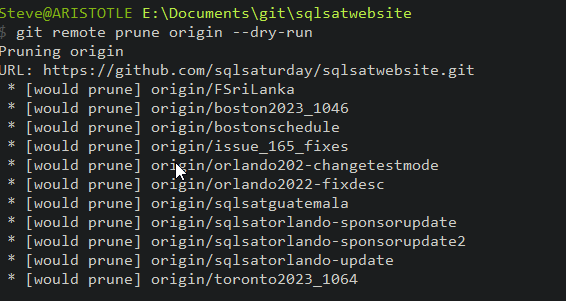
In the last post I showed how to get a list of branches with dry run. This was the image I showed of branches. If I re-run that without the dry run, the branches are removed.

2024-04-11 10_51_57-cmd

The output is similar, but either set of output works. Once we have a list of branches, what do we do? Let’s use SSMS to help.

SSMS Makes This Easy

If I highlight the results of my git prune, I can copy/paste those into SSMS. You can see below I’ve done this, and then held the ALT+Shift key to select a bunch of text in a box. This is all the text apart from the branch names.

2024-04-11 10_54_39-SQLQuery4.sql - not connected_ - Microsoft SQL Server Management Studio

Once I’ve done this, I can let go of those keys and type “git branch –d “, which will replace the text on every line. You can see this below.

2024-04-11 10_54_52-SQLQuery4.sql - not connected_ - Microsoft SQL Server Management Studio

This is a great technique, and while it works in VSCode and some other editors, I usually have SSMS open and it works very well here. I then select all this text, paste it back into the CMD window, accept the note that this is a multi-line paste, and all my deletes run.

2024-04-11 10_55_27-cmd

Voila, all remote branches deleted are removed from my local git install. A few of these were already removed manually as I experimented.

SQL New Blogger

As I mentioned in the previous post, version control skills (especially git) are core for most technology pros. DBA, developers, sysadmin, anyone working with modern software development or administration likely needs to know about version control.

This post was about 10 minutes. You could write this in 15 and showcase your tech skills to a future employer.

Posted in Blog | Tagged , , , | Comments Off on Deleting Stale Local Database Git Branches with SSMS–#SQLNewBlogger

Action Over Knowledge

I saw a quote recently that resonated with me. It’s not something I’ve often struggled with, but I have at times. Here’s the quote:

“Life rewards action, not intelligence. Many brilliant people talk themselves out of getting started, and being smart doesn’t help very much without the courage to act. You can’t win if you’re not in the game.” – @JamesClear

Part of my goals in life are to help others and motivate them to engage in life and drive themselves forward. I have tried to motivate my children, I work with kids I coach to grow and change, and I (think) write about this often here. I want you to take charge of your career and life and drive it forward in the way that works for you.

However, you have to work at things. The quote above notes that it’s not how smart you are, but having success in life comes from action. From doing something. From making efforts. The last part is the most important, if you don’t engage and become part of your game, your life, you can’t win or achieve your goals.

As Ferris Bueller said, life can move pretty and you can miss it if you’re not paying attention. As I get older, that means more to me. Life slips by, days, weeks, months, even years seem to fly by. Especially after the pandemic, where I see someone and realize it hasn’t been a year or two since I’ve seen them but four years.

You don’t have to be extremely driven and type A. I think I might be a little too driven at times, living in chaos, but I met someone recently who spent more than 5 years trying to transform a company. This individual worked their job, spent nights and weekends trying to learn more about their business, and drove themselves and others well beyond what I’d consider a balance in life. They were working well over 60 hours a week for years, as were some employees. I don’t think that’s a great way to live, and whether it’s work, hobbies, or something else, forgetting to balance the various parts of your life isn’t good.

At the same time, inaction, not trying to grow, learn, practice, or even attempt something new in any part of your life isn’t good either.

Work on your career and skills but balance that with the time you need away from work. Invest in your education to change careers if you like, but don’t plan on working what is essentially two jobs to become a way of life. At least not for too many years. Enjoy your hobbies, but remember there is family at home that deserves and needs your time as well. Find ways to engage in life, but in a way that respects all the commitments to work, family, friends, faith, hobbies, and yourself. Especially don’t forget about taking care of yourself.

Effort is often more important than the short-term results. Just being engaged and in the game gives you a chance of success, but more, it allows you to enjoy the ride. Just do so in a balanced way.

Steve Jones

Listen to the podcast at Libsyn, Spotify, or iTunes.

Posted in Editorial | Tagged , | Comments Off on Action Over Knowledge