A New Word: Rubatosis

rubatosis– n. the unsettling awareness of your own heartbeat, whose tenuous muscular throbbing feels less like a metronome than a nervous ditty your heart is tapping to itself, as if you casually remind the outside world, I’m here, I’m here.

I practice yoga, breathing, and often my heart and breath are calm. My resting heart rate is about 51bpm across the last year. In general, even during some exercise, I don’t think or hear my heart.

However.

There are times when it’s pounding, and at weird times. I might wake up, and my heart isn’t racing, with the rate still in the 70s, but I can literally hear the pounding in my ears. I can feel it in my chest, like it’s letting me know that it’s there.

It’s rubatosis and it’s annoying at night since the noise sometimes stops me from falling back asleep quickly.

From the Dictionary of Obscure Sorrows

Posted in Blog | Tagged , | Comments Off on A New Word: Rubatosis

An Experimental Mindset

I wrote a post about Git recently since I’ve found far too many people who didn’t know Git well (or at all) and they seemed hesitant to experiment and learn.

Is this because of being too busy? Do we have so many people who are working in tech where “it’s just a job” and not because they enjoy technology? Or has management in too many places beaten people down to the point they don’t want to try things? Perhaps your coworkers are resistant to change (or lazy) and you don’t want to discuss new ideas with them.

In working with software and databases, I marvel at all the ways in which we can mold and change the system to match the creative ideas we come up with. I’m pleasantly surprised when someone solves the same problem I do, but in a very different way. Even using the same language/tools/frameworks, we can often come up with a variety of solutions that work well. I think we teach each other something when we compare disparate solutions.

When I was learning about computers, we were encouraged to experiment. Those who were willing to try things and learn from them were often more excited by the task, and I think these were often those who went on to successful careers. I’ve found the people who don’t like to experiment or try something new, even when there is no risk, are often limited in both their accomplishments and opportunities.

I don’t expect those who enjoy experimenting with technology to work more than others. I’d prefer that everyone have a balanced life that separates time at work from personal time, and limits the investment in your skills to a reasonable level. Live and enjoy your life outside of technology, but when you do work, make an effort to do your best work, while working to improve what “best” is for you.

Try something new this week. Solve a problem, use a new tool, read about new technology, and write a little code. It’s good for you.

Steve Jones

Listen to the podcast at Libsyn, Spotify, or iTunes.

Posted in Editorial | Tagged | Comments Off on An Experimental Mindset

SQL Compare Force Column Order in a Table

I had a client that was concerned about SQL Compare behavior when a developer adds a column to the middle of a table. I wanted to reassure them, so I wrote this post to show how SQL Compare behaves by default.

This is part of a series of posts on SQL Compare

Making a Table Change

Let’s assume I have this table in a database:

CREATE TABLE [dbo].[Product]
(
[ProductID] [int] NOT NULL,
[ProductName] [varchar] (50) NULL,
[ProductDesc] [varchar] (1000) NULL,
[ProductSize] [char] (1) NULL,
[ProductWeight] [int] NULL,
[ProductColor] [varchar] (20) NULL,
[StatusID] [int] NULL
)
GO

I want to add a column to this table, called ProductQtyPerUnit. However, I decide to add this before that StatusID column so all my product data is together.

Note: This shouldn’t be done. Don’t worry about order of columns. Deal with that in your INSERT/SELECT statements instead.

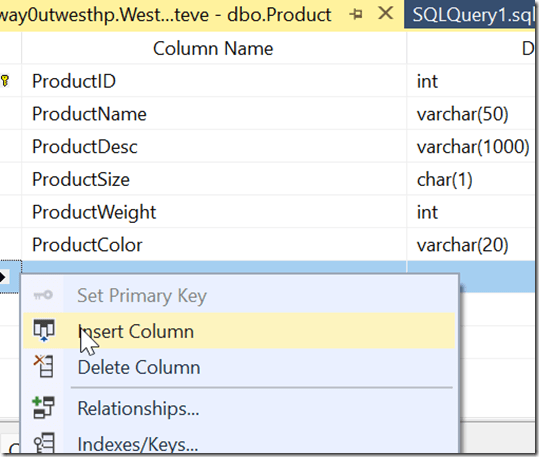
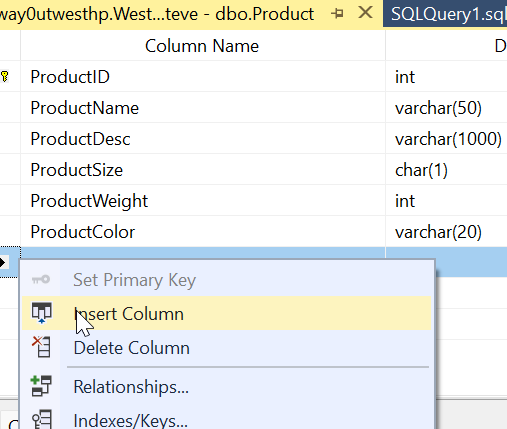
If I do this in the SSMS designer, I’ll right click the table and select INSERT Column.
2024-03-12 12_23_15

Then I can add the column, as appropriate to my table.
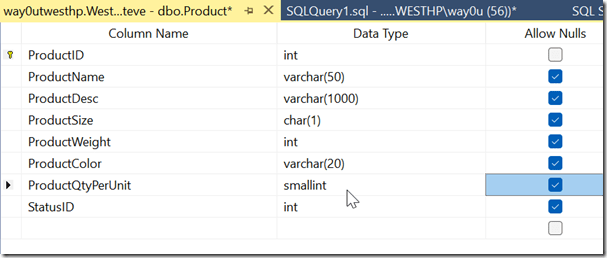
2024-03-12 12_24_54

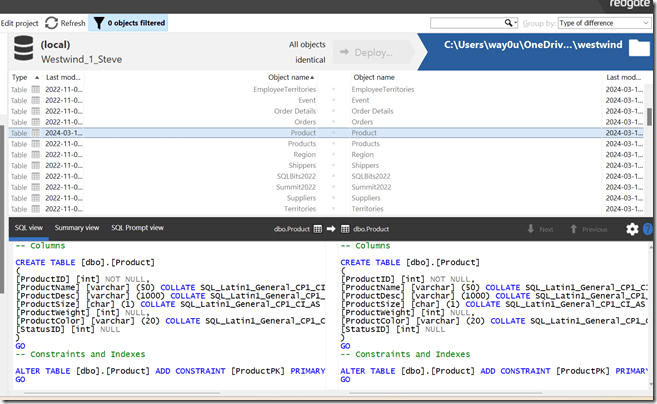
Before I save this, I’ll create a scripts folder and compare things. As you can see, things are in synch.
2024-03-14 13_10_46

Now I’ll save the change.

SQL Compare Behavior

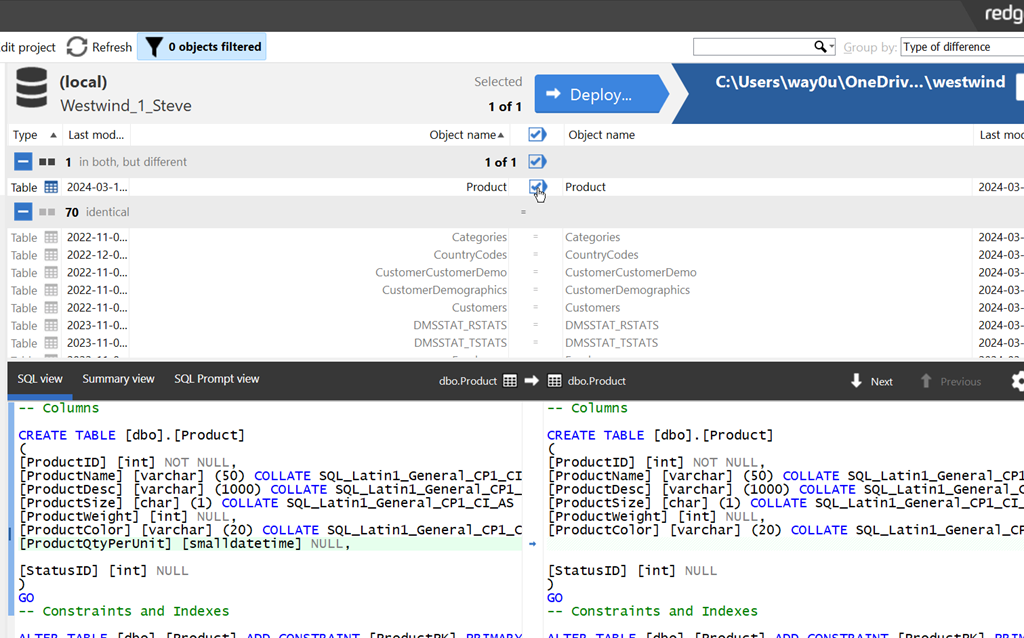
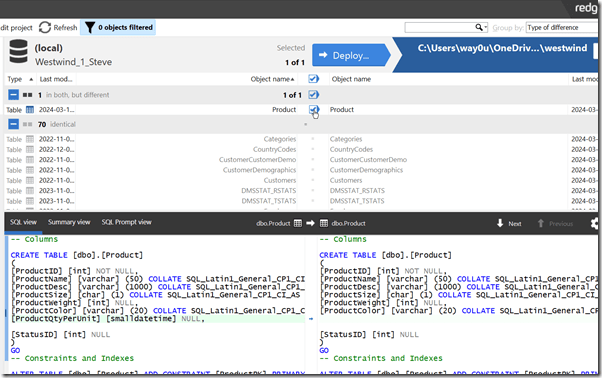
Now I’ll refresh my project. When I do that, I see a difference, as I should. Note that SQL Compare detects the change, and shows the new column in the middle of the table.
2024-03-14 13_12_56

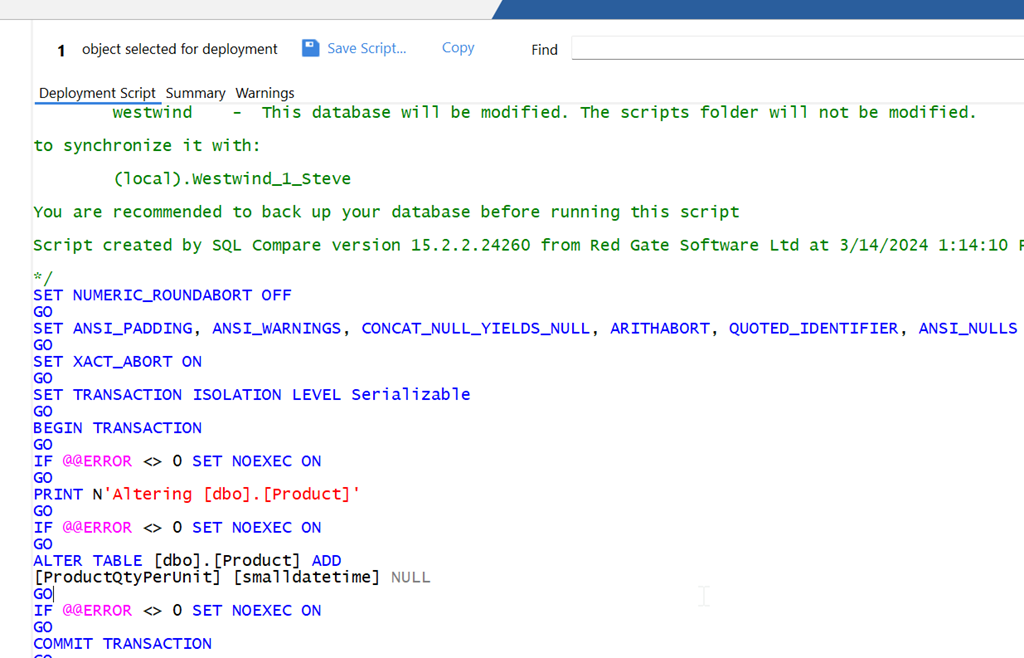
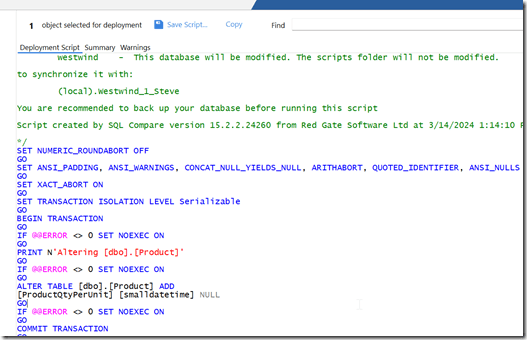
I’ll click Deploy and generate the deployment script. When I do that, I see the script below. Note that SQL Compare has just added a column, not rebuilt the table.
2024-03-14 13_14_21

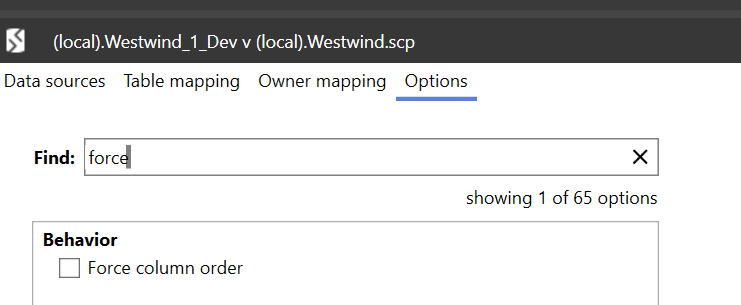
This is controlled by the Force Column Order option, which is off by default. This is the way we’d like to have the tool behave, as rebuilding tables is unnecessary.

I’ll close this dialog and then click Edit Project and select the options tab. I can search for Force and see the option is off.
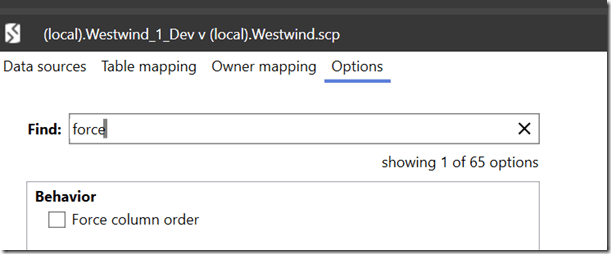
2024-03-14 13_15_32

to show how this works, I’ll check the checkbox and then recompare. Now when I generate the deployment script, I see this. The deployment wizard opens to this warning.

2024-03-14 13_16_30

If I view this script, you can see below that this part of the script creates a new table and then renames it after data is moved and the old table dropped.
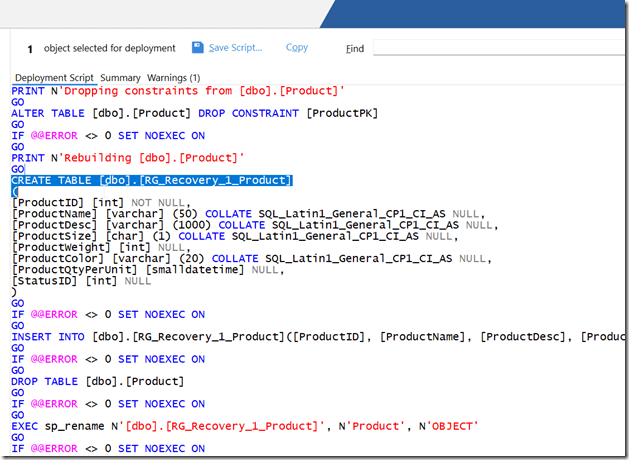
2024-03-14 13_17_13

In general, you should leave this option off all the time. The physical order of columns doesn’t matter.

If you haven’t used SQL Compare from Redgate, it’s the industry standard for SQL Server schema comparison and an amazing tool. Download an eval today and give it a try.

Posted in Blog | Tagged , , | 2 Comments

Re-platforming

Re-platforming is the process of moving a system to a new platform. Imagine taking an ASP.NET/SQL Server website and moving to Azure Functions on Azure SQL Database. Or maybe taking a Java client/server app with Oracle and moving it to a series of microservices against MongoDB. Those changes could be a net benefit to your organization in the end, but they aren’t quick or easy. They’re often fraught with various challenges that can cause a lot of stress while creeping over budget.

There’s a post that talks about some of the things you might think about if you embark upon a re-platform. Often this takes place when an organization is looking to modernize their tech stack. Quite a few of the technology DevOps success stories take place when the older structures are not maintainable, but also not able to handle increased workloads or performance requirements.

It’s often said that a complete rewrite rarely makes sense. I think that’s likely true, but that doesn’t mean it isn’t something you should do. It says that you should rarely do it, and you need to pick a good time when your old application, database, network, or some combination of these can no longer meet your anticipated future growth demands. This is likely a debate that your organization should have every year or two and ensure that continued investment in the current platform makes more sense than a new one.

Once you decide to move forward, it will be a journey, which means understanding how new and old systems will interact becomes important. Compatibility, at least for some time, is very important. I’d say this is especially critical for how your data systems will work together and what options you have to replicate/ETL/etc. the data between systems.

Even if you plan to make a cutover from one system to another, data migration is fraught with issues. Anyone trying to ensure data moves cleanly from one place to the next should have strong checks, usually with automated tests, that evaluate if your data is moving correctly. Row counts aren’t enough, or not the only metric. Random checks of individual rows, as well as checks for outliers, should be a regular part of any project that will migrate data. Learn where you struggle to correctly transform data because there will be places where this happens.

I don’t believe that wholesale re-platforming often makes sense. Leaving SQL Server to go to another database platform, or even when you might try to change the paradigm with NoSQL or a Data Lakehouse, often costs a lot. Getting a return after staff training, migration costs, and even delays from inefficiencies during the process often equals many years of licensing. I think slow migrations are a better idea, perhaps adding something like ElasticSearch or Redis, experimenting with a small data lakehouse for a particular purpose, and replicating some data to Neo4J for complex hierarchy queries. These evolving mechanisms give you the chance to experiment and learn about the process. It will help you understand if there is a positive ROI if you continue.

In many ways the world of technology changes slowly. We have lots of new shiny toys, but many of them don’t magically solve your problems. There are always tradeoffs and without strong domain knowledge, you may have more unknown unknowns that reduce your chances of success. Re-platforming can work, but make the decision carefully and proceed methodically, not with haste.

Steve Jones

Listen to the podcast at Libsyn, Spotify, or iTunes.

Posted in Editorial | Tagged | 1 Comment