Daily Coping 11 Feb 2022

I started to add a daily coping tip to the SQLServerCentral newsletter and to the Community Circle, which is helping me deal with the issues in the world. I’m adding my responses for each day here. All my coping tips are under this tag.

Today’s tip is to thank someone for cheering you up in the last month.

Someone didn’t actually cheer me up. Well, certainly some people did, but it was more the memory of someone made me smile and brought a moment of joy. Actually, two people.

I’ve been to Australia twice and New Zealand once. Recently my wife and I were talking about the trip we took together down there, how much we enjoyed it, and some of the people she met (I’d known them previously). The memory of standing next to this guy made me smile:

20190608_090133_HDR

Hamish’s joy and love for life is infectious, and I miss him. I am hoping New Zealand will allow visitors again and I can return.

The same week, Martin Catherall reached out on another matter, and my wife and I enjoyed time with him in Australia. Martin also has an infectious, happy demeanor, and a wonderful accent, that I enjoy every time we talk. Hoping to get back to Australia again as well.

Thanks to both of them for cheering my up this month.

Posted in Blog | Tagged , , | Comments Off on Daily Coping 11 Feb 2022

Daily Coping 10 Feb 2022

I started to add a daily coping tip to the SQLServerCentral newsletter and to the Community Circle, which is helping me deal with the issues in the world. I’m adding my responses for each day here. All my coping tips are under this tag.

Today’s tip is to share what you are feeling with someone you really trust.

This is tough for me. I tend to be a little closed off and private in many ways, but I’ve learned to open up a bit. Part of this is growth, part is being a good partner, part is modeling what I hope my kids to better than me.

My wife is my partner. In many ways, she is the only person I “choose” in my life that is a constant. I didn’t choose my parents, I didn’t choose my kids, and I certainly don’t get to choose co-workers. I choose friends, but there often isn’t quite the same closeness.

I won’t share my feelings here, but I have been working to let my wife know more often when I am feeling when I feel it. It’s that last part I can struggle with. I brood, I think, I over-analyze.

I’m not a stream-of-consciousness talked, but I am learning to do that more often. It’s been a 2 decade plus long journey that I continue today.

Posted in Blog | Tagged , , | Comments Off on Daily Coping 10 Feb 2022

Daily Coping 10 Mar 2022

I started to add a daily coping tip to the SQLServerCentral newsletter and to the Community Circle, which is helping me deal with the issues in the world. I’m adding my responses for each day here. All my coping tips are under this tag.

Today’s tip is to notice 3 new things today.

I was trying to get ahead on a few tips before my trip to the UK this week, but I wanted to save this one for the journey. I’ve flown to London perhaps 50 times, but I made an effort to notice new things on this trip (I also set reminders in my calendar).

Thing 1

When I transit through Heathrow, I am always entranced by the size of the A380 planes there. Usually there are 2-3 at T2 that I walk past. I’m not a big plan fan, but these things are massive.

When I went through Monday, the Thai Airlines A380 was replaced by a “normal” plane.

20220307_105607

Thing 2

The legendary Heathrow lines are back, at least I noticed them. I arrived at Heathrow at about 11am, well, that was the time after the long walk from the end of T2. When I got there, I saw this:

20220307_110312

The back and forth lines here at the T2 border were longer than I expected. I’ve often tried to land after 10am, which used to be a quieter time. The 7-9am flights packed this space. However, today they were worse. I actually got directed to walk past down the hall to wrap around and walk right back. This was to manage the lines.

The line actually went back towards the flight connection area, wrapping back and forth and then through this spot to the e-gates and agents. My guess was that at the time I arrived and got into a line, there were 1,000 people here.

I noticed a couple things. First, lots of griping. Typically I’ve been able to get through in 10 minutes, or less with the Trusted Traveler program. I have heard people lightly complaining in the past about a line, but today quite a few people were expressing their displeasure. A couple people complained about having to walk down the hall and back to create a new orderly queue, and a few about the number of people and the few e-gates available.

My apologies as these were mostly ugly Americans. What’s crazy is I think the US lines in some places, like Chicago, are as bad or worse.

In any case, I was able to transit through in about 45 minutes, this despite a few people around me saying they’d been there an hour, which I don’t believe.

The second thing is that the line was almost always moving. I was trying to maneuver with a sprained wrist, get something out of my bag and take off a second shirt (it gets warm there). I had few chances to actually stop long enough to remove my shirt. People were processed very quickly through the border, fast enough to keep the line moving.

Thing 3

An annoying thing. I was (painfully) aware of how often people stop walking with their bags to look or check something, and how closely people stand in a queue (line).

Every time I quickly change directions, or someone bumps my roller while I’m holding it, my wrist flares with a little pain. I try not to use it for pulling my bag, but I needed to do it a few times.

I tried not to use that arm, but sometimes I needed to. The other shoulder was wearing out. In lines for planes, or border patrol, I was bumped numerous times. While trying to navigate airports, as someone that walks medium speed (not too fast or leisurely), I bet people stopped in the flow of walkers 10 times between Denver, Dulles, and Heathrow, forcing me to quickly swerve around them or stop.

I try to be conscious of others, and if I need to look, step out of the way. I had to do that when I got out of the plane and was dragging the bag with the bad hand. I waited until there was a space I could stop and switch without preventing anyone else from walking past.

I also realized I need a 4 wheel spinner. I have really liked my roller bag, but the weight of that and my laptop bag is getting a bit much. Or I’m getting old.

Posted in Blog | Tagged , , | Comments Off on Daily Coping 10 Mar 2022

OLTP Star, Snowflake, and Galaxy Schemas

This is part of a series on my preparation for the DP-900 exam. This is the Microsoft Azure Data Fundamentals, part of a number of certification paths. You can read various posts I’ve created as part of this learning experience.

There are types of schemas the exist in data warehouses. This topic is definitely on the exam.

OLTP/Relational

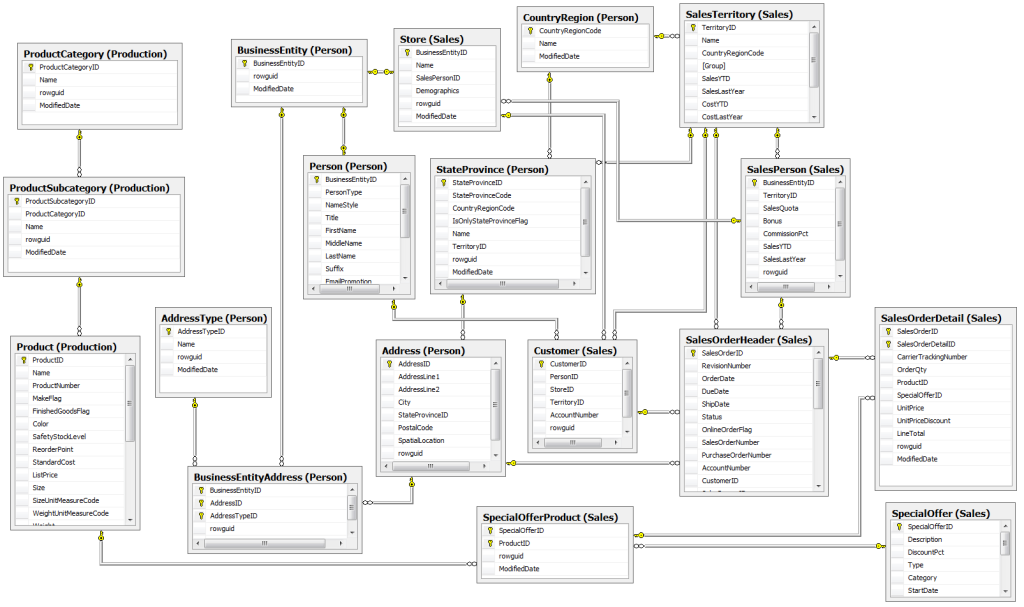
The type of schema that many of us work with is the standard OLTP or relational model. We have lots of transaction tables, most should have a PK, some of which have PKs. The schema expands to meet different needs and can have lots of entities.

As an example, here is a view of the AdventureWorks database.

adw_er

This isn’t fundamentally different from the schema types below, but there isn’t a central, or two central, tables here. Instead, we have a lot of different groups of tables. The structure is designed for normalization, and usually has lots of tables compared to a data warehouse.

Star

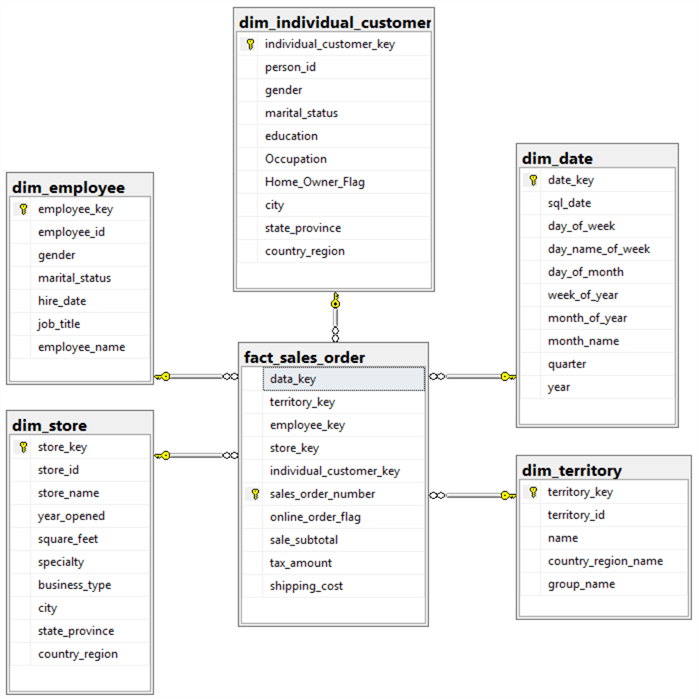
The star schema is often used in data warehouses. The name comes from the fact that the table arrangement looks similar to a star. There is a central fact table, which has some details of the main data, often something like sales, and a lot of foreign keys (FK).  The fact_sales_order is the fact table below.

Then there are supporting tables around the fact table, linked by the FKs. These are the dimension tables, and contain details about a specific dimension or area. In the image below, we have date, employee, store, and other dimensions tables.

5690_create-star-schema-data-model-using-microsoft-toolset.028

This is a somewhat de-normalized structure, as the primary purpose is to report on a set of facts.

Snowflake

This schema builds on the star schema. Here there is still one fact table (Sales below), but the dimension tables have their own dimension tables, providing more details. Essentially, the dimension tables are normalized. An example is the Employee dimension, which has a linked Department dimension.

Capture-163

Galaxy

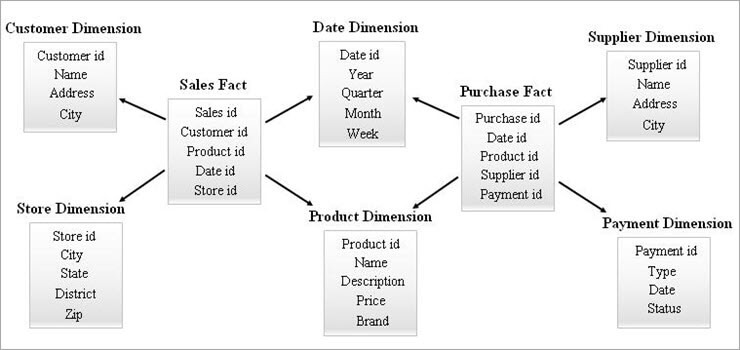
The galaxy schema expands with a second fact table. In the image below, we have the sales and purchase as fact tables. There are dimension tables, which can be linked to one or more fact tables.

Galaxy-Schema

It isn’t that important you know how to build these schemas or design the entities for the DP-900 exam, but you do need to recognize the structures.

Posted in Blog | Tagged , , | Comments Off on OLTP Star, Snowflake, and Galaxy Schemas