The Book of Redgate: Taking Breaks

We work hard at Redgate, though with a good work-life balance. One interesting observation for me (as an American) is how well most of the company in the UK works normal hours and rarely works outside of those.

However, sometimes we do find people, especially engineers, heads down and very focused. With our engineers in the office a day or two a week, they might end up coding in a group and trying to solve a challenging issue.

We used to have engineers working more than 8 hours regularly, often late, when they were in the office. I came across this page in the Book of Redgate.

2026-04_0229

The text below is: Working too hard? Why not relax with a gentle game of ping-pong.

Our offices have always had some game tables. I don’t think we have ping pong in the new office, but we have a pool table near the coffee machines and I’ll see people taking a few minutes to play a game at different times. We also (I think) still have a foosball table.

We have a piano upstairs, and some guitars in the foyer. I usually take a few minutes between meetings and strum some songs. Here’s the view I have most days when I’m in the office, a few minutes at a time.

20260121_094507

We’re not afraid of resistant to working hard. We just try to take breaks and find balance.

I have a copy of the Book of Redgate from 2010. This was a book we produced internally about the company after 10 years in existence. At that time, I’d been there for about 3 years, and it was interesting to learn a some things about the company. This series of posts looks back at the Book of Redgate 15 years later.
Posted in Blog | Tagged , , | 1 Comment

Funny Money: #SQLNewBlogger

While wandering around the documentation looking for some Question of the Day topics, I learned something new about the money data type. This post discusses what I learned.

Another post for me that is simple and hopefully serves as an example for people trying to get blogging as #SQLNewBloggers.

The Money Type

Did you know that you can add a currency symbol to the money data type for assignment? I didn’t. This isn’t in the documentation, but it’s something I need to submit as a PR.

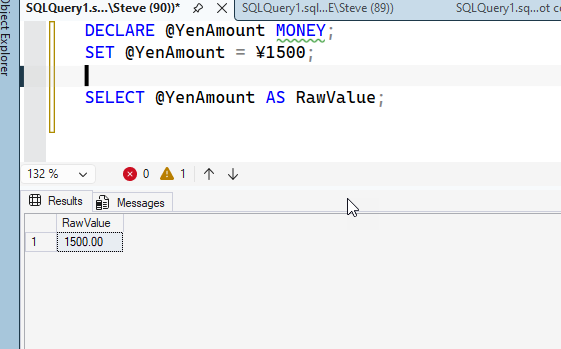
In any case, I can assign money like this:

DECLARE @YenAmount MONEY;
SET @YenAmount = ¥1500; 

SELECT @YenAmount AS RawValue; 

Note that this isn’t really assigning Yen values. It’s just a number, but since the money type supports certain literals, this works. If I select the amount, I get just a number.

2026-05_0087

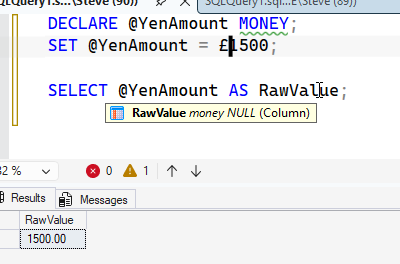
If I change the symbol, it still works because SQL Server doesn’t really interpret the amount and symbol or the variable name. That being said, this is bad code.

2026-05_0089

The money and smallmoney data type page lists the symbols you can use, but none of them are stored. Where this page fails is that it doesn’t help you get the values back out as the currency.

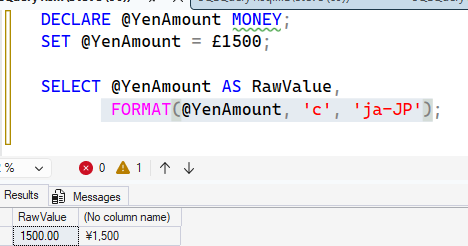
Format helps here. I can use this with some culture to determine what I want to get out. For example, I get Yen with this:

 FORMAT(@YenAmount, 'c', 'ja-JP')

You can see the results here:

2026-05_0090

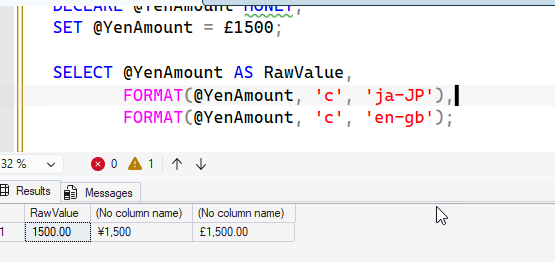
I can also get Pounds.

2026-05_0091

SQL New Blogger

This post took me about 5 minutes to assemble as I’d already had the code, but it’s an example of a quick thing based on other work I was doing.

You can showcase this and help others see that you are learning and growing.

Posted in Blog | Tagged , , | Leave a comment

Un-Migrating From the Cloud: T-SQL Tuesday #199

This month we have a very interesting invitation from Koen Verbeeck. He has hosted once before, and agreed to help me out this month by tackling another topic. We’ve shared a few beers in the EU, though not in some time, so I hopefully will get the chance to buy him a pint and thank him for this month’s invite.

He was inspired by another friend, Alexander Avidsson, who wrote about skills and the cloud, but with an interesting take. This month’s invite is about moving back on-premises from the cloud, which is something I’ve had a few customers do, or start doing. Nothing is quick when migrating systems, either to or from the cloud.

Here’s my take.

How Easy Is It To Un-Migrate?

I decided on a fun title here, since so many people talk about migrating to the cloud. Is going back on-premises an un-migration? Or a re-migration? Just a migration? I won’t worry about the semantics.

I work with a lot of different customers at Redgate Software. Whether they are discussing development topics (Prompt/Toolbelt), deployment issues (Flyway), production stuff (Monitor) or compliance (all of the above + TDM), I find that most of them are still rooted in an on-premises mindset. Even when they’ve migrated to the cloud, it’s often lift-and-shift, with VMs running in AWS/Azure/GCP. In that sense, they still tend to manage things in an on-premises way.

They’re more comfortable with those skills and more confused by cloud auth systems, still. In 2026.

I think that’s still the norm and it’s easy to think that most people work in the cloud all the time. Some do, and I think most people have some familiarity with one of the major cloud systems, but I would expect that lots of people would love to come back on-premises.

Is it easy? No. It’s another migration, and while you might find it easy to re-provision hardware (whether purchased or rented from another provider like Rackspace) there are still major data movement challenges in the db world. How do I sync systems? Can I get log backups? What type of quiescing and cutover is there?

The tech stuff, matching versions, etc. is likely easy. After all, most of us don’t use the latest and greatest functions from SQL Server, so moving back to on-premises likely just works. If you are in the IaaS world, this is simple, other than the latency of copying data down (and explaining the egress charges).

I actually think customers might gain some efficiencies from moving systems with known workloads and costs back on-premises. Especially those that create lots of tickets for DBAs or developers. Any time spent moving back will come back in the skills that so many have with on-premises systems.

The one downside I think might cause some issues is HA. It’s easy in the cloud, and hard on-premises. Those are skills that some people likely need to brush up on if they don’t have a significant HA footprint with VMs.

Posted in Blog | Tagged , , , | Leave a comment

Would You Retire Rather Than …

Bjarne Stroustrup is the creator of C++. I read a few of his books and alternately loved what he’d done with the language and hated having to write C++ code in university and at a few jobs. I found it tedious and hard, though arguably better than C once you had a decent set of classes structured. BTW, I love his website, the basic text view of the world, which is how I have built a few sites on my own.

I caught an interview with him and this short response on AI and coding. He had this quote: “Senior developers are already retiring rather than deal with it.” He doesn’t love the results from AI, which is fine. And it’s not what I want to talk about today.

The idea that senior developers, presumably like Mr. Stroustrup, would rather retire than work on codebases that are being changed by AI is interesting. I suspect that in some problem domains, you might hate AI code and not want to deal with it, but would you retire? Is that the answer?

I have known some IT people who retired because they didn’t like their jobs. My wife left tech because it was too stressful, but it wasn’t an easy decision. She’s questioned it a few times, but she had a passion for something else and wanted a new job. I think that in both cases, someone moved towards something rather than away from something. They had another thing they wanted to do in their lives.

I wonder how many of you would really retire or leave your job because you don’t like the work. Most people I know who don’t like the work are looking for something else to do until they retire. I would be sad to hear about someone who is hanging on to a bad job until they retire, especially if retirement isn’t coming soon (like the next 2-3 years). I would also hate to think that some people see AI as making their job so un-enjoyable that they decide to retire earlier than they expected.

I do have a good friend who was close to retiring in his early 60s. He decided it was too soon and took another job after his previous employer was sold and closed their local office. He’s spent a little over a year working remotely and he doesn’t like it. He’s going to retire this year because he doesn’t like the job and doesn’t want to look for a new one. He is close enough to retiring that he’s looking to the future doing less and finding a way to enjoy life without work.

AI might force some people out of the industry, but I think it’s more likely that there are other factors, like a poor work environment, bad management, or some other factor. However, if you disagree, let me know. If you would stop working because you don’t want to deal with data or technology, let me know. As always, if you don’t want to post publicly, message me and I’ll post something anonymously for you.

Steve Jones

Listen to the podcast at Libsyn, Spotify, or iTunes.

Note, podcasts are only available for a limited time online.

Posted in Blog | Tagged | 5 Comments