Tag: software

  • Migrating from EverNote to Joplin

    Recently I got a message that my Evernote subscription was going up. It’s been a $3 a month service, but moving to $4 for me. From USD$35 to USD$50 a year. Not a big change, but a little annoying to me. I have a few reasons, outlined below, but this post is mainly describing the process of moving my data.

    Setting up Joplin is easy. You download the app, install it, and then (optionally) connect it to Dropbox, where it adds itself as an app in the /apps folder.

    Export and Import

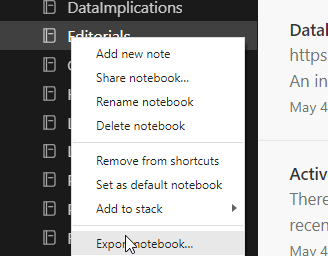
    I can easily export a notebook in Evernote to their ENEX format. I do this by right clicking a notebook and selecting Export notebook.
    2023-05-09 09_14_45-Editorials - Evernote

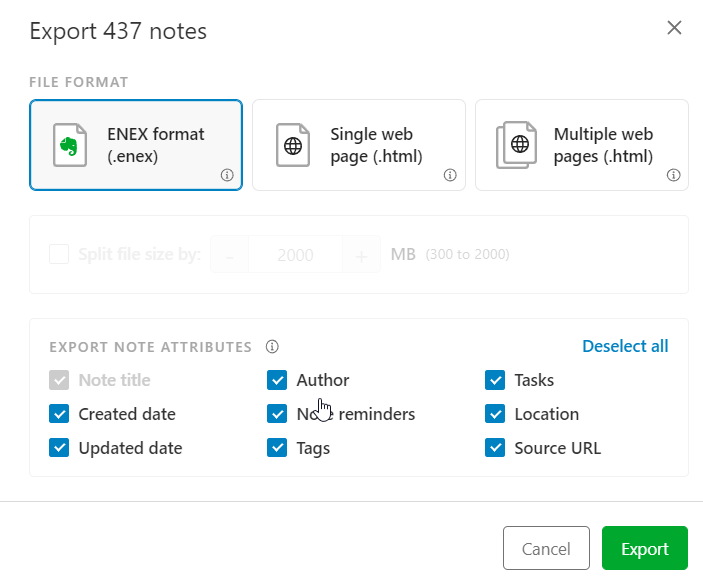
    This asks me how to store the output. I get a single file, pick a name/location and this creates a file.
    2023-05-09 09_15_09-Editorials - Evernote

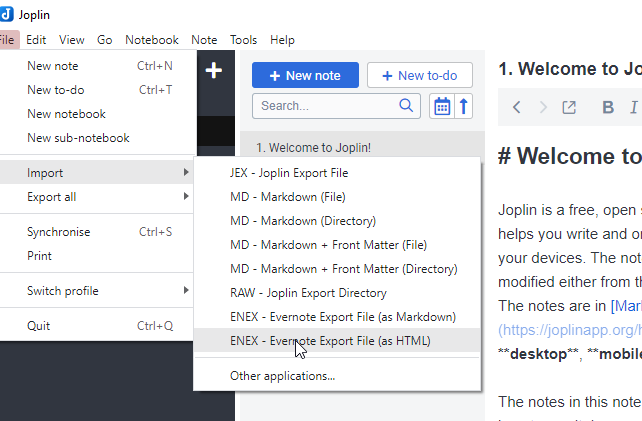
    Once this is done, in the Joplin desktop app, I have a few choices. I pick ENEX and then the type, select the file, and things import.
    2023-05-09 08_49_14-Joplin

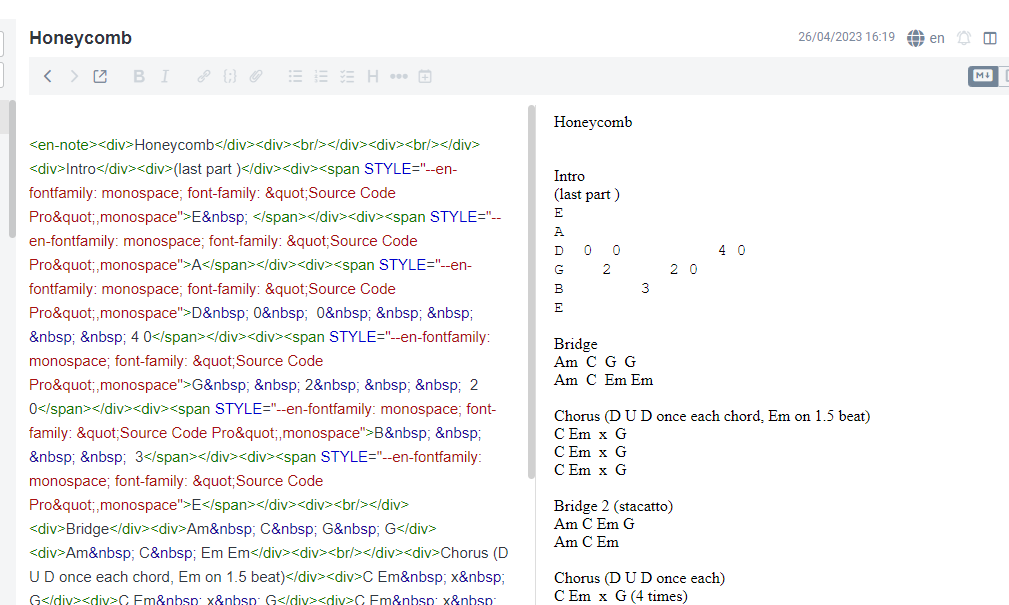
    I tried HTML, but got a mess.

    2023-05-09 08_49_51-Joplin

    If I could edit in the right pane, this would be OK, but I have to edit in the source pane, which is annoying. I know HTML, but don’t want to write in it.

    Instead, I picked markdown, which gives me a better view.

    2023-05-09 08_50_57-Joplin

    I have perhaps a few thousand notes, but really only about 12 notebooks. Since I can export 12 times and import 12 times, this is easy.

    I then have all my notes in a new app, where I can sync them between desktop, mobile, and the iPad in the kitchen.

    Note I’ll spend a couple weeks working in Joplin and see what I think.

    Why Leave Evernote?

    Evernote has continued to expand their capabilities, which I get. As a software service, they want to keep growing and attracting more customers and providing more features.

    However, for me, I want to simply take notes. I almost never include images, web clips, etc. Instead, I like simple text and quick software. I want to make notes and save them, syncing across devices. To me, I need a glorified way of capturing text files and moving them between machines.

    While Evernote has worked well, they’ve done some things that make this less ergonomic for me. Specifically:

    • They add a div tag that notes this item was clipboard’d, which is perpetually annoying. I also copy/paste often as this is my writing tool and they add some markup in HTML, which I then have to remove.
    • New notes mean I have to select if this is a note, a task, or something. One extra, very, very annoying click.
    • Their navigation options are clunky and slow on mobile/tablet.
    • Their UX has me constantly clicking from the top to the bottom to the top of the screen.
    • They’ve become more chatty, and single-threaded with more lags. Something I find annoying.

    They have also deprecated the Plus subscription, which is simple.

    I decided to try Joplin, which I found in this PC Mag article. Joplin is an open source app, and if I keep using it, I’ll donate some money to the developer. I don’t mind paying for software, but I need something simple.

    If this doesn’t work, I have other options. I might just create a private GH repo and use folders to organize text files. That’s about what I need.

    I can also renew Evernote for a year and kick the can and hope they don’t try to force me into the $12/mo subscription.

    I know lots of people love OneNote, but I find it overkill and too annoying.

  • Cloud First Software

    Watching the evolution of SQL Server and the Azure SQL Database (ASD) variant has been interesting across the last decade. For a long time, ASD felt crippled compared to the on-premises product. The last few years, however, it seems that ASD is getting features first, which then slip into a release that I can download and run locally. It’s a cloud-first database now, even though there isn’t parity with both products.

    In my career, I’ve worked with a number of platforms in production environments. One of those is Db2, though that’s often felt like a legacy platform. I’ve rarely seen users starting new projects on Db2, though they might add some new databases, especially on AS/400, mainframe, or Linux platforms. I never thought Db2 was less capable than other choices, but I just don’t see it used very often.

    There’s an article that notes IBM is moving to a cloud-first version of Db2, where there will be a cloud version coming first, then “traditional” releases. I assume this means a model similar to ASD and SQL Server, which makes sense. It’s much quicker to develop and deploy to the cloud, and test things behind feature flags with a limited audience. Those items that work well can then be bundled up for a versioned release on-premises.

    I don’t know that I think Db2 will gain a lot of market share beyond what it has with this announcement, but it does make me think this is the model that a lot of companies will adopt if they even sell software for download. Most companies seem to want to move to a SaaS (software as a service) model where they can “rent” you access to code rather than deal with the struggles of supporting an install on your machine with who-knows-what configuration.

    I get why this is attractive to companies. I also get the struggles of consumers. For some things, sure, I’ll rent access. Music makes sense. Some software makes sense, but others worry me. Already I can see that companies that control the data, and its format, might be poor choices for consumers. If I don’t like your software, can I still get whatever data I have stored with you? Is there any way to port this to another system?

    I don’t want to see regulations deciding how data and software should be implemented, but I would like to see some contract requirements with consumers that ensure the ability to leave a platform. Companies ought to be required to provide a way to extract out data into a common format, allowing me to move my pictures, tax data, sales records, health data, etc. to a new provider if I choose.

    This is often easy to do in databases, and many people know how to extract data. The harder problem becomes when higher-level vendors, those building applications, want to use proprietary formats. I don’t mind that, but I do mind not being able to extract my data if I choose.

    Steve Jones

    Listen to the podcast at Libsyn, Stitcher, Spotify, or iTunes.

  • The Digital World Remaking the Analog One

    I got a taxi at Heathrow in the UK recently to go from one terminal to the other. I know, there are buses and trains, but it was late, I had my wife with a lot of luggage and I was worried the restaurant in the hotel would close before we managed another method of transport. As we were making our way over the driver noted there was a £5 charge to drop off at a terminal. That sounds silly, but I saw a billboard noting this and there is a link that this charge applies to almost all vehicles entering the airport terminal areas.

    You might agree or disagree with the charge, or concern yourself with whether the airport authority or local government can (or should) add this as a little tax to those that drive to terminals. That isn’t my focus today. Instead, I thought this was a somewhat amazing, DevOps experiment of how the digital world is remaking the real, analog one.

    Making this decision in the past would require a lot of infrastructure, some gates, people to man them or automated systems to take payment. In this new world there cameras needed, and software that must be built, but this can also re-use payments systems online and take advantage of computing power to assess this charge. The costs might even be lower as the government might absorb some of the camera cost and maintenance as a part of their security concerns.

    Maybe more importantly, adjusting the charge or eliminating this is a decision and a small software or data change. We can remake the way the world works without much effort at all, similar to how we might remake the digital one when we change code. The world of software is only limited by the imagination of developers. That seems to be bleeding into the physical one.

    I find more and more places where software is changing and affecting the physical world. We saw digital menus replace physical ones during the pandemic. While some places have returned to physical ones, others have used hardware tablets to not only present menus, but take orders and payment. In a recent trip to the UK, many places allow complete self service where a patron enters a table number and someone brings their order without any other interaction. I don’t know I think this is better, but it is changing the way the physical world works.

    It’s not just payments and charges, but there are more and more places where software helps manage traffic flows (people or vehicles) without infrastructure. Just directions that people follow, and perhaps get fined when they don’t. I see live translations of text changing the need for producing signage in multiple languages.

    There are plenty of examples, especially as AI/ML systems can help adjust our interactions in the physical world with less hands-on coding from human developers. Something that becomes more important as we are struggling to find developer talent in the modern world.

    Whether you like this or not, the world is changing. We might not like it, and we might try to convince others to build software we prefer, but we will be interacting with software more in ways that change how we interact with the physical world.

    Steve Jones

    Listen to the podcast at Libsyn, Stitcher, Spotify, or iTunes.

  • What’s Important to Your Organization

    I’ve had the chance to work in a number of organizations in my career. Every one of these places needed to run a network and software applications to support the business. Most of them also built a portion of the software they used, with some applications being purchased. No matter how much software they built, whether it was a lot or a little, there was always a need to manage a software lifecycle. Whether you build or buy software, you will have new applications, patches for existing systems, and the retirement of others over time.

    While every organization recognized the value of software, some saw this as an expense, like salaries or buildings. The funds needed for computing the “cost of doing business.” In organizations that felt this way, there was always a focus on controlling or reducing costs, doing just what needed to be done, and being efficient with how computing was used. These organizations seemed to be stodgy and traditional, with management focused more on the analog world than the digital one. Some were quite successful, which I often think is a combination of good management, good staff, and luck.

    These days, I think that view the software is an expense is less and less successful in many industries. Over time, this view will see a deterioration in the success of those businesses compare to competitors that treat software differently. It might be a slow decline over decades or a more rapid one in a few years. I truly believe in software eating the world, and every company needs to be a technology company. They don’t all need to build software, but they do need to manage it, and more importantly, take advantage of software to better run their businesses.

    We see this in all kinds of industries. Perhaps it’s highly visible in the automotive industry these days, but in plenty of others, from finance to insurance to retail to manufacturing, the use of software as a strategic asset improves the competitiveness of business. Even in government, organizations are finding that making better use of software allows them to offer more services at a lower cost.

    I wonder how many of you see your employers treating software as a strategic part of their business model. Do they aim to increase profits or become more efficient or even innovate in their industry with the power of modern computing? Or is it just a tool that they depend on, and consider the cost of doing business? If your group isn’t seen as strategic, likely they don’t value your work as highly, don’t provide training, and don’t create opportunity or innovation that ensures your work is interesting. If those are things that matter to you, perhaps it is time to look around for other employment.

    Steve Jones