
I’ve been struggling with an author for a few months. I tried to work throughs some issues, and I couldn’t get anywhere. This was very frustrating, and I spoke with a few people in the company. They were sympathic, without many ideas. Eventually I vented a bit on Twitter (initial, another update, there are a bunch of other daily updates). I was mostly trying to get feedback on whether I was behaving appropriately.
I’ve had suggestions from people, developers have gotten involved to build some tools, and this has been quite a journey going back to March. I’ll give a little history at the bottom, but first, I little of why I’m in this spot.
Abuse
On a daily basis, I clean out my queue, ban account(s), and try to work around the issues. I mainly do this so that I can see and work with other authors and continue to run my site. This feels like some sort of attempt at denial-of-service, though since this just clogs my editing queue, I’m not being denied. It also feels a little abusive and stalker-ish.
In a very light way, it reminds me of the stories I’ve heard from women and minorities about being abused or stalked online. This isn’t anywhere near the stress and angst that I’ve had friends go through, but it’s a little glimpse of that.
I’m powerless here in many ways. If this person wants to continue to submit things with new accounts, I can’t stop them. Any suggestion of changing things up creates different work for me, not necessarily less.
This is a hole in the freedom of the Internet. It’s also one that I don’t know how to close, but I do think that understanding this is important. If nothing else, it helps me appreciate just how much accessibility matters for some people (life, career, etc.) and how that is impacted by bad behavior.
I could call this person out, but so far, I’m working on
Patience
I think what’s going on borders on abuse, and is certainly trolling. However, as Andy Leonard pointed out, and something I believe in, I don’t know the other side of the story.
Apart from my learning something, as I noted above, I also don’t quite understand what or why the person is doing this. I go into some of this below, but I’ve had little communication, and no real complaints. I don’t know if they are confused by a language barrier, but I don’t think so. I also don’t know.
I don’t know if I committed some affront and they are seething with rage. I don’t know this is justified, but again, I don’t know.
I certainly don’t know if this person had some personal tragedy, lots a job, relationship split, illness or death in the family, or even a mental breakdown. I’m unsure of the view from the other side.
So, to date, I haven’t outed the author. I’ve tried to contact people that might know them, and I have sent some emails.
At this point, I’m along for the ride, to grow and learn about myself as much as anything else.
The Long Story
This is long, so if you don’t have time and a beverage, come back later.
As an example, on 16 Jun, I removed 8 submissions from my queue. These were from 2 new accounts created in the last 14 hours. I looked later in the day and 5 more were added, with a new account. A few hours later, as I was knocking off, another new account and 3 more submissions.
That’s thrice he’s submitted in 24 hours, and that has happened multiple days.
This story starts in February 2021. This author submitted a couple articles. The titles were a bit strange in English, and the writing wasn’t well organized or flowing. Lots of grammar and phrasing issues, which is fine. I deal with non-native English speakers all the time. I saw on the article for a week or two, trying to decide what comments to give.
My normal process is to add comments inline and return the piece to the author through our WordPress engine. I set the status to reviewed, the author gets an email, and if the go into the article, they see my comments in red.
Awhile later, the author resubmitted the two articles (a and b), with comments removed, but very little changed. I responded with some comments, noting that there were still issues. Since I sometimes go through 4-5 drafts, I wasn’t concerned. I also changed the title of one, as the name didn’t make sense to me.
A few weeks later, I got the same articles submitted. Comments removed, and as far as I can tell, the original text I’d rejected. Title changed back. I sent an email asking them to rewrite based on comments and not to resubmit them.
No response to email.
I set the articles back to draft for the author, but reappeared. I deleted them, thinking the author might take a hint. He (I think) restored them and resubmitted them.
At this point, we’re into March, and I’m a little annoyed. I get an email response. I am somewhat confused.

I set them back to draft, and send another email. I come in a day or two later to find not only articles a and b, but also c, d, e, f, g submitted. These are technical pieces, all in a similar style and somewhat related to each other, but not well written. The flow doesn’t explain itself, there is an opening titled “Question” in each, but without a question. Merely statements. There isn’t enough detail.
I drop a comment in all of these (copy paste) that these need to be rewritten, and the comments I add to one apply to all. I comment on some of the structural changes in one and refer the author to a forum to ask for help from others in proofreading. We have a lot of community people willing to help. I include this in an email as well.
I come in the next day, with all articles moved from pending review –> draft –> submitted, multiple times. I get notifications for some of these, as this helps me manage a queue, but I have 8 articles submitted, about 24-32 emails, and they are all in the status from the previous day. Original text, comments removed.
I play this game for a few days, just marking all these articles as needing review to remove them from my working queue. Each day they come back. I’m somewhat unsure of what to do.
I spend about a week trying to work around them in my queue, but it’s distracting and annoying to me. Finally, I permanently delete these items, change the user’s password, and alter his email. I am expecting an angry email to myself or the webmaster.
A few days later, I get an email. As Grant would say, I’m gobsmacked.
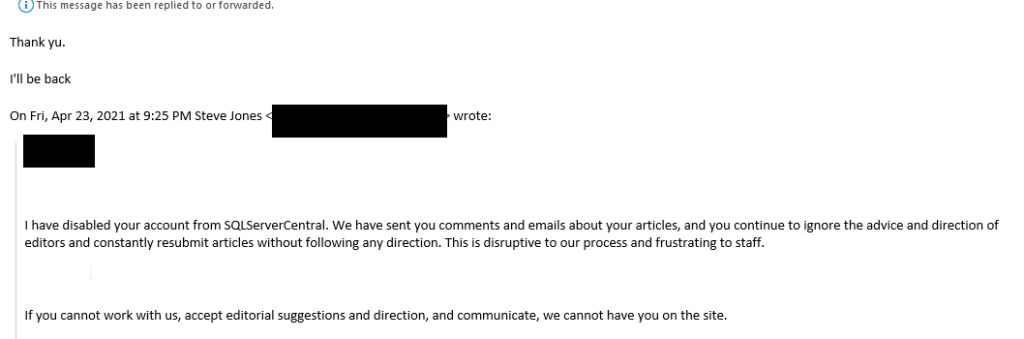
A week or so later, I get the same 8 articles submitted under a new account. We didn’t have great tools for stopping an author in April. Original text, original titles.
I play this game for a few weeks, and it’s usually a few days after I delete the articles and mess with the account before I see new copies submitted. Some registrations are with the +xcvxvcx after the user name, some are at a new domain (free provider). I send a couple emails, but no responses, so I stop trying.
Finally, I vent on Twitter. I get some suggestions, and I engage developers that are coming off some internal projects. They add some tooling to ban a user and some reg-ex filters to stop new accounts with the same name. So far I’ve been getting variations on a name. I won’t use the real one, but this is the idea.
- jdoe33 (original)
- jdoe033
- j33doe
- jdoe_33
- etc.
Each of these gets banned when I see them. After a few days of nothing, all of a sudden the process repeats, with more creativity in the user names.
We add a ban using regex to the email addresses, which were similar variations, but a +33, _303, +3333, etc. after the user name. Now we get more creative email addresses and user names.
Developers don’t know whether to laugh, scream, or cry. I don’t either.
A few people suggested banning the IP. I get infrastructure involved and we do this, but it’s a mobile provider in another country. I hate to ban the /16, but we might do that.
I’m trying to roll with the punches, but we’re in June here. I do some daily Twitter updates, mostly to cope and keep a sense of humor. The author gets banned daily, and I drop the articles into a “limbo” status, which moves them out of queue and doesn’t notify the author.
They sometimes create 4, 5, 6 accounts a day and add more copies of the same 8 articles. My limbo queue for a few weeks in June is at 158.
I’ve reached out to a few people in the author’s country. I contacted them to see if they know this person. I saw a similar name at a few SQL Saturdays in the past, and at SQL Bits (not accepted, no session presented). I had someone try to mediate, but the contact info they had bounced. The information I found from events show a deleted twitter account and a blog URL that’s invalid.
I don’t know what has happened to this person, or really, what the motivation is. I hate to out this person, as I don’t know exactly who it is, if they’re really a presenter/speaker, or if this is some crazy misunderstanding of some sort.
Right now, it’s a surreal situation.
I wonder how it will end.



 Voice of the DBA