Tag: health

  • Using ThinOptics to Read Data

    As I’ve aged, I find myself struggling to read many things in my life. It started with difficulties seeing menus, but moved on to other areas. During the pandemic, I was coaching kids and taking stats. I realized at one point I couldn’t tell if I’d made 3 or 4 marks on the page to represent some action.

    Soon after, I got some reading glasses and started wearing them to do certain things. Over time, I’ve found that I needed these more and more for all sorts of computer work.

    I’ve actually ended up purchasing a few pairs and stashing them in various coats, bags, and cars. I’ve liked these slim ones with a hard case the best, but I still sometimes forget them, especially in the summer when I don’t wear a coat.

    Recently, I realized that I am struggling to read the labels in grocery stores, where I often run inside and forget my readers in the car. After we had a good laugh, my wife realized that I am a bit frustrated with my eyes and the inability to consume data in my daily life.

    ThinOptics

    My wife has taken pity on me, and decided to help me. She got me a pair of ThinOptics, which are in a case that sticks to my phone. You can see what I got in the mail below:

    These are flexible bodies that slip into a case that is always on my phone. I wasn’t sure this would work well, but I find I can still charge my phone wirelessly as well as pay with NFC despite the case being attached to the back of my phone.

    What’s more, they are always with me.

    I still prefer the slim REAVEE readers, and carry those in my bag, but I find the ThinOptics are very convenient. They do grab my nose a bit and feel like they are scratchy at times, but it’s not too bad.

    If you are struggling to read as you get older, you might check them out and see if they help you as much as they’ve helped me.

  • A Corporate Wellness Day

    Today is the corporate Wellness Day at Redgate. It’s a day off for almost everyone in the company, unless they have something that can’t get moved. A few support people, a few others, like me, that are traveling. We, however, will get another day that we can take off.

    When we revamped benefits for 2023, one of the things that we wanted to encourage was health and wellness. We added a couple days off, like this company holiday and a birthday day off. We also reduced the ability for employees to get out of vacation by not buying back days and emphasizing that managers should ensure they work with people to take their entire allowance. We can carry over 5 days, but no more.

    I like the idea of this day off, as it means people take some time away and won’t come back to a bunch of emails or other things that people sent during their break. Instead, the company is essentially shutting down.

    I don’t mind missing today for travel. I’ve got things to do and I’m looking forward to working with a customer tomorrow. However, I also value my days off and I am looking to try and get a day later this week or next and get up to the mountains.

    Whether you think this is a good idea or not, I would hope you admit that it’s nice that the company is trying to ensure employee wellness. Last week had a number of meetings for Mental Health Awareness Week, and to cap off those efforts, we close today.

    I’ve never had a corporate closure like this as a benefit. I’m looking forward to next year and taking the day off with everyone else.

    I hope.

  • Using Technology and Devices to Track My Health

    I read Robert Cain’s post on his use of technology to improve health, and wrote an editorial with a few thoughts. I’ve been doing some similar things for years, so I decided to add some notes on how I use technology and devices for looking at my health.

    I’m not fanatical about this, and I’m not trying to capture everything in detail, and this might not be good enough for many of you, but this gives me some information with a minimal impact to my life.

    Water Bottles for Hydration

    I’m going to start here because it’s the easiest thing that helped me. A few years ago I found myself feeling dehydrated on some days. This was especially true after traveling away from Denver. Many place aren’t as dry as home, and I find myself not drinking enough water when I return.

    I found a simple way to help me remember was to just fill multiple water bottles and set them on my desk in the morning. Throughout the day I could see if I had 4, 3, 2, or 1 full bottle of water. This helped me to increase my intake at home. When my doctor told me to go from 64oz to 100oz, I changed 2 24oz bottles to 32oz ones.

    On the road, I’ve started to carry a bottle and do what I can. I could use an app, and I might try Robert’s app for my next trip, but I don’t want to get annoyed. The habit at home has helped me to be more cognizant away from my desk.

    If I go to the gym, I just grab one of the four and take it with me. This is a good low-tech approach for me.

    Garmin Forerunner for Exercise

    Redgate gave me a 10 year anniversary gift of a Garmin Forerunner 645 smart watch. I’d been considering a few, and this was a good one for me. The main advantage I found with this watch is the battery can last 4-5 days if I don’t use the GPS. Since most of my exercise doesn’t use this, not needing to charge this daily is something I appreciate.

    Many of the Garmin watches (and others), allow you to track exercise. I have loaded a number of exercise tracking profiles loaded. For me, I can click a few buttons and select from yoga, weight lifting, biking, swimming, etc. I start tracking when I start and end when I end. For a few items, I can click a button that marks a set, lap, etc.

    For weight lifting, this tracks sets, but also tracks rest time. I try to take no more than a minute between sets, so this is handy. It also helps me remember if I’ve done 5 or 6 sets. That is nice since I might be looking at email, reading, etc. while I work out.

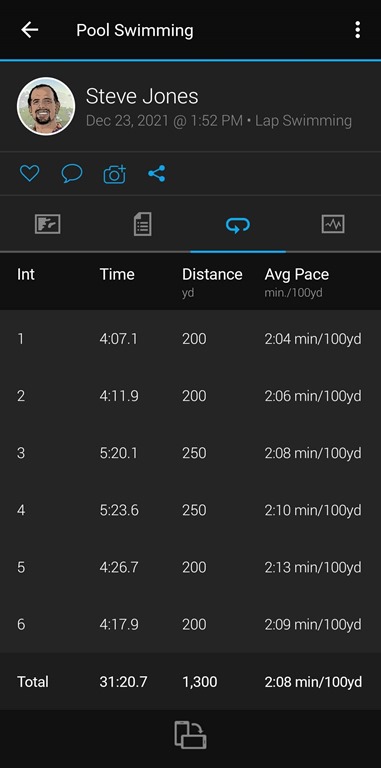
    After exercise I glance at my results to see my average heart rate, my level of effort, etc. As a couple examples, here is what I see for swimming:
    Screenshot_20220302-131847_Connect

    I tend to find 2:00-2:05 is pretty pace for me to stress myself. If I get above 2:06, either I’m slacking, or my body is worn out and I don’t realize it. A minute or two here, against what I thought my effort level was helps me evaluate my stress and sleep.

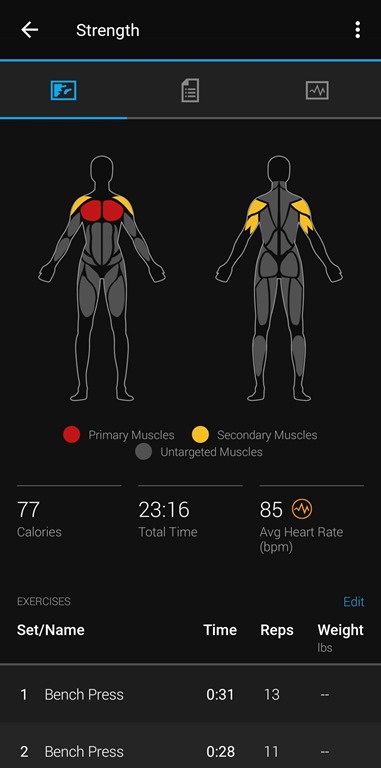
    For weight lifting, the app guesses pretty well for some exercises, but not all of them. I could edit these, but I don’t bother. I’m more concerned with time and heart work here.
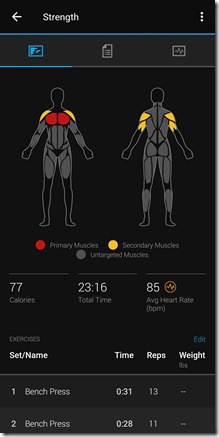
    Screenshot_20220302-131718_Connect

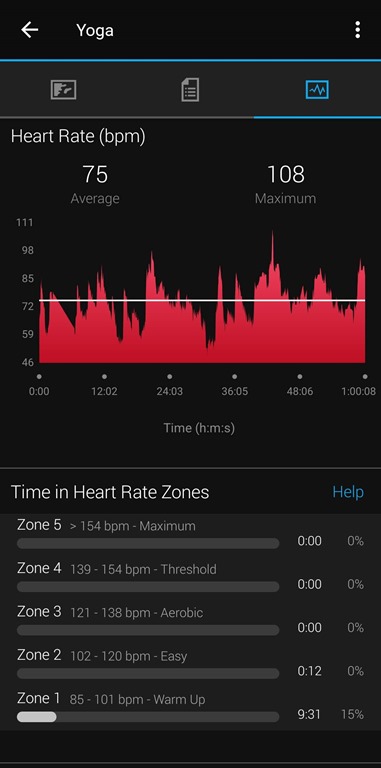
    I usually only look at my effort level for yoga afterwards. Here you can see I wasn’t working hard enough on this day, but I can decide then how I view that. Sometimes I need a break, and that’s fine. Sometimes I see this and it reminds me to work harder tomorrow.
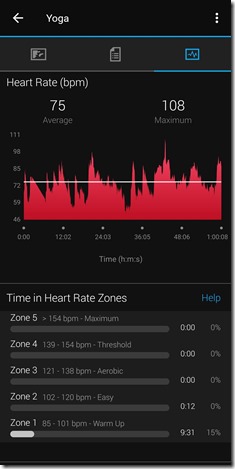
    Screenshot_20220302-131650_Connect

    Heart Rate

    I don’t have a history of heard issues in my family, but I do think that heart rate can be an early predictor of other issues or increasing stress. When I got my watch, I started tracking my  heart rate. It was interesting to see what my resting heart rate was, which was around 54bpm 4 years ago.

    I usually look at the 30 day views, but I can see a longer term, which you see here. My 1 year average is 51bpm. I’m at 48bpm for the last month, which is an improvement. I think that’s been dietary changes.

    Other Metrics

    The watch tracks sleep, which I sometimes glance at across a week, mostly just to see if I’m resting enough. I don’t need to this be amazingly accurate, but more it helps me think about myself if I’m feeling rundown.

    I started adding my weight in here every day or two. I step on the scale, get a number, and then click “add” and “weight”. The app remembers my last weight, and if it is unchanged, I can just click OK.

    The watch tracks steps, floors, stress, and probably more. I don’t bother. I sometimes look at steps if I haven’t done any exercise that day. I can then decide if I need to make time to exercise, or live with the amount of movement I’ve gotten that day.

    Lose It

    I didn’t use Lose It, but my wife liked it. She tried Noom, and liked it, but felt it was a little too intrusive in her daily work. A friend recommended this, and she liked it. She could type into search the food, or scan a bar code.

    This helped her track calories and make decisions on what to eat. I, however, find this to be too much data entry, and then too much work to then try to plan future meals for the day.

    Health Records

    I am in the UC Health system in Colorado. My insurance covers this group of physicians, and there is a nice integrated system that captures appointments and notes, but also includes test results. They do graph and track things across time, but I’ve started to download and save results.

    As I get older, knowing how your body is changing might be useful for future doctors. I want to have a better view of my health, so I’m managing this. I don’t have a great solution. I am lightly testing a few apps, but recommendations appreciated.

    MapMyRun

    There are lots of places to track long term exercise. While Garmin does track this, I always worry about a data breach, failure, or some issue when I don’t control the data. I used to manually enter things into Mapmyrun, and that was where I tracked my running streak.

    There is a link from Garmin to MapMyRun, and my watch now updates both places. I have over a decade of exercise in MapMyRun and I periodically download my data to have it.

    Community

    I haven’t really participated in the community aspects of either Garmin Connect or MapMyRun. Neither appealed to me, but I do know some people use these to motivate each other, or they attack challenges that are available.

    You might find these things useful.

    Summary

    Health is important to me, and I hope to you. I don’t think that you need to obsess or make this the most important thing in your life, but I do think this is something to pay attention to, especially once you get to 40 or 50 years of age.

    We don’t necessarily need to track everything, but we ought to be aware of some metrics and how they might change over time.

  • Using Technology for Health

    I’ve been fairly healthy and fit for most of my life. While I’ve always had a few extra pounds, I do try to eat better than average and I exercise regularly. That didn’t stop age and some pandemic laxity from catching up with me. My annual checkup last December had my doctor (and me) slightly concerned about a few things. I made a goal of exercise for January and better eating in 2022.

    I thought about how I’ve used technology to help me with this after reading Robert Cain’s post on his efforts to get more healthy. Robert is a friend and I enjoy seeing him at various events. I’m looking forward to our next meeting and seeing the changes in person.

    He uses an Apple Watch and his iPhone, as well as a few devices to measure and track different aspects of his health. He can review his progress towards goals and export data for his physician. The post provides some recommendations and explanations of how technology helps. I found it interesting, as well as a contrast to what I do.

    Technology is more of a substitute for my memory, giving me a view into how I work on my health and fitness with a light touch. I don’t track food, but I have been on a fairly limited diet, which means I have a rough idea of what I consume and the calories involved. I don’t track hydration, but I started to fill 4 water bottles, about 120oz, and empty them each day. I use my watch to log exercise and heart, but I mostly glance to see if I am working hard enough and if my long-term trend for heart rate changes. I do track my weight, but I step on a scale every day or two and record the value in an app.

    It’s common for people working at desks, especially in technology, to lead a less than healthy lifestyle. While I go to the gym often, my wife is probably healthier because she works outside and is active most every day. Technology can help some of us improve our health. The gamification and community aspects of technology apps definitely change how we may approach the challenge. Various devices also lower the effort of data entry.

    If you are looking to improve your health, or you struggle with making changes in diet or exercise, read Robert’s post and think about harnessing some of the power of tech devices to help you improve your life. If you do use some technology, write about it and maybe you’ll inspire others.

    As for my goals? From Jan 4 to Mar 2, I exercised on 48 different days. Not every day, but good enough for me. I have lost about 15 pounds and my long-term resting heart rate has dipped below 50bpm. Technology didn’t really make this happen, but it helped, and I am glad that I can easily see some incremental progress, which isn’t always apparent when I rely on my memory of what my stats were a month ago.

    Steve Jones