Eight Minutes

When I was at the Small Data 2025 conference, one of the speakers was talking about their work with AI technologies. This person uses it a lot in their day job, often to complete tasks that they would have struggled to work on in the past, mostly because of time constraints, but also a lack of resources. Sometimes this person has an idea, but doesn’t want to distract themselves or others by having them work on a side project.

During a recent ride in a Waymo (self-driving car), this person had their laptop out and running Claude Code. They gave it a prompt, asking it to build a small app for some data analysis. During the 8-minute ride, the agent had spit out the code, a Readme, and committed this to a git repo. Later, the speaker tried it and found it solved most of his requirements, and then did some other work on the project, as well as having Claude write more code to get something that was beyond a minimally viable app.

He then gave us this William Gibson quote: “The future is already here — it’s just not very evenly distributed.” I’ve thought about this quote a lot during the last few decades, especially as mobile phones and apps have become prominent. In Colorado, the bandwidth and connectivity have lagged behind other places. When I get frustrated with the mobile network, I want someone to put a copy of that quote above every developer’s desk at Google, Microsoft, Meta, etc. so they realize the way things work in Silicon Valley isn’t how they work elsewhere.

I’ve been feeling that way about AI tech lately. It’s the future, and it’s not well distributed. There are some successes out there, among lots of failures, but I suspect that some of this is that we’re all working with unevenly distributed models, knowledge, and problems. Some of us are learning to use things better than others.

So I’m wondering, what do you think you could do in 8 minutes with a coding agent? Take a Waymo if you want, but you might be more comfortable with Claude Code (or another agent) at your desk. Take a problem you’ve been working on and give it to the AI agent. See what happens. Maybe even tackle a side project you can’t seem to find time on which to work and see what happens.

As I started this, I actually kicked off Claude Code and asked it to load some data from messy files into a database. Across a couple of days (I started late one afternoon), I estimate I spent 10 minutes approving actions, but for less than $5, I had a lot of data loaded (88 files) and the code to do it committed in a repo. With very little effort from me.

Think about what you could do in a few minutes with an agent. You might get something useful, with little effort or cost. It probably would not be a production-ready app, but it would be something to test an idea, or maybe some code that might inspire others to tackle some of their own backlog.

What do you want an agent to help you build?

Steve Jones

Listen to the podcast at Libsyn, Spotify, or iTunes.

Note, podcasts are only available for a limited time online.

Posted in Editorial | Tagged , | Comments Off on Eight Minutes

Flyway Tips: AI Generating Migration Script Names

AI is a big deal in 2026, and at Redgate, we’re experimenting with how AI can help developers and DBAs become better at their jobs. One of the areas we’ve started to add some AI is in Flyway Desktop (FWD), with a few features designed to help reduce the cognitive load and context switches needed while developing code, and help users better understand what changes they’re making in their systems.

I wrote about summaries of migrations scripts last week, which are helpful when you or your colleagues don’t generate good script names, or commit messages. This post looks at another of those changes, which is the generation of the script name.

I’ve been working with Flyway and Flyway Desktop for work more and more as we transition from older SSMS plugins to the standalone tool. This series looks at some tips I’ve gotten along the way.

Generating Complex Scripts

In Flyway, we call the deployment scripts “migration scripts”, but they are the same thing. These are scripts that are changing, altering, or evolving our database schema in some way. New or altered objects, various schema items, and more.

Our guidance for a lot of customers is to keep the migration scripts simple and easy. That can work, but sometimes we want to put a few things into a script to ensure that we deploy all the changes at once. In the last article, I had this list of changes in one script.

2026-01_0168_thumb[1]

I generated this in the last post with a poor name.

2026-01_0175

Let’s fix that.

Using the Power of AI

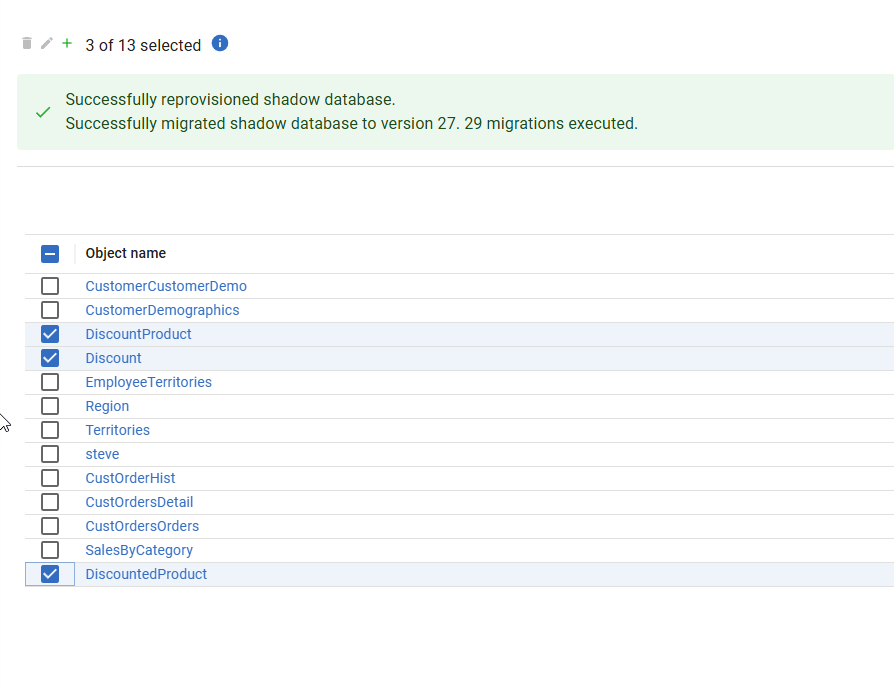
I’m going to delete that script and get my list of objects in the Generate tab. I’ll select a few, as shown below.

2026-01_0177

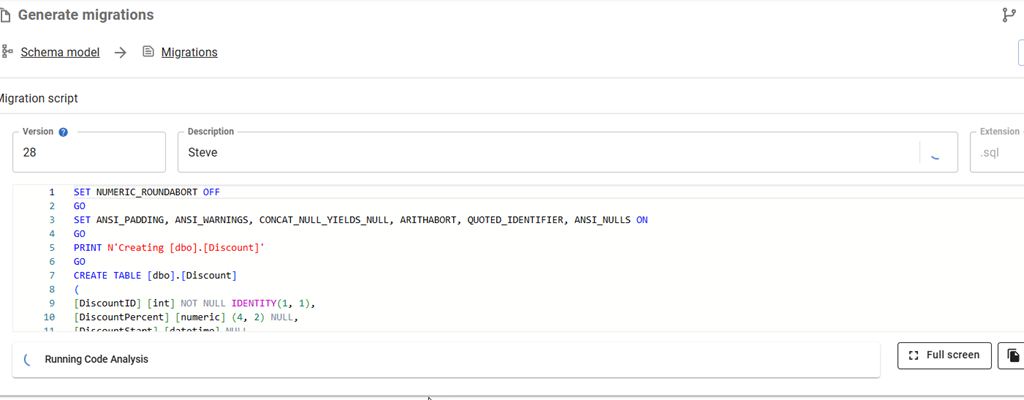
Now I’ll generate the script.When the script completes, I see my default “Steve” name for the description. However, look to the right. There’s a looping circle at the far right side of the Description box. I didn’t capture a good image, but it’s actually moving in a circle.

2026-01_0178

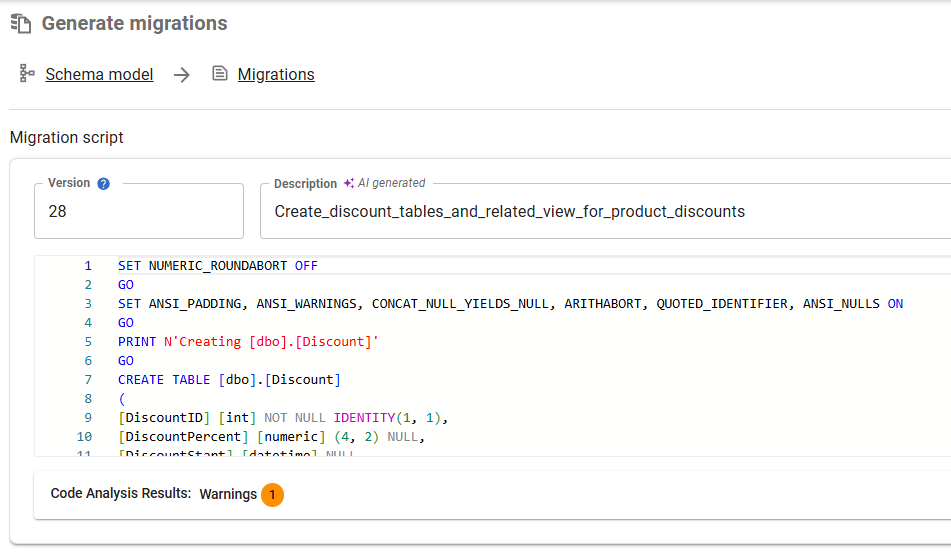
When it completes, I have a better description for my changes.

2026-01_0179

Let me save this and repeat it for the other changes to the customer tables.

2026-01_0180

That’s a way better description than I would typically write.

Enabling AI Features in Flyway

This is a preview feature as of Jan 5, 2026 as I write this. To get this in your FWD, your organization needs to have enabled AI features in your portal. I’m just a member, but whoever is an admin for your Redgate products would find it here.

2026-01_0173_thumb[1]

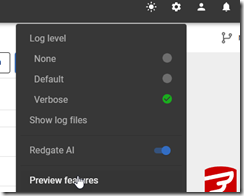
In FWD, you need to look at the Preview Features item under the config menu.

2026-01_0171_thumb

In this area, you can enable or disable features as needed. I see these marked as Red-gate only, but I think they are supposed to be released to some customers by this time. It’s likely I need to upgrade my FWD, which I’ll do when I have time.

2026-01_0172_thumb[1]

Once you do this, you should start seeing some AI stuff with the purple/pink shaded area and the sparkle icon that we’re all seeing everywhere.

2026-01_0174_thumb

Summary

Getting good migration script descriptions, or really any good descriptions, is hard. Developers get tired, they aren’t always creative, they forget things, and they sometimes just take the default.

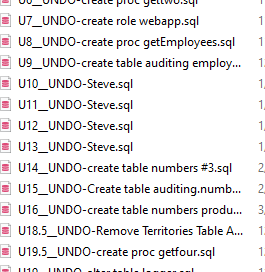
Witness my repo.

2026-01_0181

This feature reduces the burden on developers and auto-generates a name for the file. It can be edited and changed, but the dev doesn’t have to.

This feature is documented, but we are likely to enhance and change it a bit, so all feedback is welcome. If your organization doesn’t want you using AI, and you could share some schema from a migration script, I’d be happy to test it for you and see what summary is produced and send it back to you. Ping me on X/LinkedIn/BlueSky if you want.

Flyway is an incredible way of deploying changes from one database to another, and now includes both migration-based and state-based deployments. You get the flexibility you need to control database changes in your environment. If you’ve never used it, give it a try today. It works for SQL Server, Oracle, PostgreSQL and nearly 50 other platforms.

Video Walkthrough

See a video of me looking at this feature below.

Posted in Blog | Tagged , , , , | 1 Comment

The Book of Redgate: Get the right stuff done

Another of our values:

2025-10_line0108

The facing page has this quote: “We admire people who get stuff done. While there’s a place for planning, thinking and process it is better to try – and try well – and fail than not to try at all.”

This is an approach I use in lots of my life. Not always, but I do try to get things done, and make a strong effort in doing so. I ask the kids I coach to do the same. The effort is what matters; it’s more important than the outcome. The outcomes matter, but we can accept mistakes.

This is one of those values I think ought to be more prominently displayed and discussed, in most organizations.

I have a copy of the Book of Redgate from 2010. This was a book we produced internally about the company after 10 years in existence. At that time, I’d been there for about 3 years, and it was interesting to learn a some things about the company. This series of posts looks back at the Book of Redgate 15 years later.

Posted in Blog | Tagged , , | 2 Comments

JSON Has a Cost

JSON seems to be everywhere these days. Many application developers like it across all sorts of languages, C#, JAVA, Python, and more. They use it for transferring information between systems, and are comfortable serializing hierarchical object data into JSON from text and de-serializing it back into its various elements.

For those of us working in relational databases, JSON seems like a blob of information that isn’t easily queried, indexed, or stored. We prefer working with a relational set of data, which brings us into conflict with software developers. We’d like them to convert their objects to a relational structure, and they’d like us to just work with JSON.

SQL Server has added new JSON functions in SQL Server 2025, expanding the JSON capabilities from previous versions. PostgreSQL has JSON types for a few versions, as has Oracle. Lots of applications are storing JSON data in databases. Unlike XML, however, JSON seems to be working well (overall) as a data storage mechanism.

Or is it?

At a recent conference, one of the speakers noted that we do a lot of data movement these days, and there can be a high cost to this as we pay for both compute and network. This data movement often incurs a query cost to get information from the source system. JSON can exacerbate this issue as we may send more data than necessary, and we might find our compute engines don’t support predicate pushdown. Even if we index the JSON, we might still end up querying more data from disks to get what we need. Especially as we move a lot of data to warehouses and lakehouses.

Using JSON can slow things down. It’s nice for storing a bunch of information quickly and easily, but as we need to work with specific parts of a JSON document, we would likely be better off de-serializing the important pieces into more structured formats that prevent duplication, are easily indexed, and can achieve quick query performance. Everything becomes a little smoother.

JSON is great, and I do like it, but it’s not a substitute for relational systems and relational models.

Steve Jones

Listen to the podcast at Libsyn, Spotify, or iTunes.

Note, podcasts are only available for a limited time online.

Posted in Editorial | Tagged , | Comments Off on JSON Has a Cost