How Important Are Real Time Decisions?

Imagine a perfect world? I have an AI agent that knows my business well. It’s getting real time input from sales, from customers, it makes amazing decisions. We get a large order? We need to ramp up production of our widgets. We have an order pipeline of xx widgets and we know over time that yy% will close. Let’s place a larger order with a supplier overseas.

The next day, we have an election and tariffs are announced on imported parts. We react immediately, cancel the order, start the process to expand a local factory. We place ads to hire workers and order equipment. Things are looking good for our business and our factory will be up and running in a few months.

The next week we find out the tariffs weren’t really being enforced, so they’re paused. Our AI agent re-places our large order for imported parts and tried to cancel the factory expansion. Of course, it calculates the costs of both sides before deciding, and perhaps consults with me on other uses of our local factory.

How many times can we do this? Or rather, how many times would we let an AI agent keep adjusting our business?

To be fair, humans might do the same thing and over-react, but mostly we become hesitant with unexpected news. That slowness can be an asset. We often need time to think and come to a decision. Lots of our decisions aren’t always based on hard facts, and a lot of business isn’t necessarily fact driven either. We often put our thumb on the scales when making decisions because there isn’t a clear path based on just data.

Things can get worse when we collaborate. I used to run real-time reports for an importing company, and we found that executives would print a report, get busy, and after minutes (or hours), discuss the report with someone in a department. However, their numbers rarely matched because the reports were printed at different times. At first they lost trust in the system because the same report on the same day had different numbers. Even when we added a “print” or an “as of” time, the reports were too annoying to users to be helpful because the numbers didn’t match.

Real time isn’t what most of us want. Except in the Olympics. There we want the photo finish right away.

But not in all sports. A review is good. In the NFL, I’ve come to like instant reply. It’s gotten better/faster and often gives us the right answer. Not always, but often. It’s better, arguably, then just real-time humans.

Real-time decisions and reactions can be good in some cases. Adjusting machinery, vehicles, electricity, etc. where we need too-quick-for-humans decisions based on data is a good place for real time data. Lots of business decisions we make aren’t the places where we really need real-time insights. Our human brains just don’t work that fast.

Steve Jones

Listen to the podcast at Libsyn, Spotify, or iTunes.

Note, podcasts are only available for a limited time online.

Posted in Editorial | Tagged | 3 Comments

The Book of Redgate: What Our Staff Says

This image is from 2010, and it goes along with my last post of what our Customers Say about us. However, this is what our employees said about the company.

2025-10_line0105

At this point we would have been around a 200 person company, mostly in the UK. It’s a great list of words, and if I were looking for a new employer, this type of work cloud might get me interested in applying.

Redgate has often felt like an extended family, where we care about each other, we’re bonded, and we’re working together to get through life. We disagree and bicker at times, but we love each other.

We’re now closer to a 600 person company, and I don’t know that all of us, or even most of us, feel the same ways, but I’d like to think most people still think this is a great place to work.

I do.

I have a copy of the Book of Redgate from 2010. This was a book we produced internally about the company after 10 years in existence. At that time, I’d been there for about 3 years, and it was interesting to learn a some things about the company. This series of posts looks back at the Book of Redgate 15 years later.

Posted in Blog | Tagged , , | Comments Off on The Book of Redgate: What Our Staff Says

PASS Keynote Shots

Rodney Kidd took some great shots of the keynote and published an album here: https://www.flickr.com/photos/127113040@N04/albums/72177720330695911

A few of my favorites:

Here’s one of the 8 ball and keynote (and I’m enjoying myself)

RG Keynote 20251119 069_fr//embedr.flickr.com/assets/client-code.js

This is a great shot of the audience

RG Keynote 20251119 077_fr//embedr.flickr.com/assets/client-code.js

Am I confused?

RG Keynote 20251119 127_fr//embedr.flickr.com/assets/client-code.js

A nice shot of the crew at the end, Grant obviously having fun.

RG Keynote 20251119 295_fr//embedr.flickr.com/assets/client-code.js

And a nice shot of my chatting with Tim at the end.

RG Keynote 20251119 302_fr//embedr.flickr.com/assets/client-code.js

Posted in Blog | Tagged , , | Comments Off on PASS Keynote Shots

SQL Server Licensing is Simple

Over the years I’ve had no shortage of licensing questions for SQL Server. At times it’s felt a little crazy. Look at the licensing guide. Choose EE or SE and the number of cores. Then check if you’re using VMs. Oh, and consider the cloud, and which cloud you’re running a workload on.

It’s simple right?

It can seem confusing, and at times I’ve wished Microsoft would make it simpler. And perhaps even give us some add-ons, like adding some additional hardware capabilities (cough more RAM *cough) in SE.

Then I run into something like the introduction to Oracle licensing. This is one of the smaller guides on a site devoted to Oracle licensing. There are numerous articles on there, with lots of information, perhaps too much, to help anyone get a handle on this process. There are even companies (one, two) built around helping you manage Oracle licenses.

There’s a core factor table, where you need to figure out how to adjust your “license cost” based on the CPU. That’s after you pick the edition, and likely before you go into the other features you might need. I’m guessing this is why a lot of people might just pay for the Unlimited license and stop worrying. I think this is also why Oracle is still such a huge company and worth billions (or trillions?) of dollars.

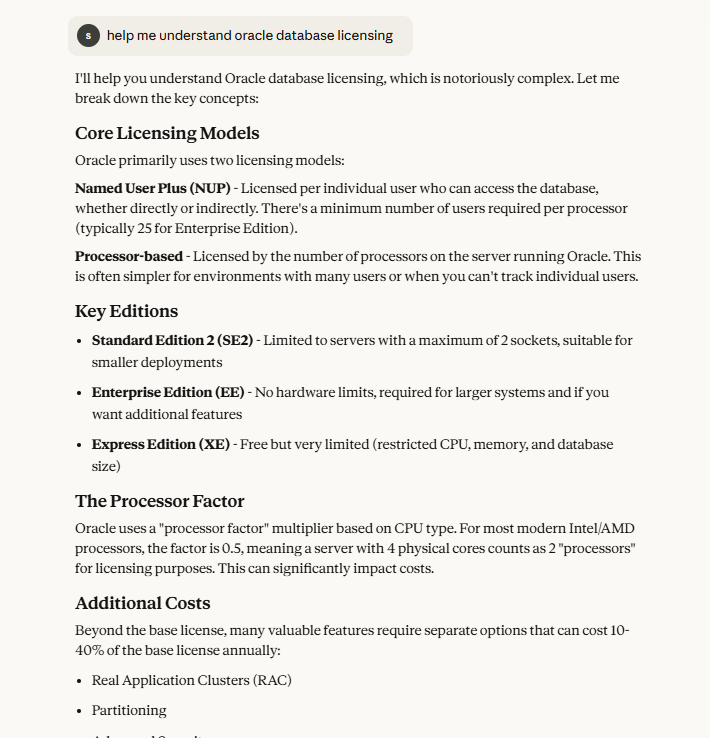
I actually asked Claude to help me with Oracle licensing. I got these (partial) results, which talks about the different core licensing, editions, and then other costs. As I ask for more details in any area, this gets very complex and confusing. While some of the rules for SQL Server can be confusing, and certainly the HA and virtualization guidelines sometimes leave something to be desired, overall, I find things simple.

I like simple.

Over the years, many software companies have made licensing more complex and confusing to customers. Often this results in more profit for them without much benefit for the purchaser. Not all vendors do this, but Oracle certainly has created a complexity that spawned a whole business model for a few companies. SQL Server licensing is simpler, and I’ve learned to appreciate that.

Steve Jones

Listen to the podcast at Libsyn, Spotify, or iTunes.

Note, podcasts are only available for a limited time online.

Posted in Editorial | Tagged | 3 Comments