Tag: computers

  • The Human Touch

    How often does human error cause issues? Recently we had a rocket crash in Russia,there have been numerous incidents of drone crashes as more and more unmanned aircraft take to the skies, and a few years ago we had an Air France disaster that might have been cause by humans making poor decisions or engaging the wrong controls. Those are incidents where the wrong button press has large consequences, either in physical damage or the loss of life.

    Many of us make mistakes constantly as we work in the various tools and environments we need throughout our day. We click the wrong button in SSMS, we connect to the wrong server and run a script, or we fail to test a change. All of these are mistakes made by humans, and often are mistakes that can be prevented if we did a better job or sticking to routines and processes. That can be hard, but perhaps checklists can help here, along with some double checks by coworkers.

    That’s why I think using scripts in T-SQL, and using the Script button in SSMS to generate the code that you can run (and save) is the best way to work with your servers. As much as I think Powershell (PoSh) can be a pain to write and debug, there’s a good argument to be made for using it when performing complex administrative tasks, especially across servers. Using code rather than forms and buttons is just a better way to accurately and consistently make changes in a controller manner.

    This is an area where everyone could work more efficiently. Developers are usually used to working with version control systems and tracking all their changes. However they often will make configuration changes to their machines, SQL Server, IIS, or some other software, and forget to track the changes. Making these changes in code, through T-SQL or PoSh, and tracking these items in VCS, would help with smoothing software deployments. DBAs and other operations staff should learn to use version control systems  as well, helping to track down root causes to issues.

    Ultimately humans are often the weaknesses in most systems. We should understand that, accept it, and compensate as best we can.

    Steve Jones

    Video and Audio versions

    Today’s podcast features music by Everyday Jones. No relation, but I stumbled on to them and really like the music. Support this great duo at www.everydayjones.com.

    Follow Steve Jones on Twitter to find links and database related items and announcements.
    Steve Jones Windows Media Video ( 15.5MB) feed

    MP4 iPod Video ( 19.7MB) feed

    MP3 Audio ( 3.9MB) feed

    Feeds are available at iTunes and Mevio

    To submit an article, rant or editorial,
    log in to the Contribution Center

  • Data Vision

    Will computers "see" more in the future and help us with new tasks?
    Will computers “see” more in the future and help us with new tasks?

    One of the things that I often do when analyzing data is examine visual representations. I don’t ignore data, but often a graph or picture of who the data is distributed or organized gives me a starting place for more details examination of the actual numbers. It has worked well for me and going back and forth from numbers to graphs allows me to better understand the ways in which patterns and tendencies are embedded.  Humans are visual, and we are expanding that capability more and more to machines.

    Years ago I worked for a company that imported wood and sold it in the US. In one of our plants we sorted and organized wood pieces using a combination of human and machine efforts. Conveyor systems moved wood along and humans examined the individual piece as they traveled by. Using chalk marks, they were able to mark items as better or worse quality than others. A computer system scanned for chalk marks and was able to separate the wood more effectively and efficiently than in the past.

    That type of human and machine analysis is being used more in many industries. However instead of using humans to do analysis, computer systems can now do that in some cases. I ran across a piece about software that examines physical parts from a manufacturing process, looking for defects. The computer system can do a better job, faster than most humans. There might be a verification step from humans, but for many parts, this means a higher level of both quality and productivity.

    I could imagine this type of computer examination has a place in data systems as well. We could train an algoirthm to look for patterns in a visualizaiton, and perhaps highlight them for more examination by a human. We could even have some secondary systems that examine error outputs from something like an ETL process and direct developers to the potential issues in their logic, or in the source files, pointing out data or formatting problems. A little more checking, or real time testing, might help improve the overall quality of our processes, whether in the real world or embedded in software.

    Steve Jones


    The Voice of the DBA Podcasts

    We publish three versions of the podcast each day for you to enjoy. Due to technical issues, we have no podcasts today. Actually, Steve’s camera died and he is in the process of replacing it. Hopefully we’ll be back tomorrow with the podcast.

  • Data Will Drive the World

    Software, and data, will eat the world.
    Software, and data, will eat the world.

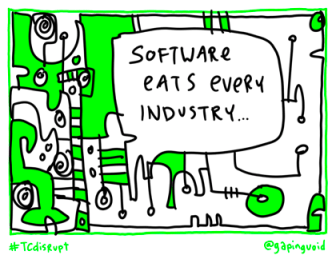
    There’s a well known essay from Marc Andreeson that talks about howsoftware is eating the world. There’s a lot of truth to this, in my opinion, and it becomes very important for more and more people to realize that software is going to become more and more of a part of their lives, all parts of their lives. Whether in business, in your personal life, in government or anywhere else, software is going to increasingly be used to interact with the world. This will bring about many opportunities for people in technology to help shape the way those interactions affect all of our lives.

    However it’s not just software that’s important. The data that drives this software is arguably more important than even the software. This data drives the software algorithms to produce some result or action. Hacking the data to change values can even change the results from the software. Different software algorithms might interpret or react to data differently. If data isn’t more important, it’s equally important as the software that processes it.

    We are seeing the additional recording and gathering of data allowing all sorts of new software to be written. Some of the software is performing jobs that humans have do in a faster and perhaps more efficient way. Other software is helping people understand the world in a way they might never have seen it. We even have software replacing other  software jobs. That feels quite surreal to me, but it’s made possible by more and more data being available to help guide the development and growth of systems.

    We are in a good business for the future, with the growing needs to process, manage, and manipulate more and more data in the future. It’s up to us to learn the skills we need to do this efficiently, and in ways that can’t easily be automated.

    Steve Jones


    The Voice of the DBA Podcasts

    We publish three versions of the podcast each day for you to enjoy.

  • When will we look back at this?

    It’s amazing how software has advanced. I look at the software I use, and I’m amazed. I still remember texting to 40404 for basic twitter usage on my Windows 6.5 Mobile. That seems miles away from the apps I know use on my current iPhone 4S. I almost can’t comprehend what my life would be like if I didn’t have a smartphone now.

    I saw this video of a HoloDesk from Microsoft Research. It’s neat, and I can imagine the possibilities of what might come, but for not it’s very basic.

    It makes me wonder when we’ll have something more like this interface: