Tag: Google

  • Searching for People

    Inside Redgate Software, someone posted a picture and was asking if anyone knew who the person was. In this case, there had been a conversation at an event, and a picture was taken, but our employee couldn’t remember the individual’s name to whom they’d spoken.

    This happens a lot, especially to me. I’m really good with faces, and often remember what we talked about, but I’m horrible with names.

    Someone suggested an image search, so I decided to give that a try and see what happened. For privacy reasons, I won’t put the person’s image here, but use mine instead.

    Google Searches

    Google will perform image searches, but it’s not doing facial recognition. They talk about that somewhere, but I’ve seen that listed a few times for privacy reasons. I took a picture of myself and decided to test this.

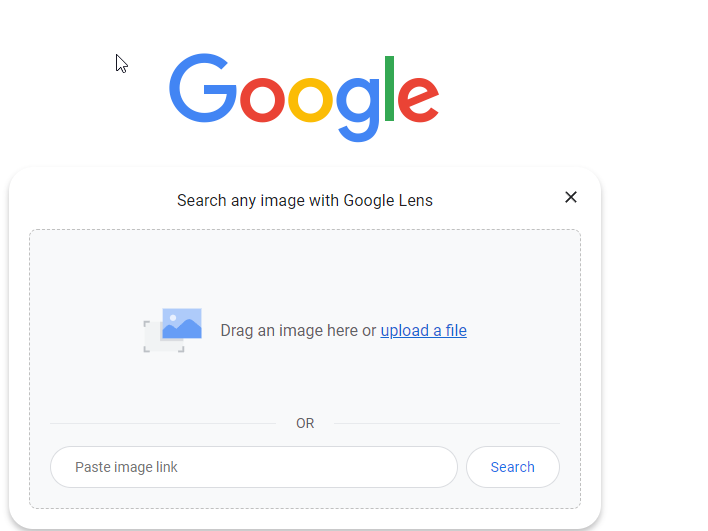
    First, go to the Google home page. In the search area, you can see an icon, which lets you pick image search.

    2023-07-28 12_05_11-Google

    If you click this, you can upload an image.
    2023-07-28 12_05_14-Google

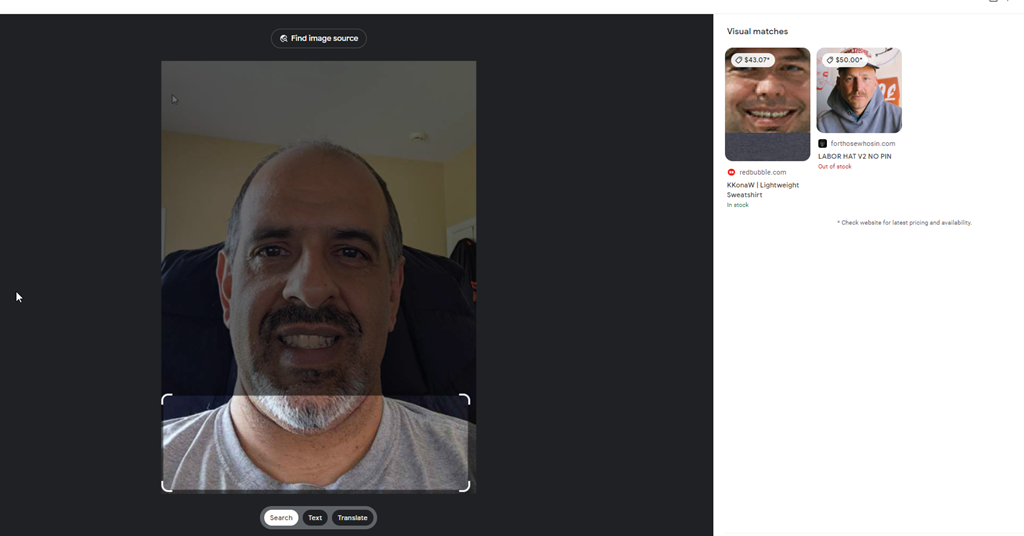
    I did that, and it clearly wasn’t looking for a person, but rather a shirt. My results are shopping oriented, and not good.
    2023-07-28 12_05_22-Google Lens

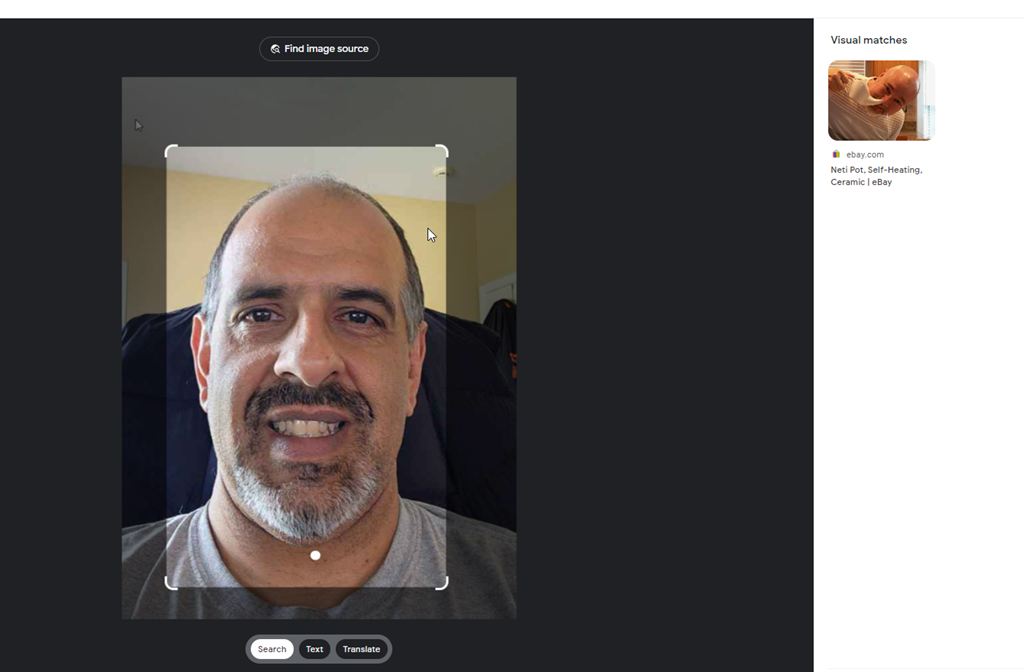
    Of I change the focus, it’s still bad.
    2023-07-28 12_05_54-Google Lens

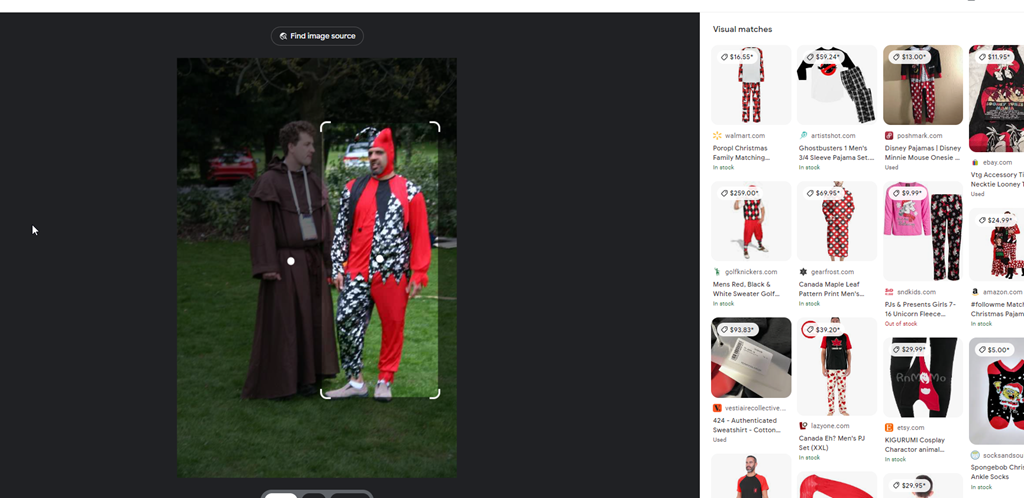
    Supposedly it’s looking to match real images, not people, so I’ll give a photo I know is on the Internet. I know because I searched in Google for this image with text, and then screenshot’d it.

    The initial focus was on Simon’s robe, but even changing this to me, it doesn’t find this picture.
    2023-07-28 12_06_43-Google Lens

    Google isn’t great here. I think because it’s really looking for something to buy. Good if that’s your focus, less helpful here.

    PimEyes

    There are other engines. PimEyes is one. This is a paid service, but I uploaded my first picture, and saw these results:
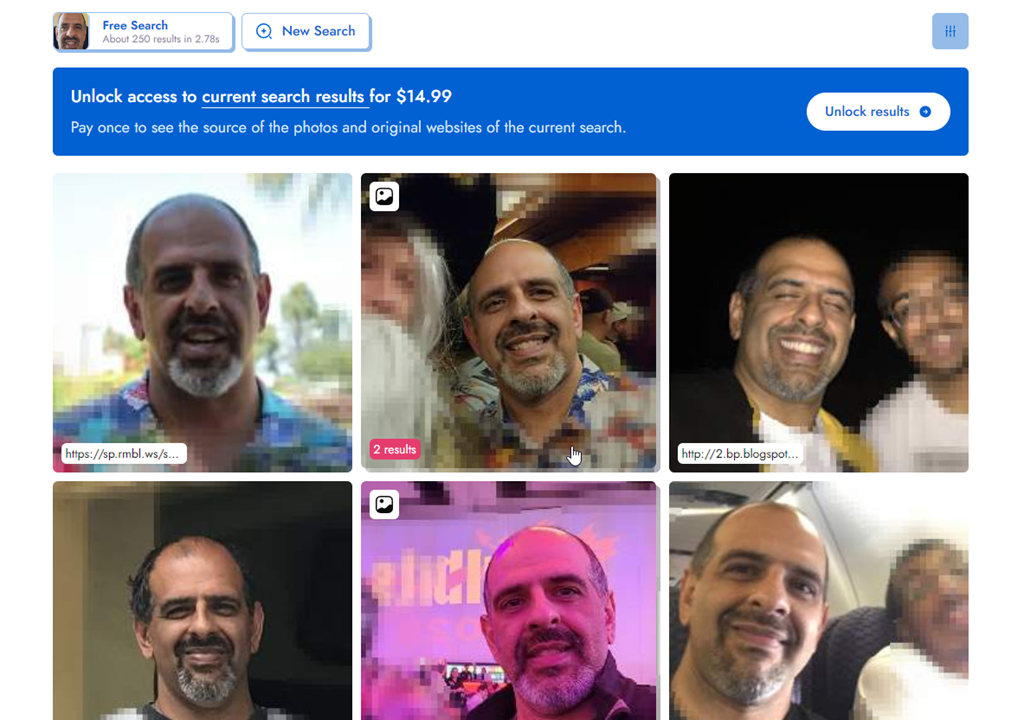
    2023-07-28 12_20_17-Look at the face I found with PimEyes! Try it yourself on PimEyes.com! _ PimEyes

    I like that they’ve blurred out some of the others, and instead focused on me. These are all pictures of my, and if I paid, I assume they would have my name. If I scroll down a bit, I’ll see some URLs, like my blog site, which would help me figure out where to find this.

    2023-07-28 12_55_51-Look at the face I found with PimEyes! Try it yourself on PimEyes.com! _ PimEyes

    I only had 3 free searches, but this seemed to work well.

    TinEye

    TinEye is another engine. This one was less useful than Google.
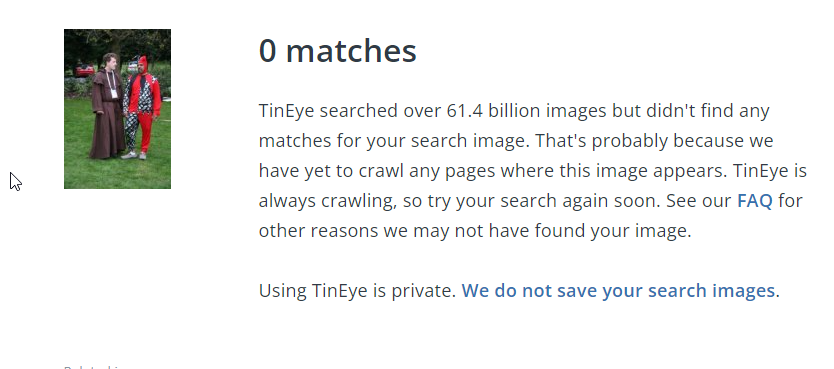
    2023-07-28 12_57_46-0 TinEye search results

    FaceCheck.ID

    I tried https://facecheck.id/, which made me feel like a Private Investigator. I had to agree to terms, meaning I won’t do this for nefarious purposes, and then also fill out a puzzle captcha.

    2023-07-28 13_00_47-FaceCheck - Reverse Image Search - Face Recognition Search Engine

    My request was queued, as I’m guessing they only have so much compute that they share amongst people that want to the service. Once the search started, it was interesting. Face flying by my image.
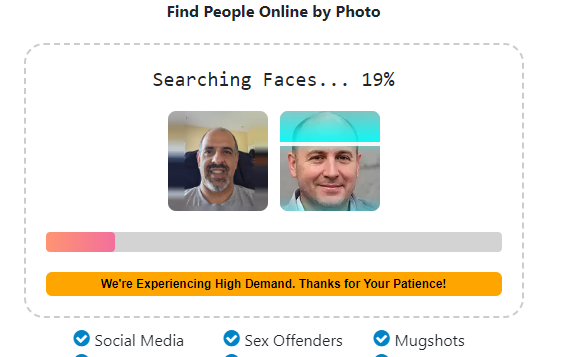
    2023-07-28 13_02_40-FaceCheck - Reverse Image Search - Face Recognition Search Engine

    When this was done, I get some great results. With rankings.
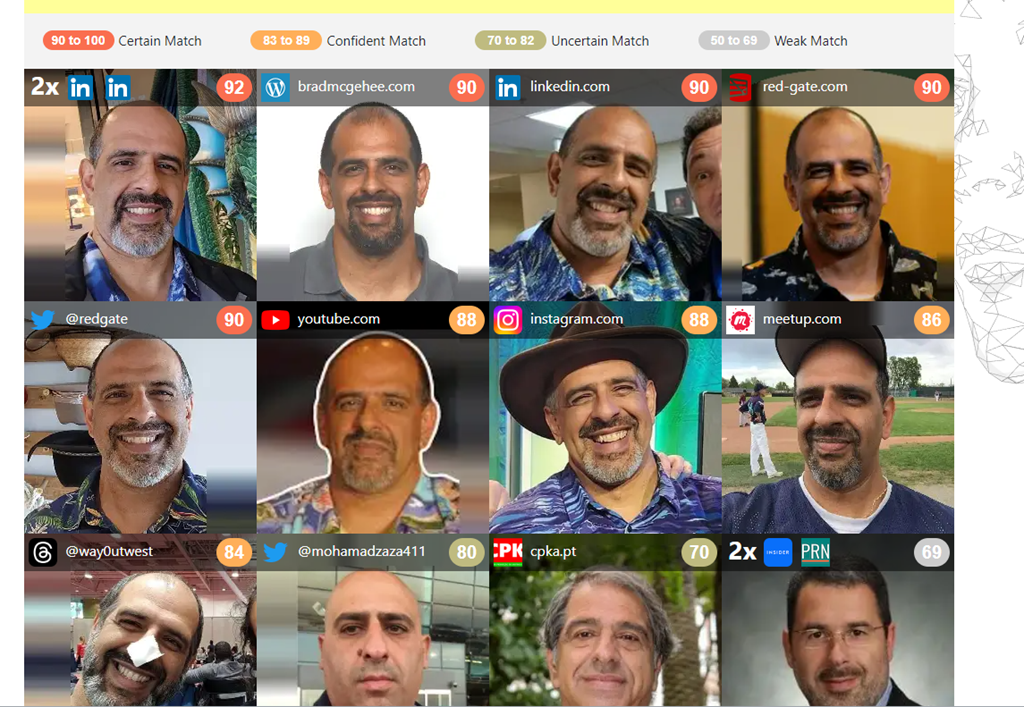
    2023-07-28 13_03_16-FaceCheck - Reverse Image Search - Face Recognition Search Engine

    The lower ones clearly aren’t me, and the rankings are in the 60s, though the lower left ranks a 68 and that is me. The lower ones made me laugh a bit. Do I look like these?
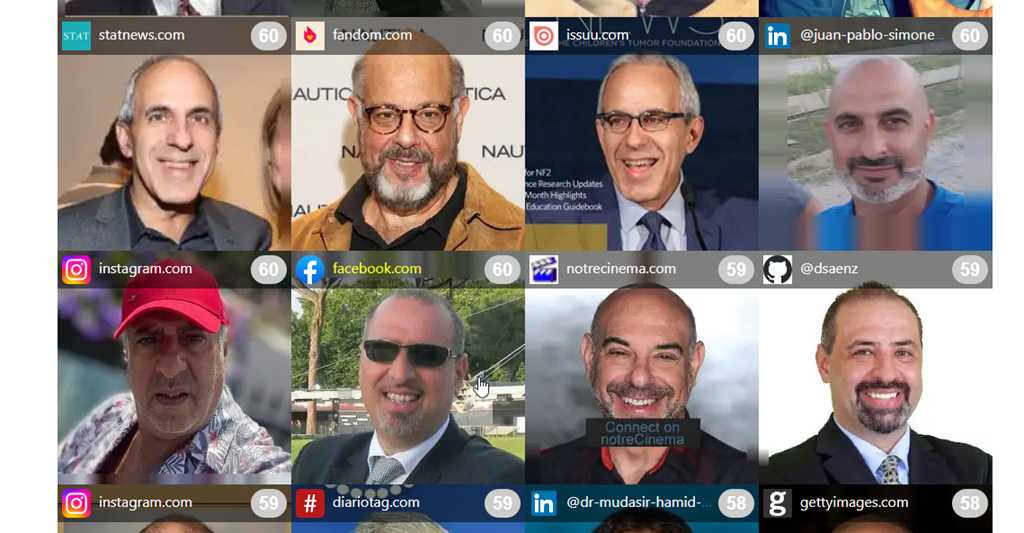
    2023-07-28 13_04_29-FaceCheck - Reverse Image Search - Face Recognition Search Engine

    Privacy Concerns and the Future

    I don’t know where this will go, but more and more people are being captured in images and uploaded to the Internet. Even if you don’t do this yourself, if you go to public places, especially while traveling, who knows if someone taking their own photo will capture you and upload your image.

    Certainly many governments and even private companies do this, though often their results aren’t uploaded to the public Internet. Not that they aren’t or that those images are safe, but hopefully those aren’t easily searchable.

    I don’t know how we get around things, but I do like that lots of companies don’t want to allow AI bots to search their content and are limiting API access. I appreciate that in this case.

    Conclusion

    Looking for someone is interesting and I was surprised both how hard it was and how easy.

    If you haven’t looked for yourself, give it a try. I wonder what you find.

  • Confidential VMs

    Ever since we started to offload workloads to hardware that we didn’t physically control, there have been security concerns. I remember when this started with application service providers and web workloads. This has continued to be an issue as more and more types of workloads have moved to cloud vendors and other hosting providers.

    Google is trying to ameliorate some of the concerns by offering customers confidential VMs. These are special types of VMs, using encryption and hardware capabilities to protect the workloads from any unauthorized access. I don’t know to what extent this practically protects a workload compared to a non-confidential VM, as the details are a bit confusing. I’m sure there is some extra protection, but the weak point in most cases here is still likely the humans that use credentials to access the VM. I’d suspect a determined attacker would try to hack the sysadmin and their laptop rather than the VM itself.

    In any case, Google is trying to ensure the added encryption doesn’t cause any workload degradation. Hardware can likely help her, but I’m not sure that you can perform encryption and decryption without using more resources. There might be minimal impact, but there has to be some resource impact. At least compared to a non-confidential VM.

    I’m glad there is research and work still happening to find ways to improve security for systems that we might no longer control. I think that’s increasingly the trend. Whether you go with a cloud vendor like AWS, Azure, GCP, etc., or you look to host with a Rackspace like provider, more and more of our infrastructure is being outsourced, and I don’t know that the trend will reverse itself anytime soon. Even if it does, the more we can provide security hurdles against unauthorized access, the better.

    Steve Jones
    Listen to the podcast at Libsyn, Stitcher or iTunes.

  • MoSQL

    Google is doing more SQL, or at least shifting towards relational SQL databases as a way of storing data. At least, some of their engineers see this as a better way to store data for many problems. Since I’m a relational database advocate, I found this to be interesting.

    When Google first started to publish information on BigTable and other new ways of dealing with large amounts of data, I felt that these weren’t solutions I’d use or problems that many people had. The idea of Map Reduce is interesting and certainly applicable to the problem space Google had of a global database of sites, but that’s not a problem I’ve ever encountered. Instead, most of the struggles I’ve had with relational systems are still better addressed in a relational system.

    Google feels the same way, and in a blog, they talk about choosing strong consistency where possible. This is a post that promotes their relational SQL database (Cloud Spanner), but there is a good discussion of why consistency matters and where moving to popular NoSQL models, like eventual consistency, cause a lot of problems. Both for developers and clients.

    This quote caught me eye, and I may use this with developers that look to avoid RDBMS systems: “Put another way, data stores that provide transactions and consistency across the entire dataset by default lead to fewer bugs, fewer headaches and easier-to-maintain application code.” I think that’s true as I think many of the advantages promoted in non-RDBMS systems are often placing a greater burden on the application developer than they realize. A burden that grows over time as the techniques used cause more technical debt.

    I think more SQL based systems are the way to go for many problem domains. Google agrees, and if you read more about the Cloud Spanner team, you might agree as well. You’ll also find them to be incredibly smart people that think deeply about the problems that are both raised and solved by relational systems.

    So go ahead and promote more SQL Server databases. Google thinks they’re good for many applications, and that’s good enough for most developers.

    Steve Jones

    The Voice of the DBA Podcast

    Listen to the MP3 Audio ( 3.1MB) podcast or subscribe to the feed at iTunes and Libsyn.

  • A Beautiful Google Mind

    I read a quote a few years ago that really resonated with me. The quote is attributed to Jeffrey Hammerbacher, an early Facebook employee that left to found Cloudera, a data analytics company. The quote went like this:

    “The best minds of my generation are thinking about how to make people click ads. That sucks.”

    That actually dovetailed with something I’d heard in the mid 2000s, when someone lamented that the best technical minds in computer science weren’t working to further our industry or even just produce amazing software. Many of them had left industries to work inside financial institutions, manipulating our stock markets and money systems to make millions.

    I can’t blame anyone for choosing to engage in a business that will reward them. That’s the beauty of capitalism. I think you can go too far, but I’d hope that most people, while pursuing their success, would look beyond just money. At least at some point. I would like to believe that most of us find there to be things at least as, if not more so, important than money.

    Larry Page founded Google, and is one of the richest people in the world. I ran across an article on his beautiful mind, which looks at the ways in which Mr. Page is trying to change the world. Perhaps he has an eye on profit, but my impression is that he also wants to make life better for more and more people around the globe. His focus happens to be ways technology might help us, and I’m hoping he succeeds. Much like I admire Bill and Melinda Gates are trying to improve health around the world. Those aren’t my passions, but I’m glad someone is driven by them.

    Many of us aren’t financially secure for life or able to fund whatever endeavor comes to mind. However, we can make a difference in the world. We can be examples that show there is something beyond making money at work. We can also volunteer or donate some of our time to help others. We can all be a Larry Page in some way, impacting the world in a small way to make it better for everyone.

    Steve Jones

    The Voice of the DBA Podcast

    Listen to the MP3 Audio ( 2.6MB) podcast or subscribe to the feed at iTunes and LibSyn.